
Polar Animals Unit Study Packet for Kids
A polar animals unit study packet is a printable school day about how penguins and polar bears survive the cold, for kids in K to 8. This grade 3 sample has 14 pages plus a parent answer key: math, reading, writing, a crossword, movement, science, coloring and a certificate, about 117 minutes of activities, plus breaks. Free to start.
By Natalie, homeschool mom and Packet Day co-founder
Updated October 2026Reviewed by Natalie
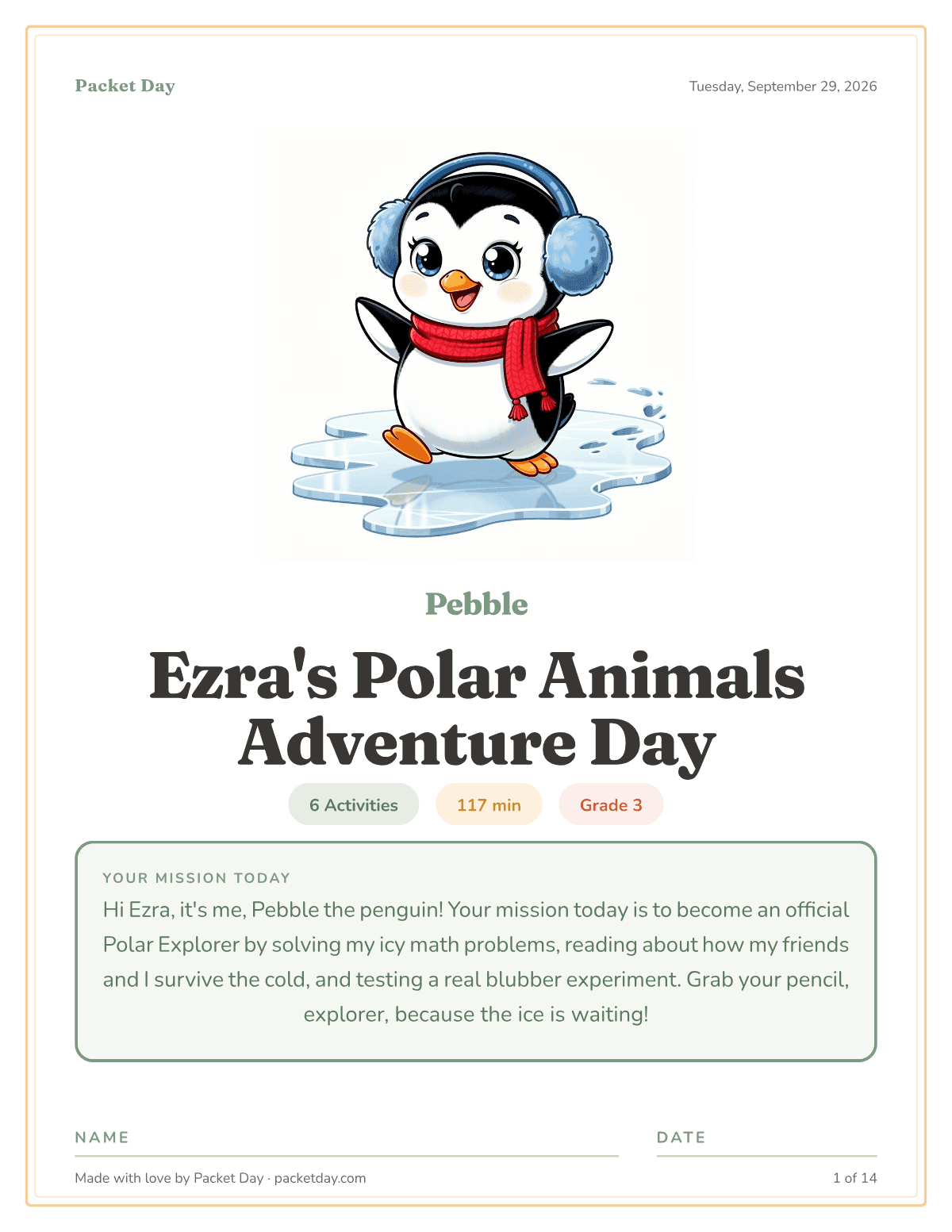
A sample packet made for a grade 3 learner named Ezra
What is inside a polar animals packet?
A polar animals packet is a full school day on paper: 11 to 17 pages built around polar animals, roughly 2 to 5 hours with breaks. This sample has 14 pages plus a parent answer key, and Pebble the penguin guides the whole day.
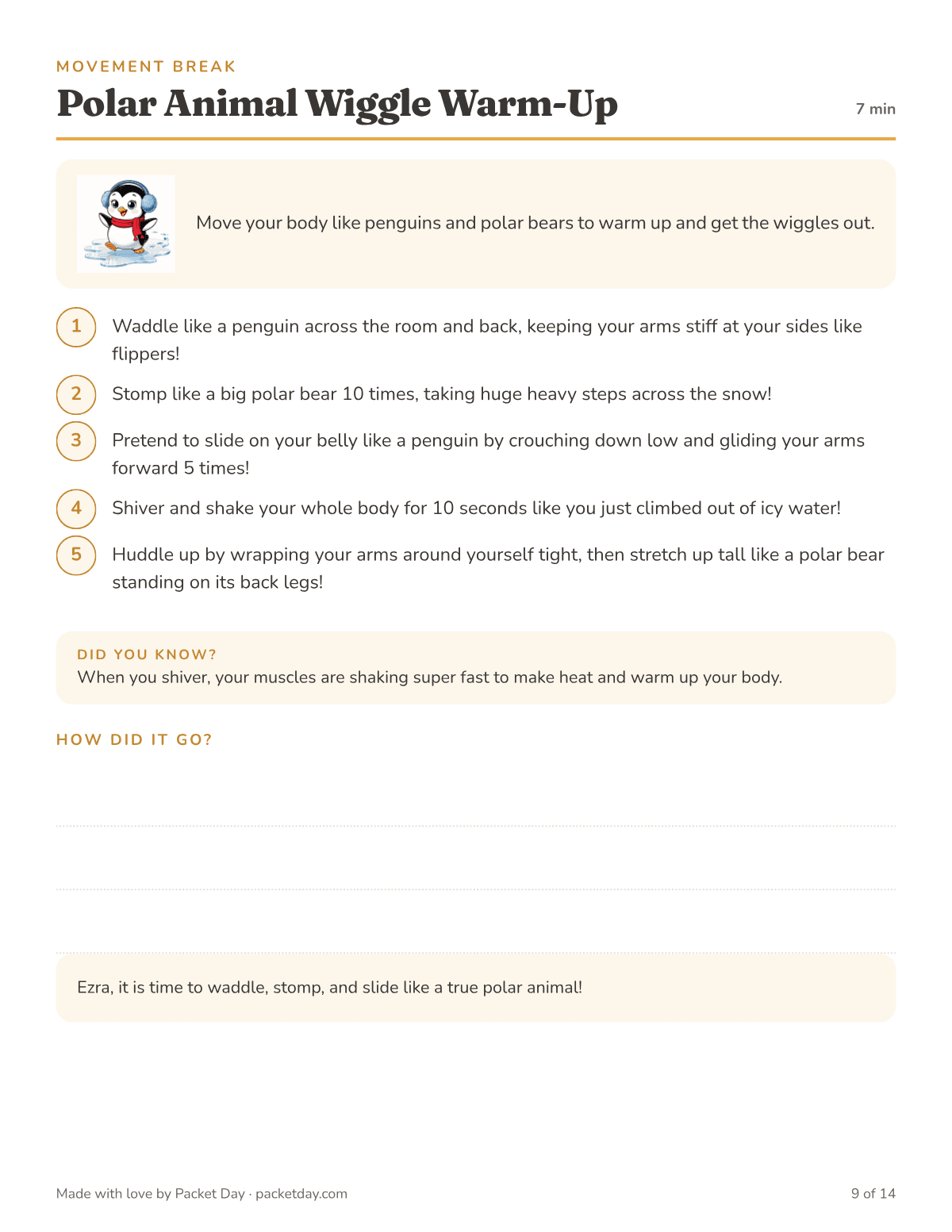
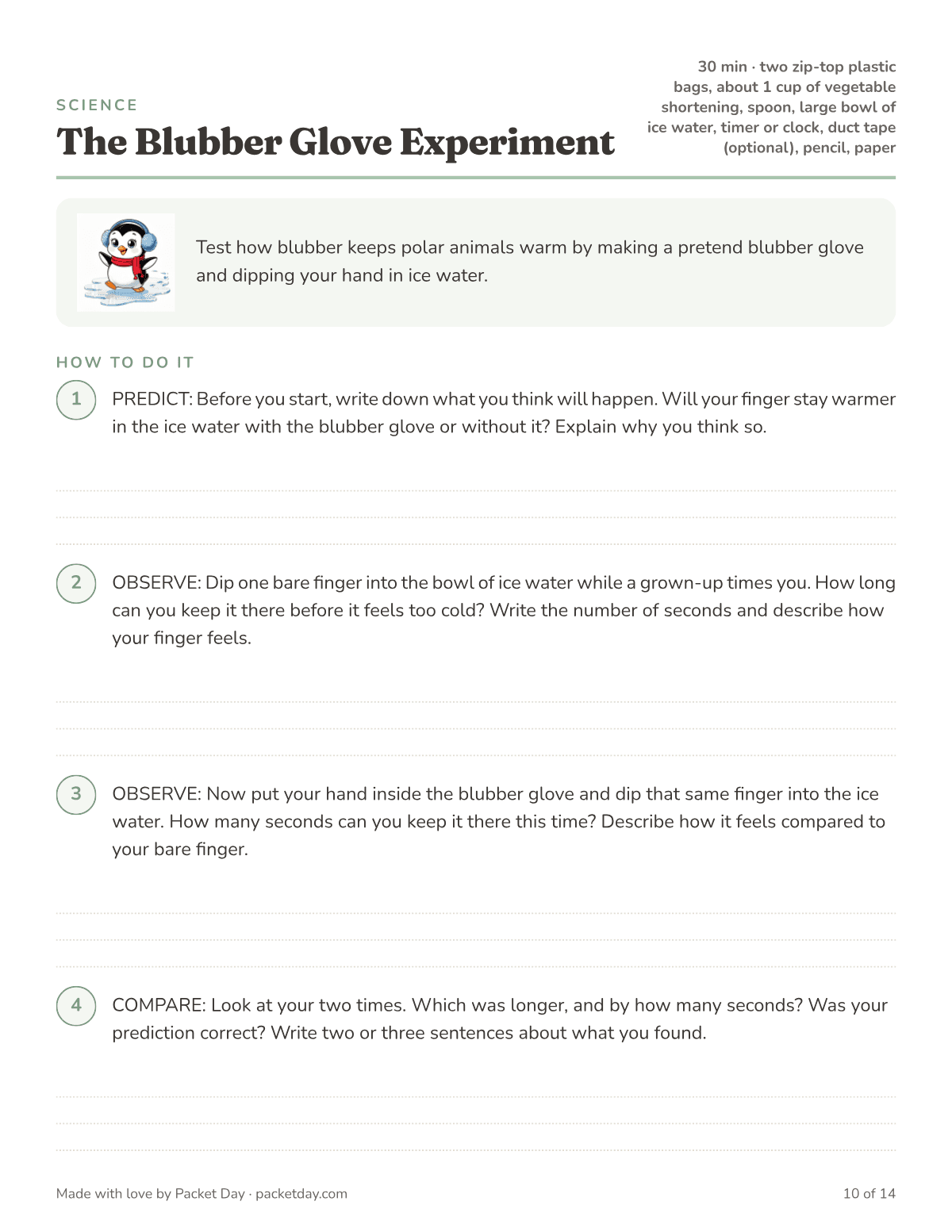
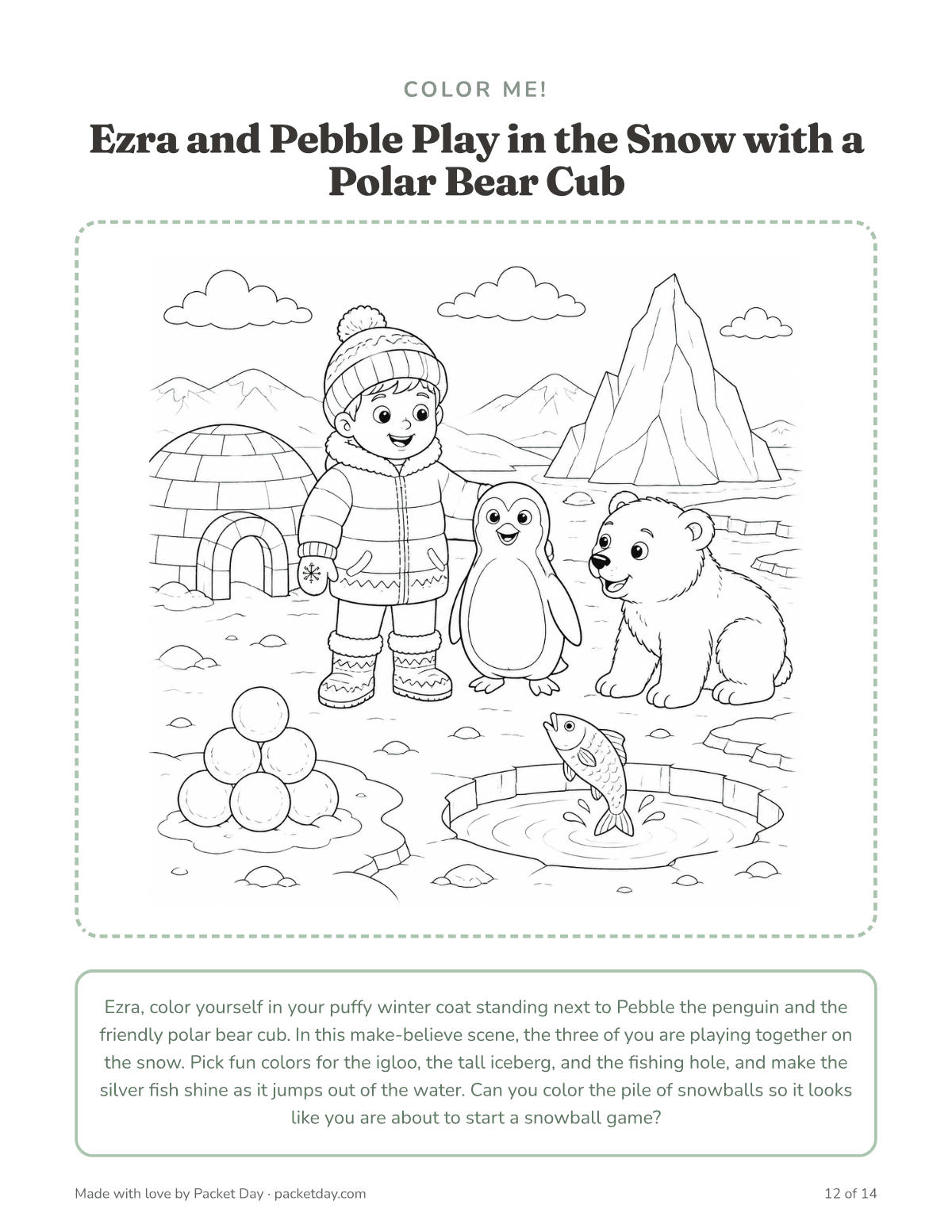
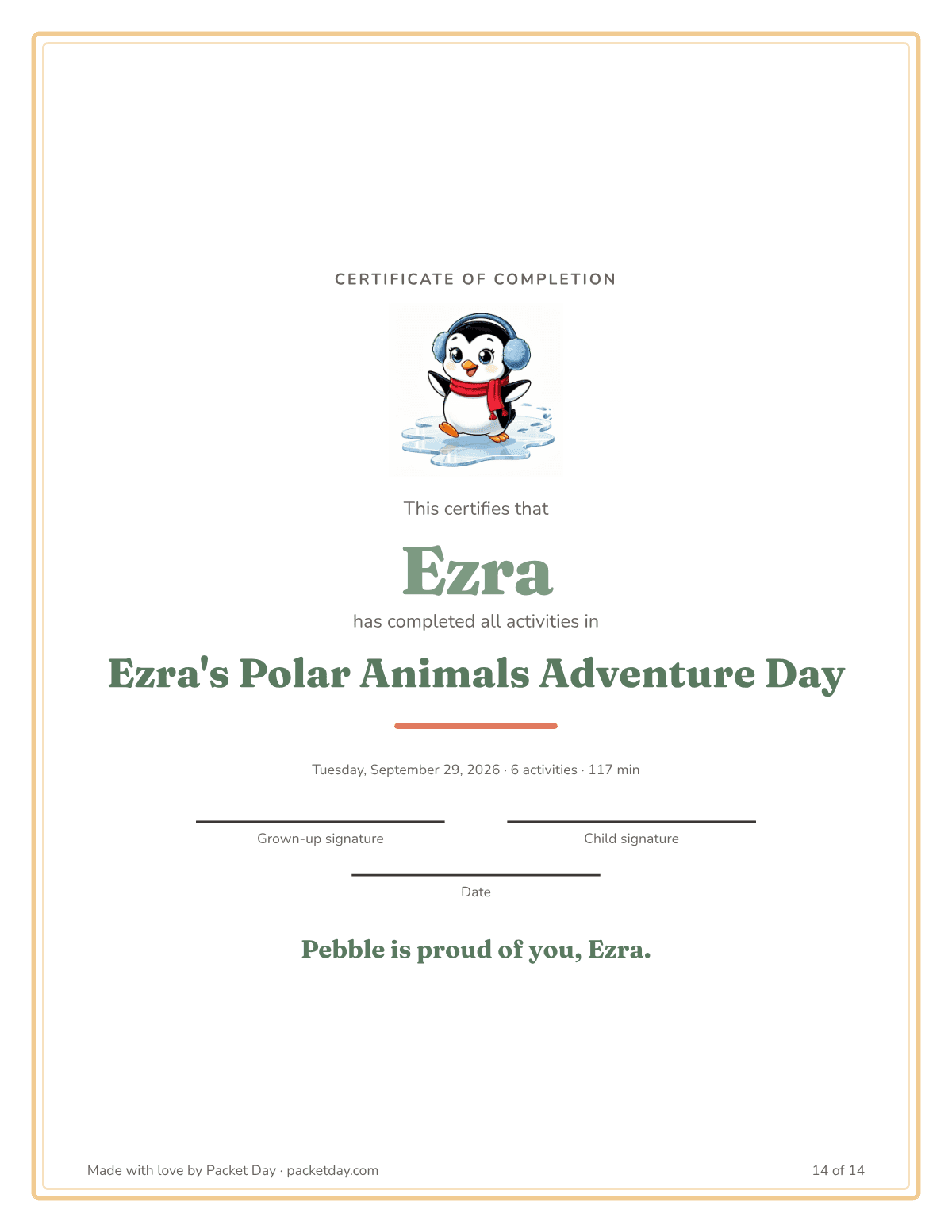
What does my child actually do?
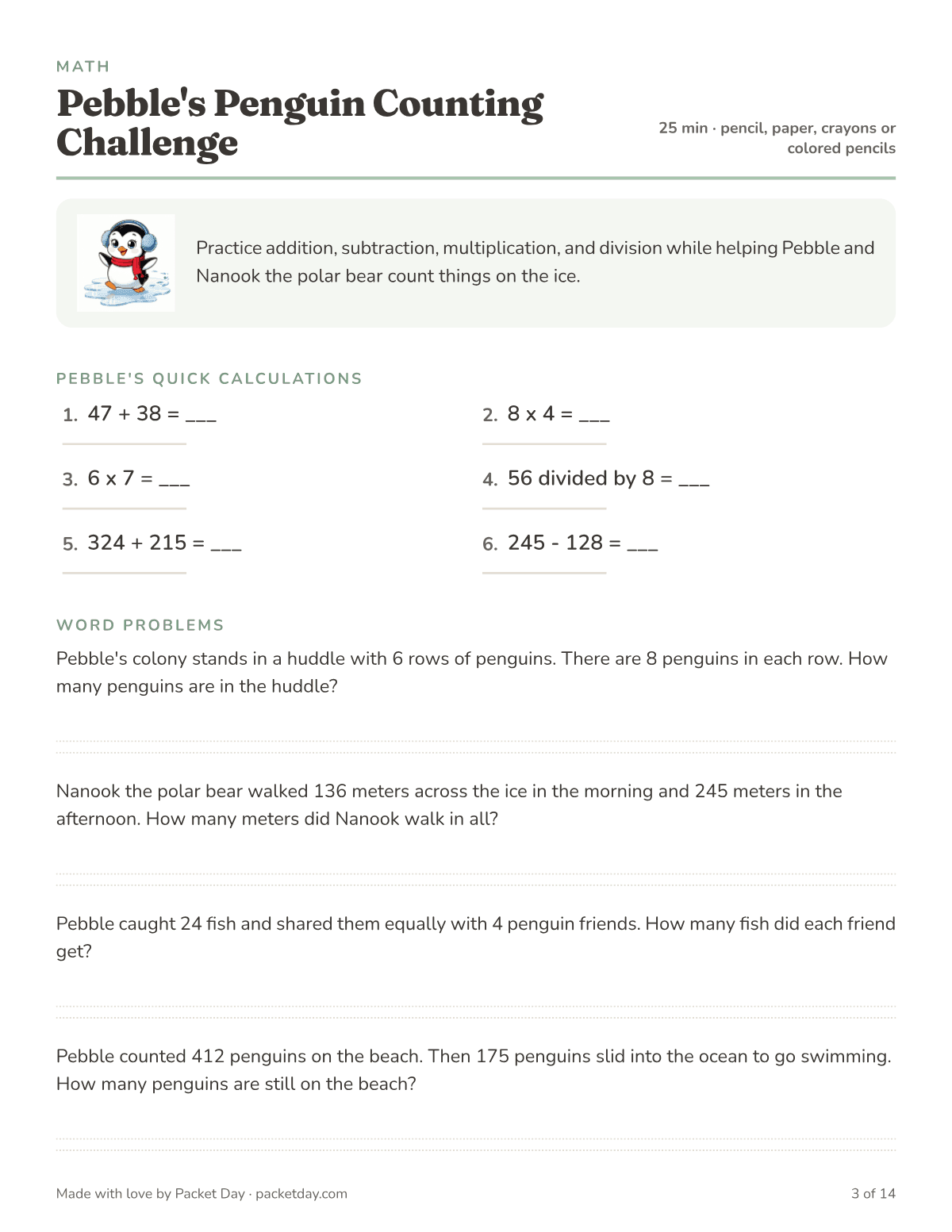
Math
Pebble's Penguin Counting Challenge
Six quick problems, word problems about a huddle of 6 rows and a beach of 412 penguins, and a draw and solve with 5 penguins on each of 3 icebergs.
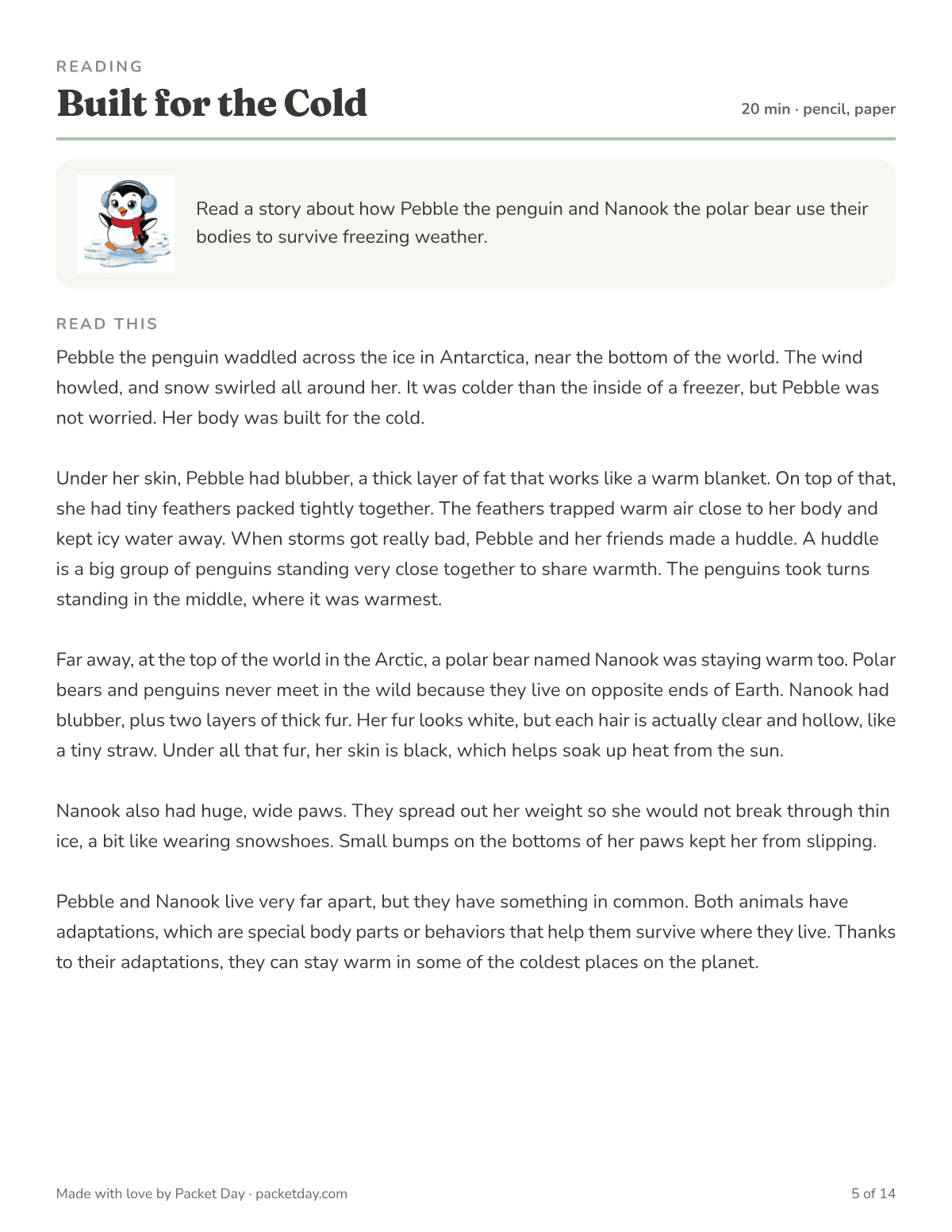
Reading
Built for the Cold
A story about Pebble in Antarctica and Nanook in the Arctic and the body parts that keep them warm, then five questions.
Writing
My Day in Antarctica with Pebble
A story about one day on the ice with Pebble, at least 3 sentences for each of three prompts, including the middle of the huddle.
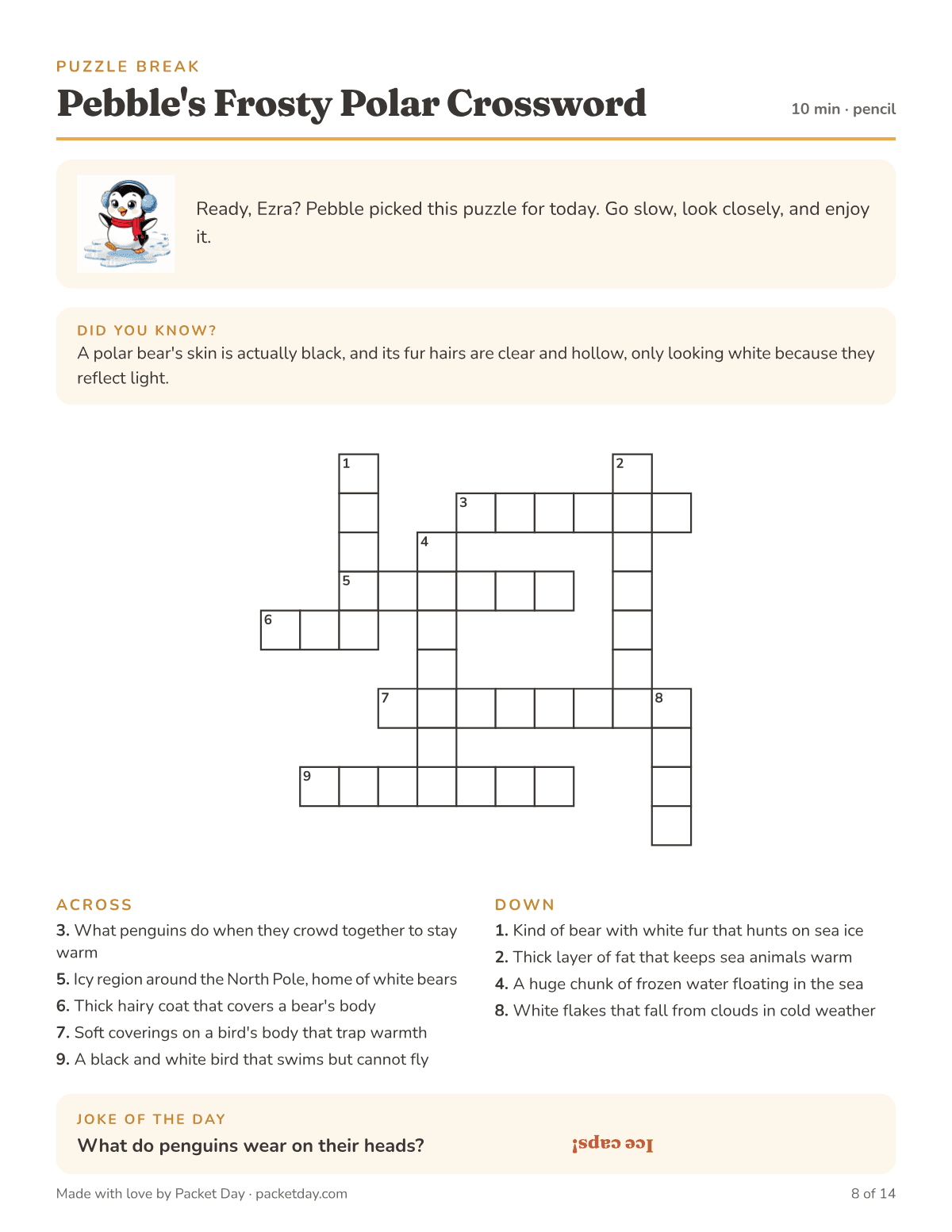
Puzzle break
Pebble's Frosty Polar Crossword
Nine clues for cold weather words, blubber and iceberg included, plus a joke of the day.
Movement break
Polar Animal Wiggle Warm-Up
Waddling with stiff flipper arms, polar bear stomps, pretend belly slides and a ten second shiver.
Science
The Blubber Glove Experiment
Your kid predicts, times a bare finger in ice water, times it again inside a shortening glove, then compares and explains.
Meet Pebble
Pebble is the penguin in blue earmuffs who runs Ezra's day, and she brings a friend. Nanook the polar bear shows up in the math problems and the reading story, even though the story is careful to say the two would never meet in the wild.
Pebble counts her colony in the math, explains blubber and huddles in the reading, saves Ezra a spot in the huddle in the writing prompt and cheers him through the blubber glove test.
The coloring page puts Ezra, Pebble and a polar bear cub together in the snow, and calls it a make believe scene right in the instructions. The certificate reads: Pebble is proud of you, Ezra.
What will my child learn?
Your child practices math, reading, writing and science around one big idea, adaptations: grade 3 math facts and three digit numbers, a story with new science words, a written adventure and a real experiment with a timer.
In math, Ezra adds and subtracts three digit numbers with regrouping (245 minus 128), works through multiplication facts like 6 x 7, and divides 24 fish between 4 friends.
The reading teaches three words, blubber, huddle and adaptation, and asks him to explain each using clues from the story. One question asks why the penguins take turns in the middle of the huddle, which takes real thinking.
The science page is a proper experiment. Ezra writes a prediction, collects two times in seconds, compares them and explains the result using the word blubber.
Which grades is this for?
Grades K-2
For kindergarten through grade 2, the same polar theme comes with shorter reading, easier vocabulary, math at their grade level and shorter writing. We are not showing a grades K to 2 polar animals packet here, so this is how packets change, not a preview of one.
Grades 3-5
This sample is grade 3, so here we can be specific. The story teaches three science words, the math covers three digit adding and subtracting, multiplication facts and simple division, and the writing asks for at least 3 sentences for each of three prompts.
Grades 6-8
For grades 6 to 8, expect longer reading, harder vocabulary, math at their grade level and more writing. We have not seen a grades 6 to 8 polar animals packet, so we are not describing one. The theme and the character stay. The difficulty changes.
A note from Natalie
Vivian once asked for volcanoes but also unicorns, and it worked.
So if your kid wants penguins and polar bears in the same packet, even though they live at opposite ends of the Earth, ask for it. This one handles the mix well: the story explains that the two never meet, and the coloring page puts them together anyway and calls it make believe.
Questions parents ask about polar animals packets
Do penguins and polar bears live together?
No, penguins and polar bears never meet in the wild, because they live at opposite ends of the Earth. Most penguins live in the Southern Hemisphere and polar bears live in the Arctic. The reading story says this plainly, and the parent note points out that the coloring page shows them together as a make believe scene on purpose.
How does the blubber glove experiment work?
You fill one zip top bag with about a cup of vegetable shortening, tuck a second bag inside it and seal them together, so the shortening sits between two layers. Your kid times a bare finger in ice water, then times the same finger inside the glove. The glove usually wins by a lot. A grown up should supervise.
Is a polar bear's fur really white?
No, a polar bear's fur only looks white. The hairs are actually clear, and the long outer hairs are hollow, so they scatter light and look white. Underneath, the skin is black. That's the surprise the reading page promises Ezra.
Why do penguins huddle?
Penguins huddle to share body heat during storms, standing so close together that the group stays much warmer than any one bird could alone. The birds keep shifting, so the ones on the cold outside get a turn in the warm middle. The reading question about taking turns is worth talking through before your kid writes an answer.
Is this a good snow day packet?
Yes, it fits a snow day or a cold week well, and it needs very little: shortening, two zip bags and a bowl of ice water for the science, plus a pencil. The movement break includes a ten second shiver, which is easy to act out after coming in from the snow. Keep a towel handy for the experiment.
Are these made by AI, and are they any good?
Yes, AI writes every packet from scratch around your kid's grade and the topic you give it. We homeschool too, and our own kids test packets constantly. They are good, not perfect, so skim it before printing, especially the science facts. The parent answer key makes checking the math take a couple of minutes.
More unit study packets
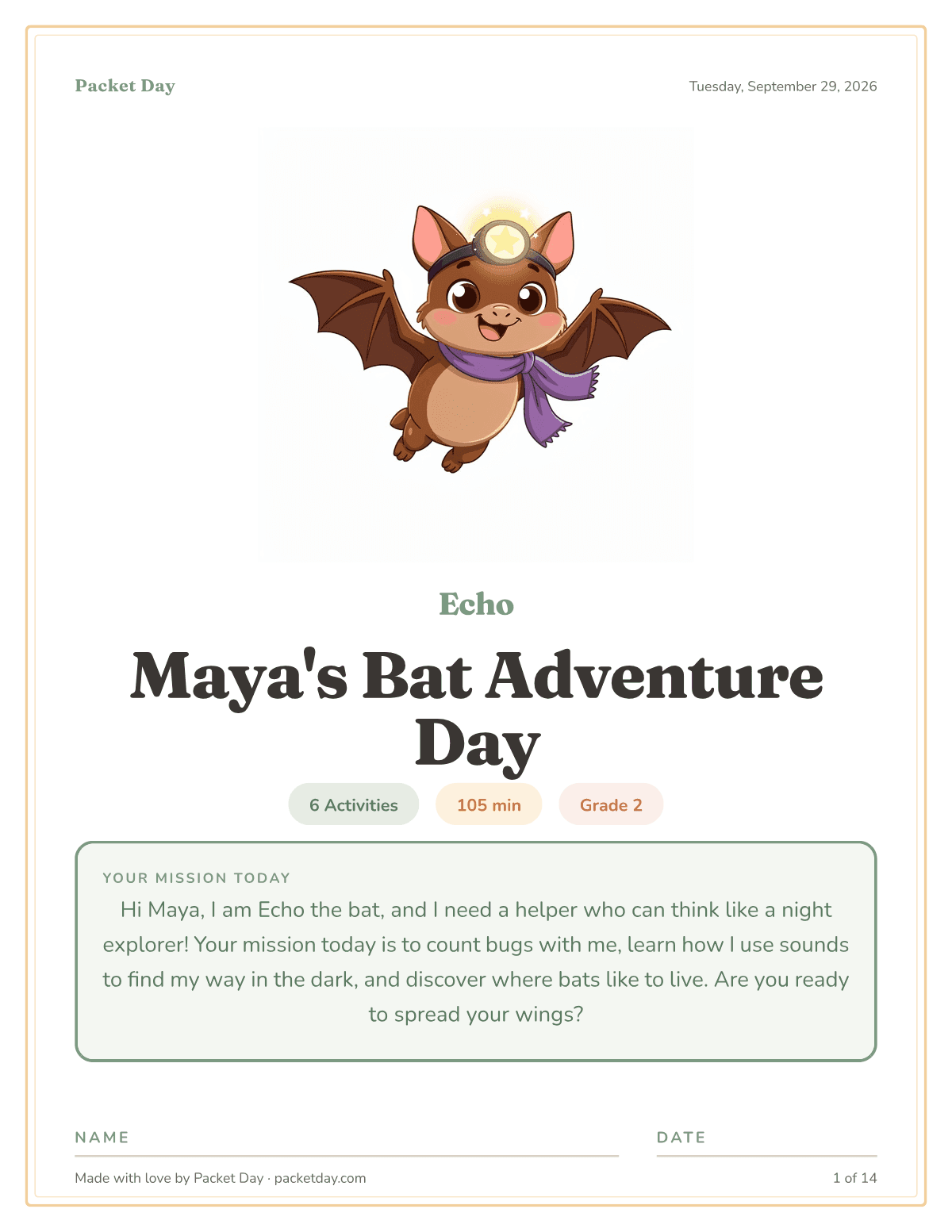
Bats
Sample made for grade 2
A printable bats unit study with a bug counting math page, a short echolocation story, a maze and a clap test you can try at home. Free to start.
See the bats packet →Every unit study packet
See all the themes we have made so far, each with real pages from a sample packet.
Browse the unit studies →Packets for the days you need one
Ready for your own polar animals day?
Packet Day makes print ready, themed learning packets for kids in K to 8, built around whatever your kid is obsessed with.
Make your own polar animals packet freeFree is 1 packet a month, no card needed. Unlimited is $9 a month billed annually ($108 a year) or $12 month to month.