
Train Unit Study Packet for Kids
A train unit study packet is a printable school day about steam engines, freight cars, signals and a snowy holiday train ride, for kids in K to 8. This grade 1 sample has 14 pages plus a parent answer key: math, reading, writing, a crossword, movement, science, coloring and a certificate. About 102 minutes of activities. Free to start.
By Natalie, homeschool mom and Packet Day co-founder
Updated October 2026Reviewed by Natalie
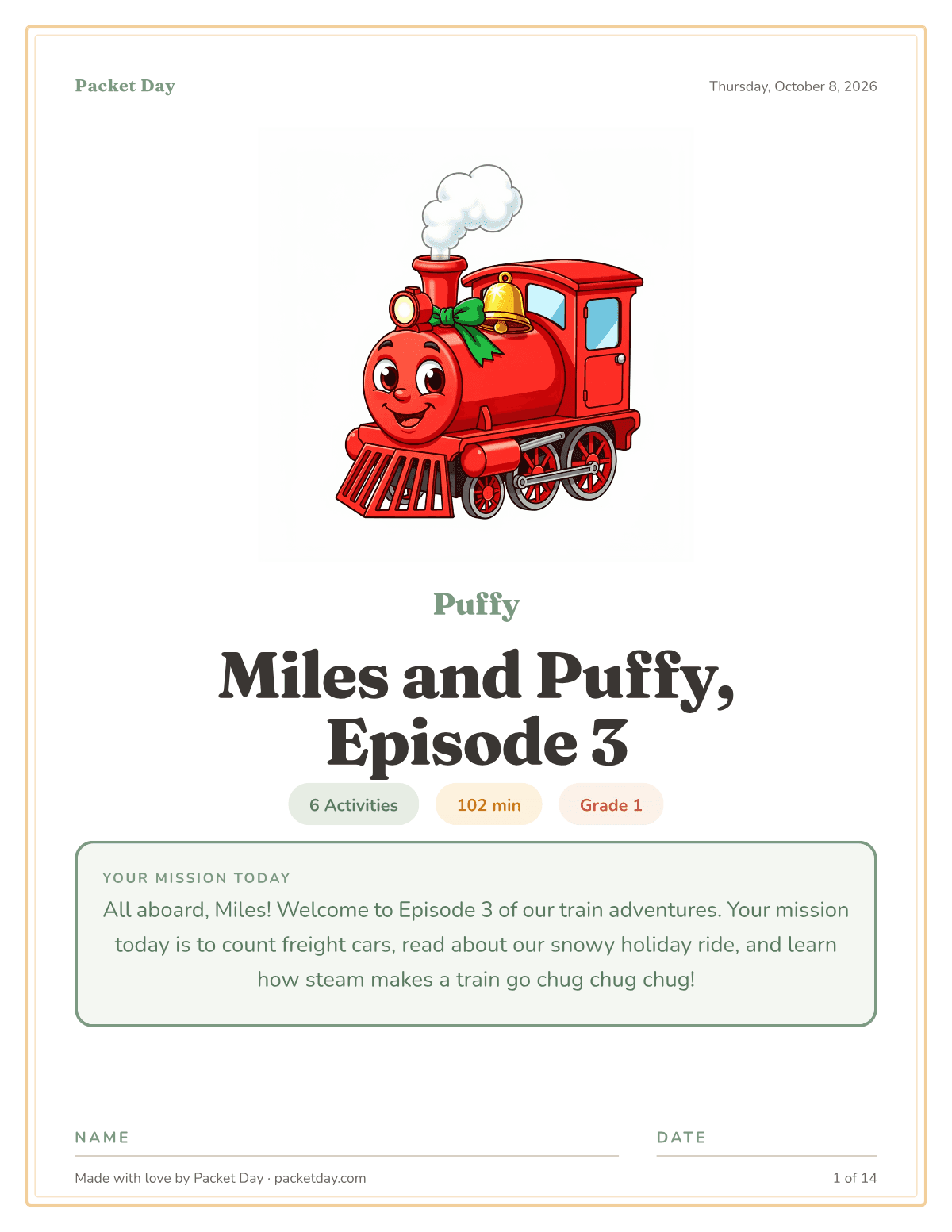
A sample packet made for a grade 1 learner named Miles
What is inside a train packet?
A train packet is a full school day on paper: 11 to 17 pages built around trains, roughly 2 to 5 hours with breaks. This sample has 14 pages plus a parent answer key, and Puffy the steam engine guides the whole day.
Free printable: Miles and Puffy
14 pages, grade 1, answer key included
Want one made for your kid instead? Make one free
What does my child actually do?
Math
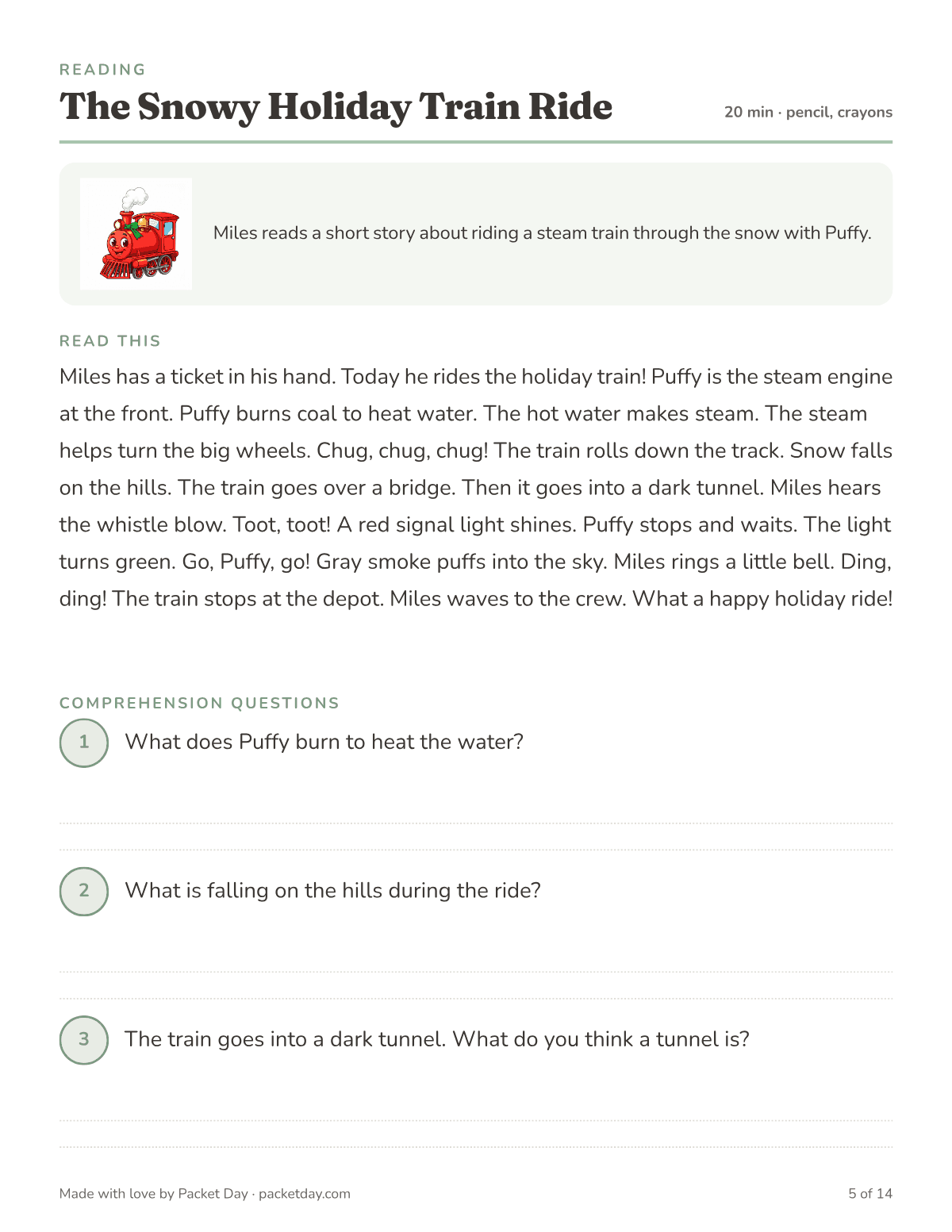
Puffy's Freight Car Count
Adding and taking away within 10, four train word problems, then drawing a 5 car train with 2 red cars and finding how many are blue.
Reading
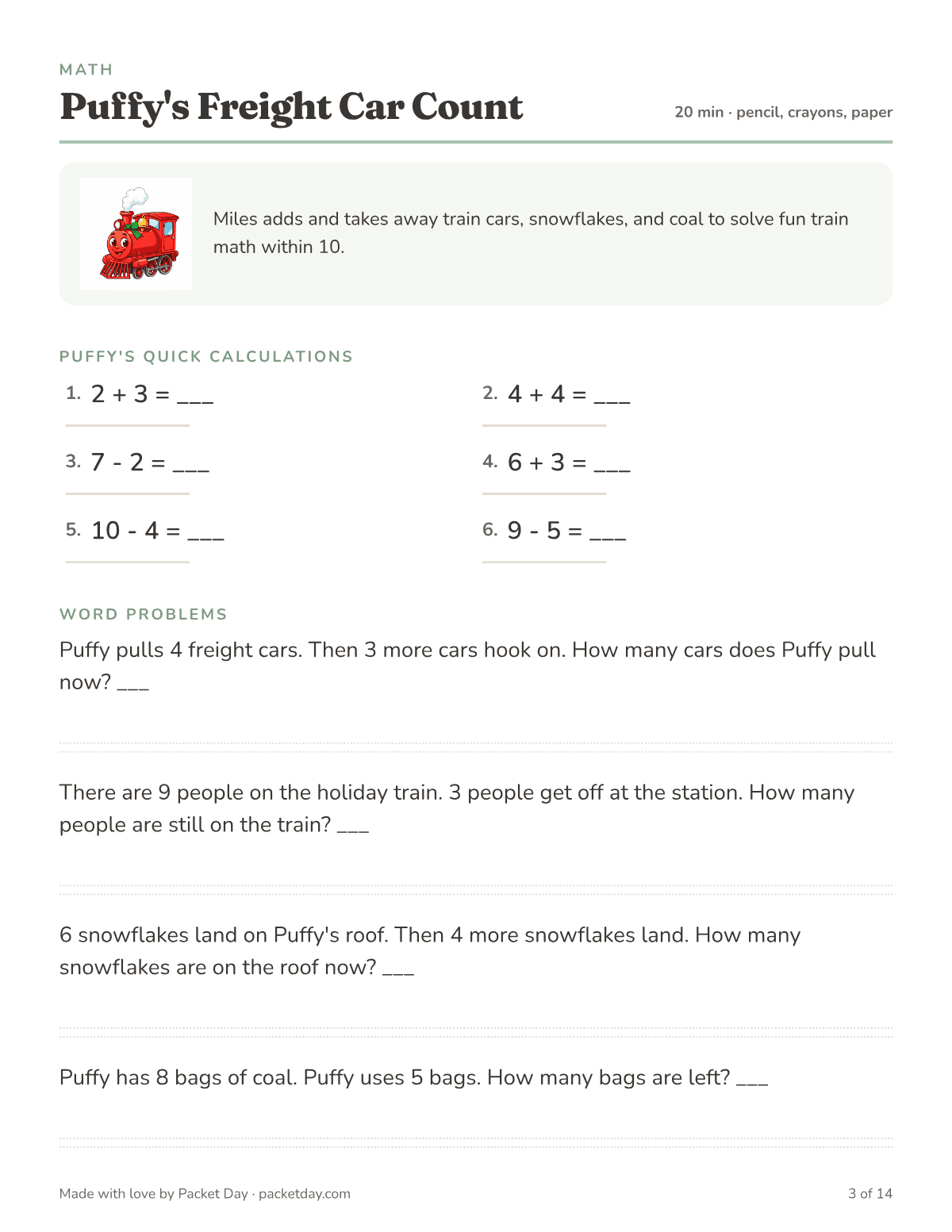
The Snowy Holiday Train Ride
A short story with a bridge, a tunnel, a whistle and a red signal, then five questions, including what a tunnel is and why Puffy stopped.
Writing
My Ride with Puffy
Two or three sentences and a drawing about a train ride, with prompts about the view out the window, Puffy's sounds and the last stop.
Puzzle break
Puffy's All Aboard Crossword
Five train words from a word bank, ticket, train, steam, track and engine, with clues a grown up can read aloud.
Movement break
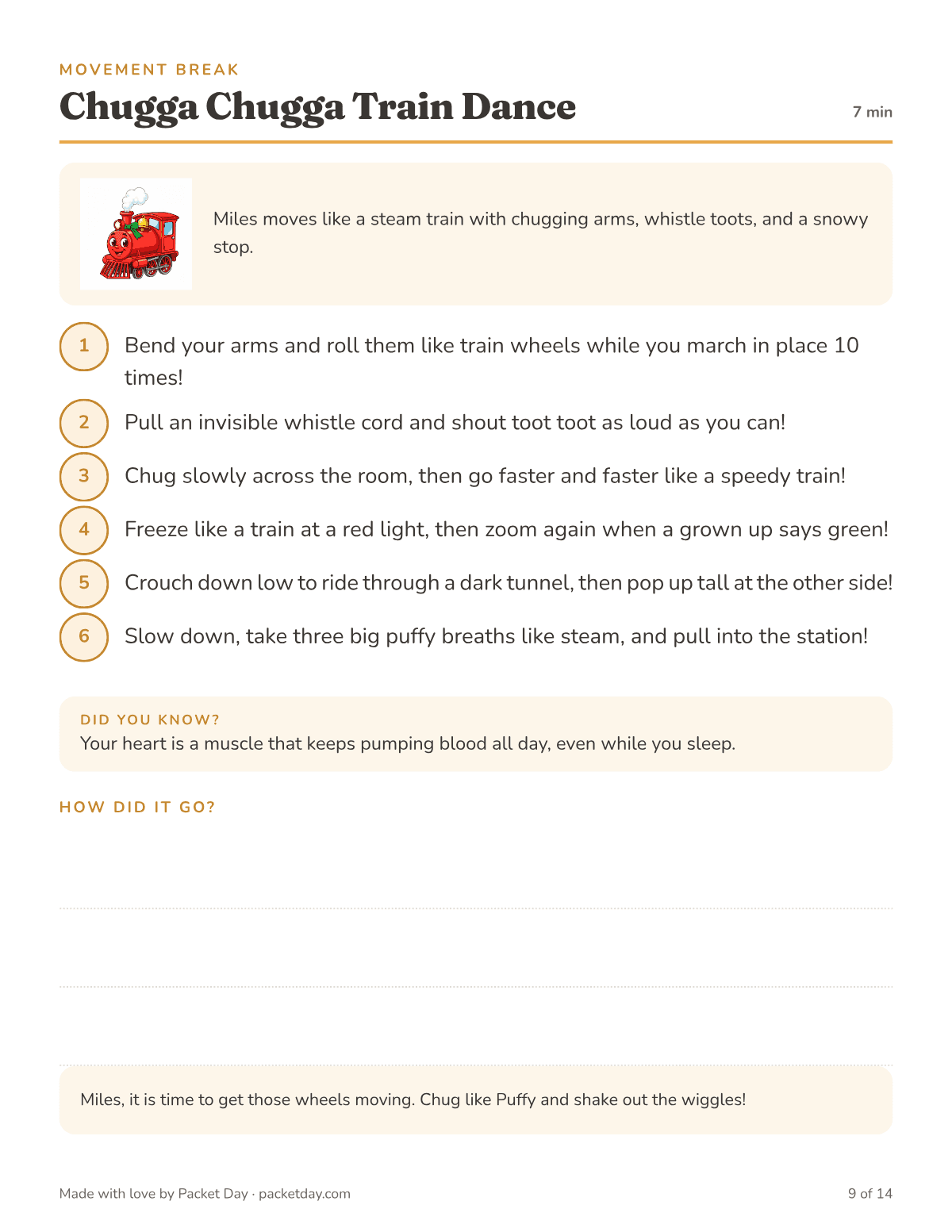
Chugga Chugga Train Dance
Wheel arms, whistle toots, a speedy chug across the room, a red light freeze, a tunnel crouch and three puffy breaths.
Science
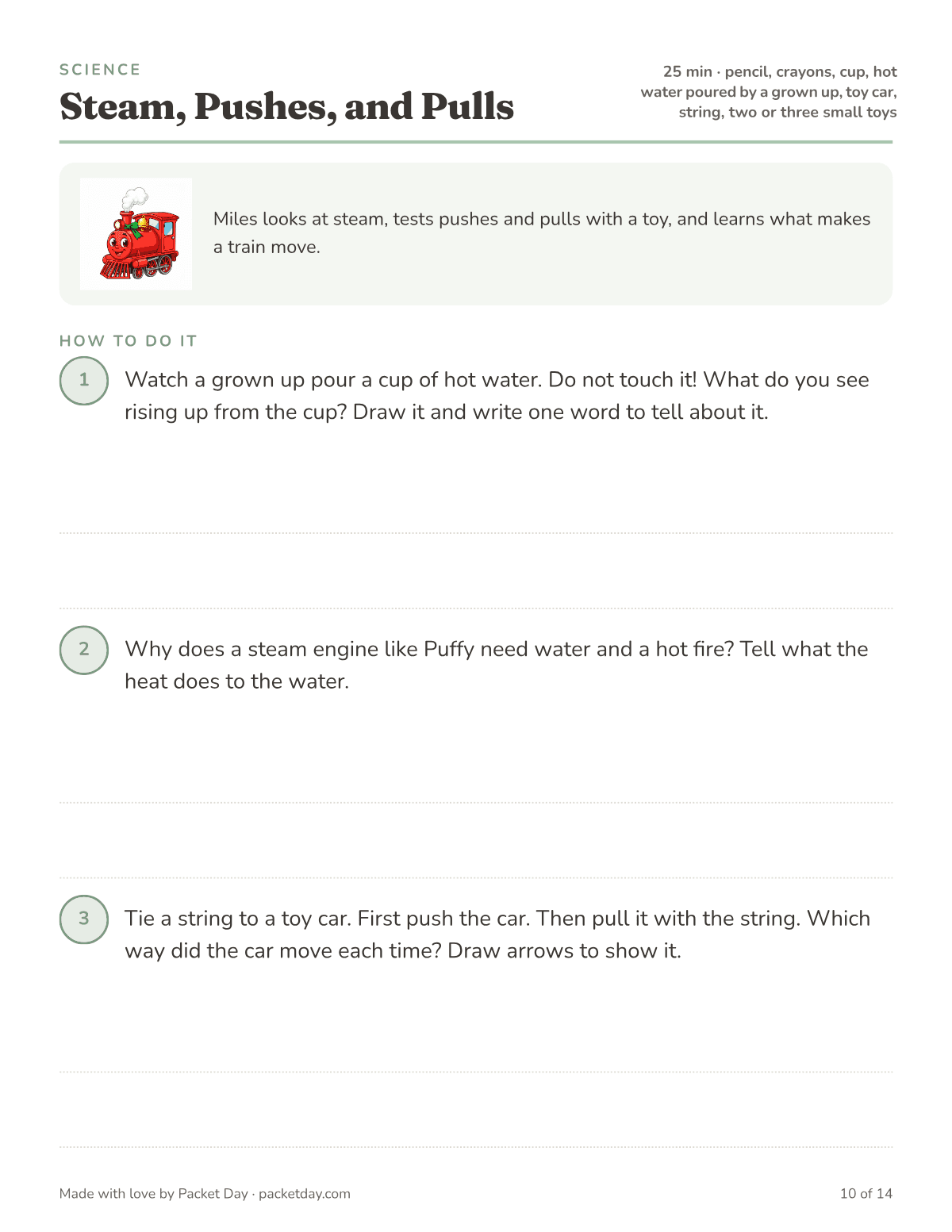
Steam, Pushes, and Pulls
Watching steam rise from hot water, pushing and pulling a toy car, and testing whether a heavier load is harder to pull.
Meet Puffy
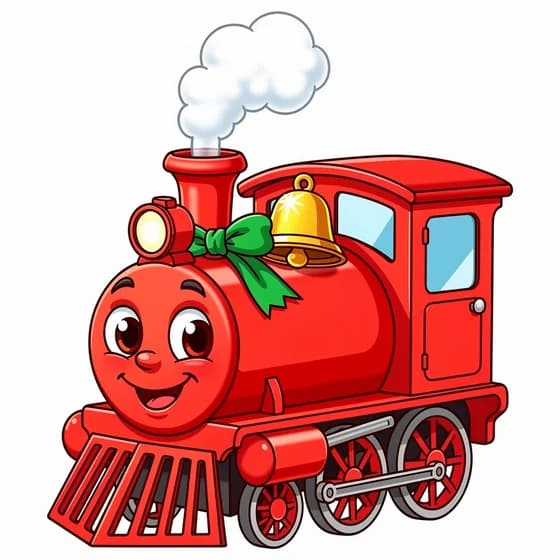
Puffy is a bright red steam engine with a big smile, a gold bell and a green bow for the holidays. He talks to Miles like an old friend.
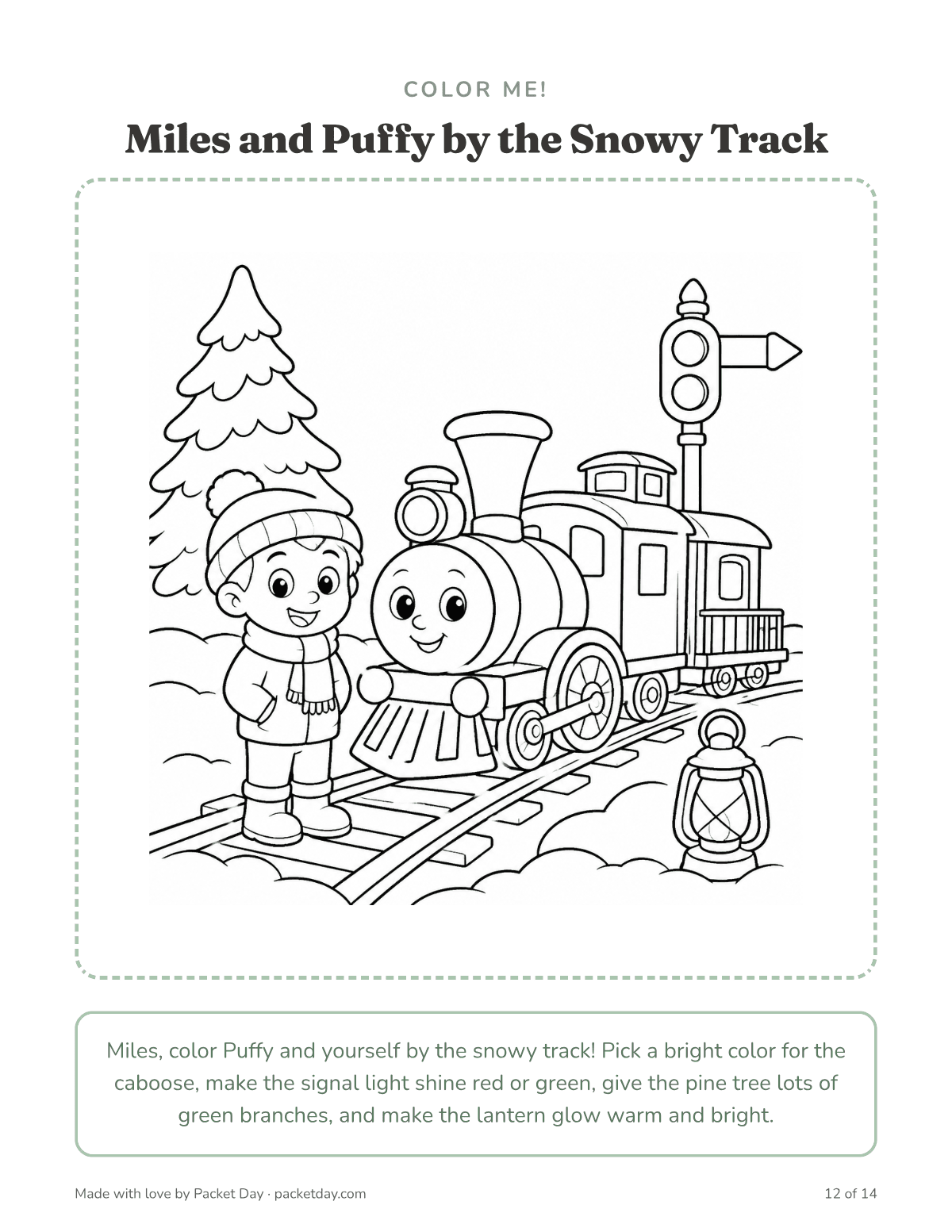
He pulls the freight cars in the math problems, stops at the red signal in the story, asks for help with the crossword and waits by the snowy track on the coloring page. He even explains his own engine: coal heats the water, the water turns to steam, and the steam turns his wheels.
A talking train is a great guide for a first grader. Every page feels like part of the same ride, so the day has a beginning, a middle and a station at the end.
What will my child learn?
Your child gets a full grade 1 day: adding and subtracting within 10, reading a short story and answering questions about it, writing two or three sentences with a drawing, and a hands on science test.
The train facts are real and simple. A steam engine burns fuel to boil water, and the steam pushes the parts that turn the wheels. Water takes up much more space as steam, which is why steam can push so hard. Railroad crews once signaled with lanterns and flags, and train whistles still send messages with patterns of long and short sounds.
The science is all pushes and pulls. Miles pushes a toy car, pulls it with a string, decides whether a train engine pushes or pulls its cars, then ties on more toys to feel a heavier load.
Which grades is this for?
Grades K-2
This sample is grade 1, so we can be specific. The story is about 120 words of short, simple sentences. The math stays within 10, with adding, taking away and a draw and solve. Writing is two or three sentences plus a picture, and the crossword comes with a word bank.
Grades 3-5
Elementary kids get the same train theme with longer reading, bigger vocabulary, math at their grade and more writing. Every packet is written new for the grade you choose.
Grades 6-8
Middle schoolers get trains too, with longer passages, harder words, grade level math and longer written answers. Each one is made from scratch for your kid's exact grade.
A note from Natalie
The kids' great uncle, Uncle Rick, has collected model trains for decades. A few Christmases ago he gave our family an LGB model train set.
Now setting it up is one of the big moments of our season. Every year the kids get so excited to put the track together and watch the train circle the tree and the presents, around and around.
This packet has that same feeling on paper. Miles rides behind Puffy through the snow, counts freight cars and figures out how steam turns the wheels. If you have a train kid at home, do not be surprised if they read the story twice.
Questions parents ask about train packets
How does a steam engine work?
A steam engine burns fuel, usually coal, to boil water in a boiler. The water turns into steam, which takes up far more space than the water did, so it pushes hard on the engine's moving parts. Those parts turn the wheels. The story and the science page say it in first grade words: fire heats water, water makes steam, steam turns wheels.
Is the hot water in the science activity safe for a first grader?
Yes, as written. A grown up pours the hot water and handles it the whole time, and the page tells your kid in plain words not to touch it. Your child only watches the steam rise and draws it. The parent note at the front repeats the same rule, so you see it before the day even starts.
Can my kid do the crossword if they are just learning to read?
Yes. The five answers sit in a word bank right under the grid: engine, steam, ticket, track and train. The parent note suggests reading the clues aloud and letting your kid pick the word, then copying one letter into each box. It turns into spelling practice without ever feeling like spelling practice.
How long can a freight train be?
Very long. Some freight trains pull more than 100 cars at once, and the Did You Know on the math page says exactly that. In recent years a few trains in the United States have stretched past two miles. That is a fun distance to talk through on a walk, so your kid can picture just how long it is.
What do train whistle signals mean?
They are messages made of long and short sounds. Under railroad rules, two long blasts mean release the brakes and go, and long, long, short, long means the train is coming up to a road crossing. The writing page has a Did You Know about whistle patterns, and the movement break lets your kid toot their own.
Are these made by AI, and are they any good?
Yes. AI writes every packet new for your kid's grade and whatever theme you type. We are a homeschool family who tests packets with our own kids, and every sample here gets a fact check. Expect good, not perfect. Read the story before you hand it over, and let the answer key cover the rest.
Packets for the days you need one
Road trips
Turn "are we there yet?" into learning they actually want.
See how it works →Screen-free days
Off the tablet and into a story they actually want to finish.
See how it works →Browse every unit study packetSee a full sample packet
Tired of hunting down free worksheets? See the difference.
Keep the learning going
More unit study packets
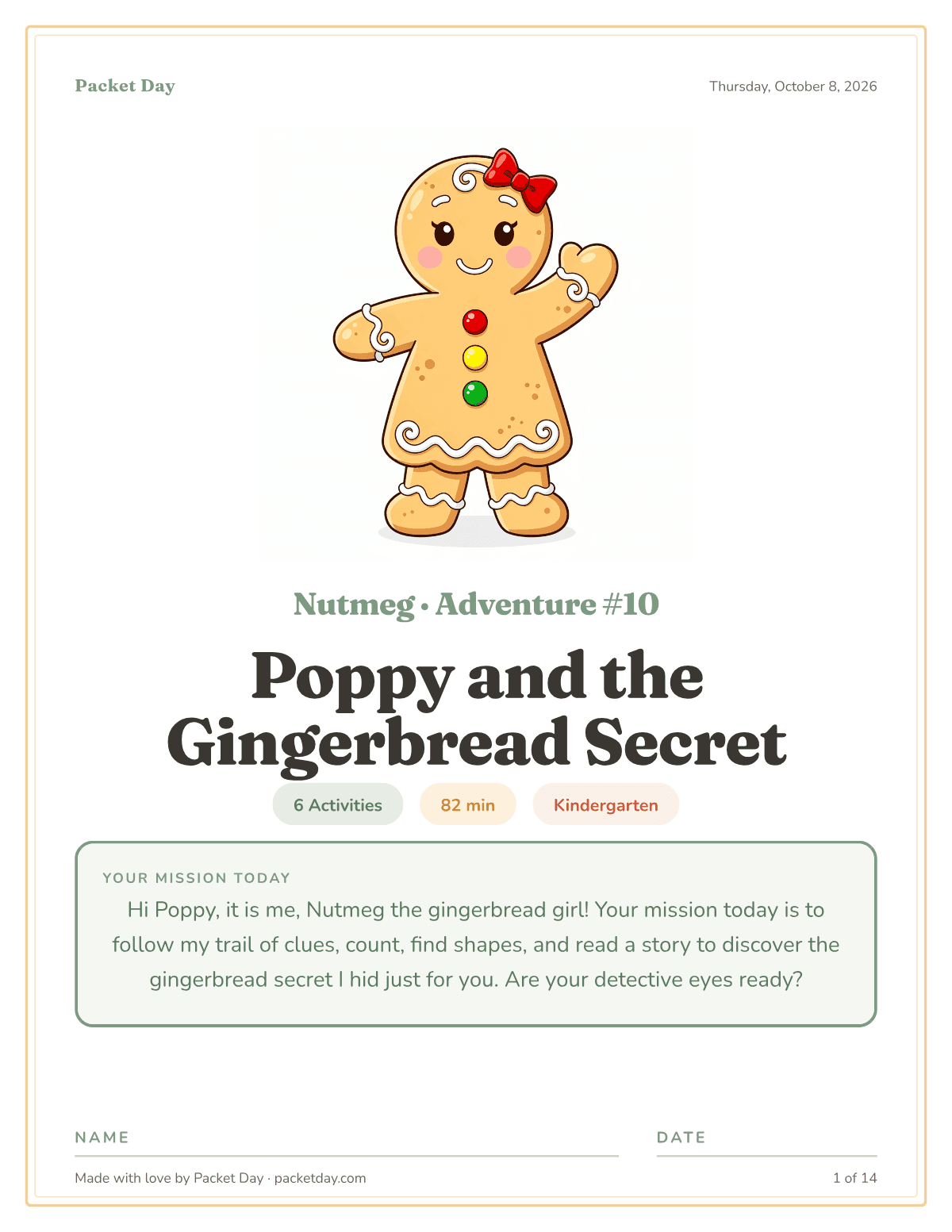 Gingerbread unit studyA printable gingerbread unit study for December: a crumb trail mystery, shapes, counting to 10 and dough science, in a kindergarten sample. Free to start.
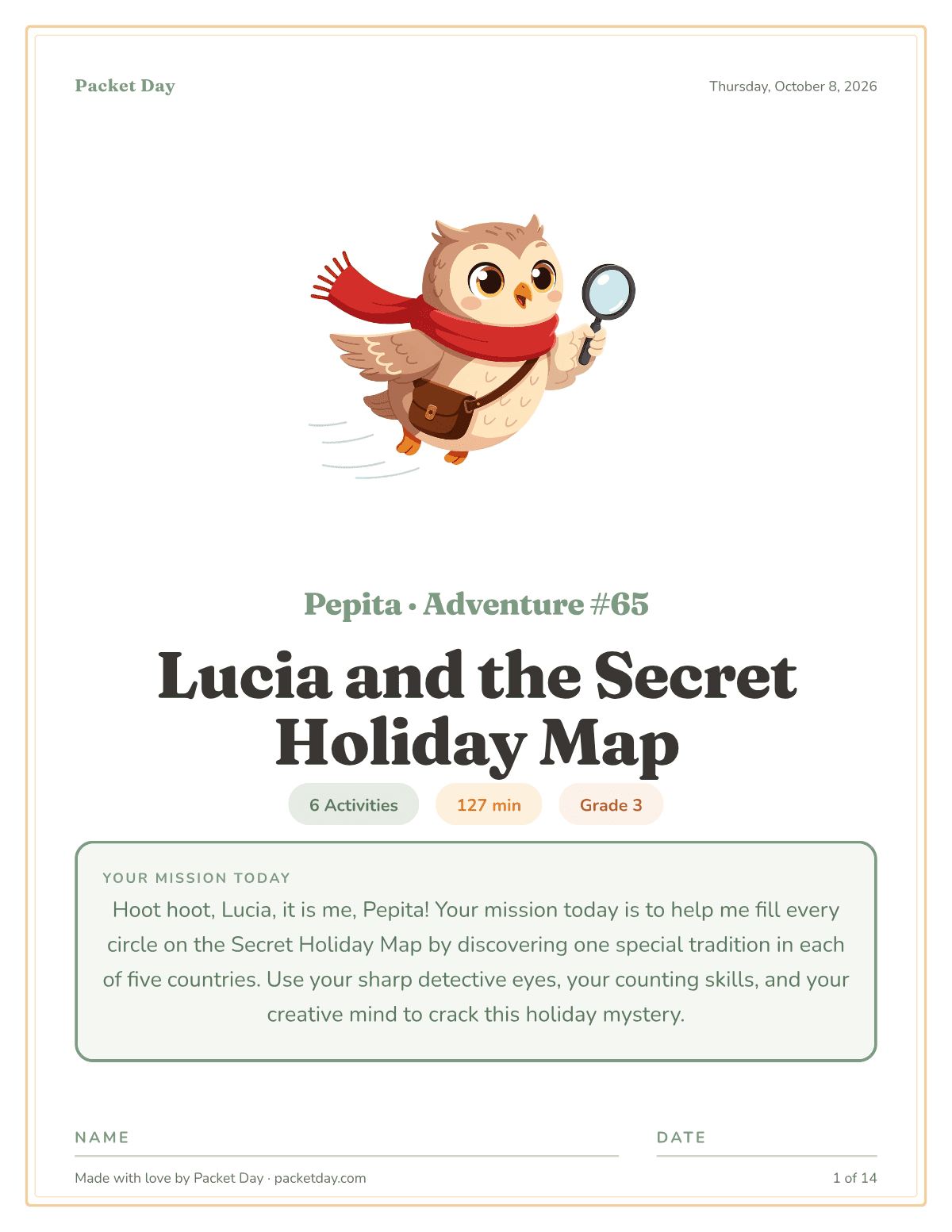 Christmas around the world unit studyA printable Christmas around the world unit study for December: Las Posadas, St. Lucia Day and why Australia has a summer Christmas. Free to start.
 Polar animals unit studyA printable polar animals unit study on how penguins and polar bears stay warm, with a blubber glove experiment and grade 3 math. Free to start.
From the Packet Day blog
- Road Trip Activities for Kids That Aren't a TabletEight hours, two kids, one dying tablet battery. Road trip activities that actually work: quiet, screen-free, and zero prep the night before.
- 25 Screen-Free Activities That Actually Work25 screen-free activities for kids that actually hold their attention: quiet, creative, and active ideas for sick days, road trips, rainy days.
Ready for your own train day?
Packet Day makes print ready, themed learning packets for kids in K to 8, built around whatever your kid is obsessed with.
Make your own train packet freeFree is 1 packet a month, no card needed. Unlimited is $9 a month billed annually ($108 a year) or $12 month to month.