
3rd Grade Homeschool Guide
Third grade is the year reading becomes a tool. Kids stop learning to read and start reading to learn, and math brings multiplication and fractions. Here's what that usually looks like, and how to teach it at your kitchen table.
Homeschool mom of two and co-founder of Packet Day
✓ Last verified against official learning standards
The short answer ⚡
Most third graders work on multiplication and division facts, adding and subtracting within 1,000, fractions as numbers, reading for meaning, and writing full paragraphs. That list comes from the learning standards many states use for public schools. Your state's homeschool law may not ask you to follow it, so treat it as a helpful map, not a rulebook.
What 3rd graders typically learn 📚
Here's what the standards ask for by the end of third grade, in plain English. Kids get there at different speeds, and that's normal.
Math
The multiplication year, with fractions arriving for the first time.
- Multiplying and dividing within 100, using equal groups, arrays and sharing.
- Every times tables fact for two one digit numbers, like 7 x 8, known from memory by the end of the year.
- Adding and subtracting within 1,000, and rounding to the nearest 10 or 100.
- Fractions as numbers on a number line. Third grade sticks to halves, thirds, fourths, sixths and eighths.
- Area, and the perimeter of shapes like rectangles.
- Telling time to the nearest minute.
- Two step word problems.
At the kitchen table: An egg carton is a ready made array. Four rows of three is 4 x 3, and they can count to check.
Reading
Reading smoothly enough that their brain has room left for meaning.
- Reading grade level books with accuracy and understanding.
- Answering questions about a story or article by pointing to the words that prove it.
- Retelling fables, folktales and myths, and finding the lesson or moral.
- Describing characters: what they feel, what they want, and how their actions move the story along.
- Finding the main idea of a nonfiction text and the details that back it up.
At the kitchen table: After they tell you about a book, ask "How do you know?" Finding the sentence that proves it is the skill.
Writing
Paragraphs with a point.
- Opinion pieces that give reasons.
- Informational writing that explains a topic clearly.
- Stories with details and events in a clear order.
- Writing often, in short sittings and in longer projects.
At the kitchen table: A short daily journal covers a lot of this. One opinion, one reason, one example.
Science
Big questions about how things move, grow and live together.
- Forces and motion: how pushes and pulls start, stop or change an object's motion, and how magnets work.
- Life cycles: every plant and animal is born, grows, reproduces and dies, each in its own way.
- Traits: what living things inherit from their parents, and how the environment can change them.
- Weather and climate: tracking the weather by season and comparing climates around the world.
- Habitats: why some animals live in groups, and why some living things do well in a place while others struggle.
At the kitchen table: Roll a ball across the floor, then nudge it from the side. That's a lesson in unbalanced forces.
Where this list comes from 🧭
Many states teach public school math and English from the Common Core State Standards. That's where the math, reading and writing lists above come from. The science list comes from the Next Generation Science Standards. Every list links to the official standards in our sources at the bottom of this page.
Some states set their own standards instead, like Texas, Florida and Virginia. Not every state uses the science standards either. If you live in one of those states, its own standards are the better map, and the details and order may differ from what's here.
Homeschool rules are a separate thing. In Texas, for example, TEA points parents who are interested to its standards, the TEKS, as a resource. Check your state's guide for what applies where you live.
Easy 3rd grade activities for home 🏡
No prep, no printer needed. Each one fits in a spare half hour.
Times tables with a deck of cards. Take out the face cards. Flip two cards and multiply them. Whoever says the answer first keeps the pair.
Measure a room. Count floor tiles or use a tape measure to find the area of a rug or a room. Then walk the edge for the perimeter.
Fraction snack. Cut a sandwich into halves, then fourths, then eighths. Line up the pieces and ask which is bigger, 1/4 or 1/8.
Two week weather chart. Write down the temperature and the sky every day for two weeks. At the end, turn it into a bar graph together.
Fable night. Read a short fable together and ask, "What's the lesson?" Then they write their own, with an animal and a moral.
A real 3rd grade sample packet 🦈
Here are four pages from a real sample packet, made for a third grader we call Max. Hank the hammerhead leads Max on an expedition to map the Deep Reef, and every page is matched to grade level.
This sample has 14 pages, 6 activities and about 127 minutes of work, plus an answer key for you. Every packet is made new for your child, so yours will look different.
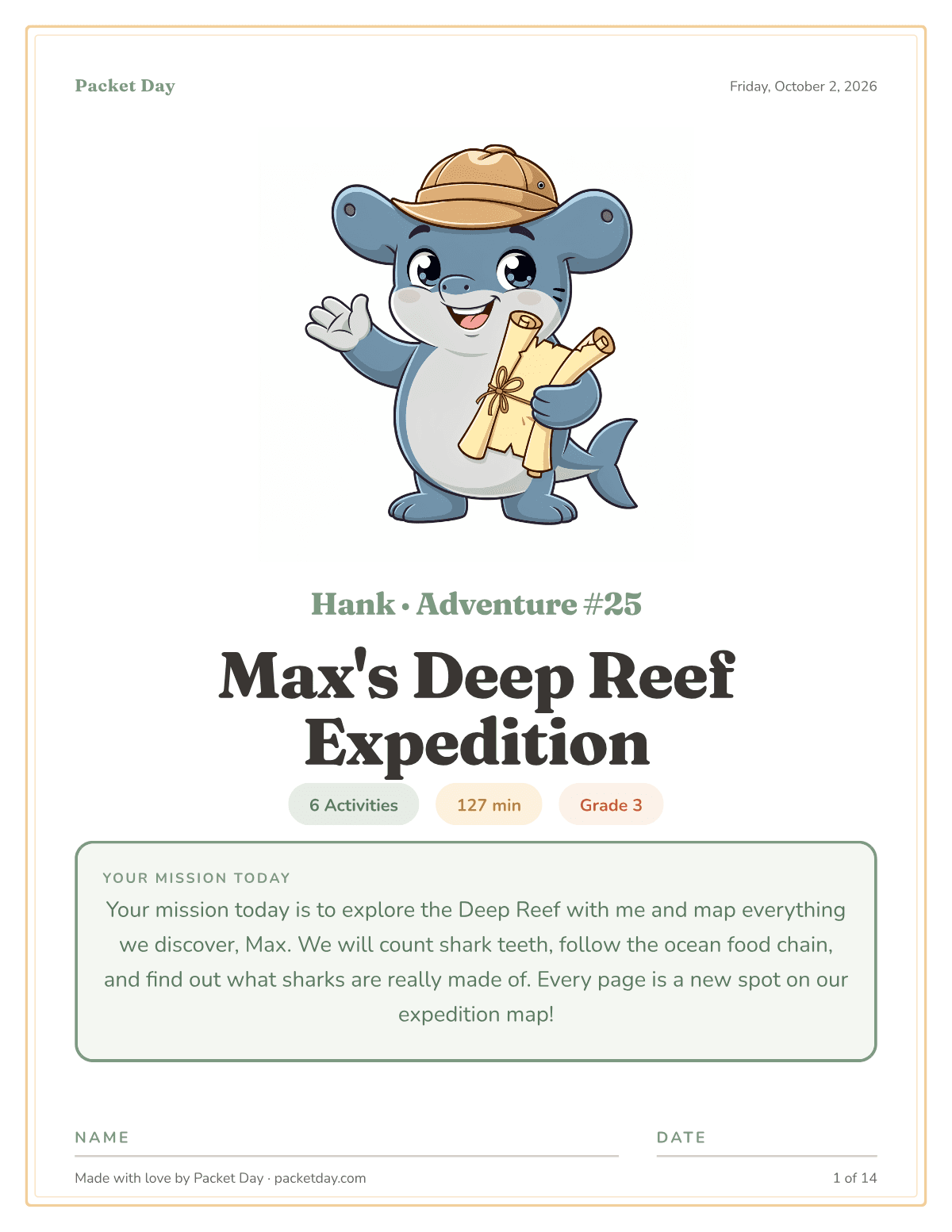
Hank shows up with a hat, a stack of maps and a plan. 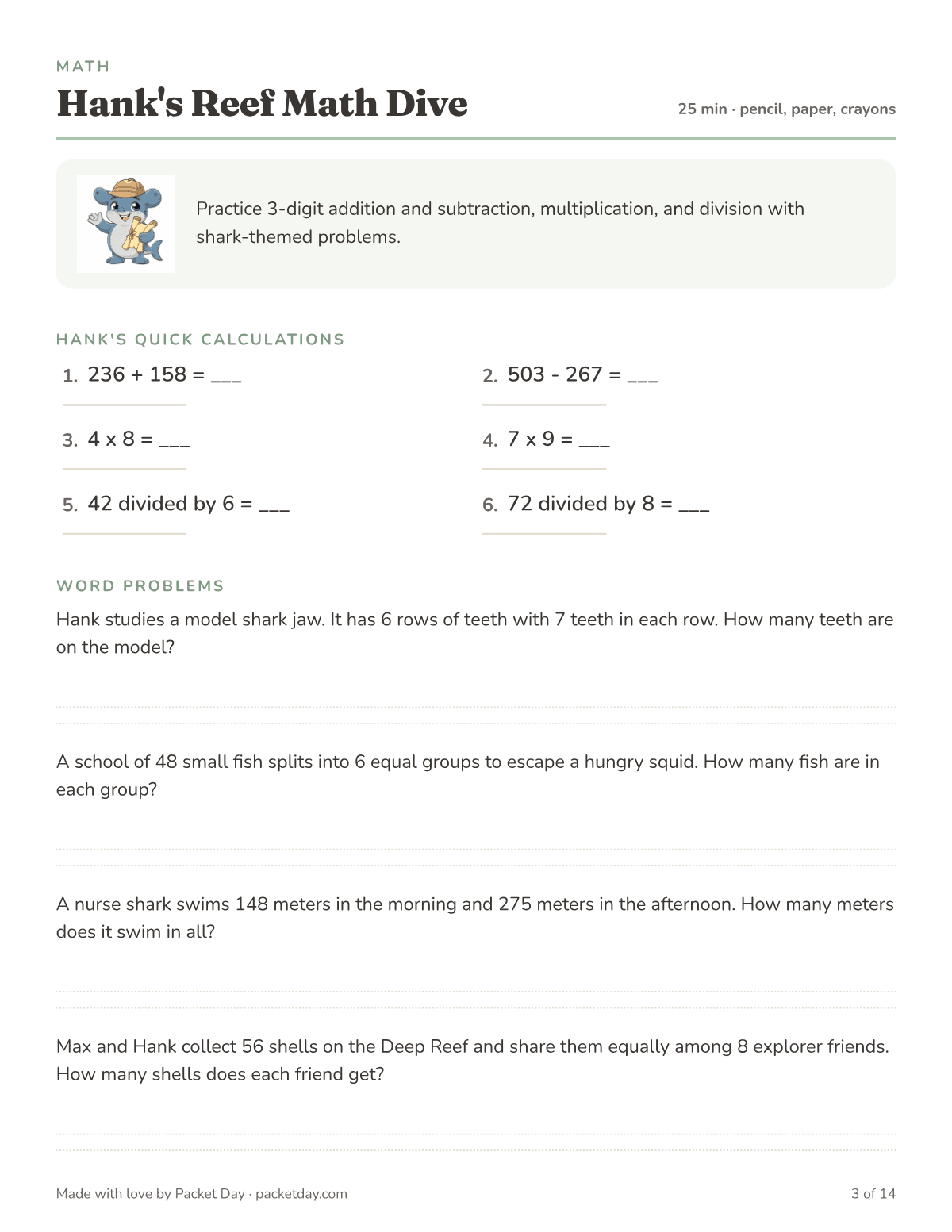
Three digit adding, times tables and sharing shells fairly. 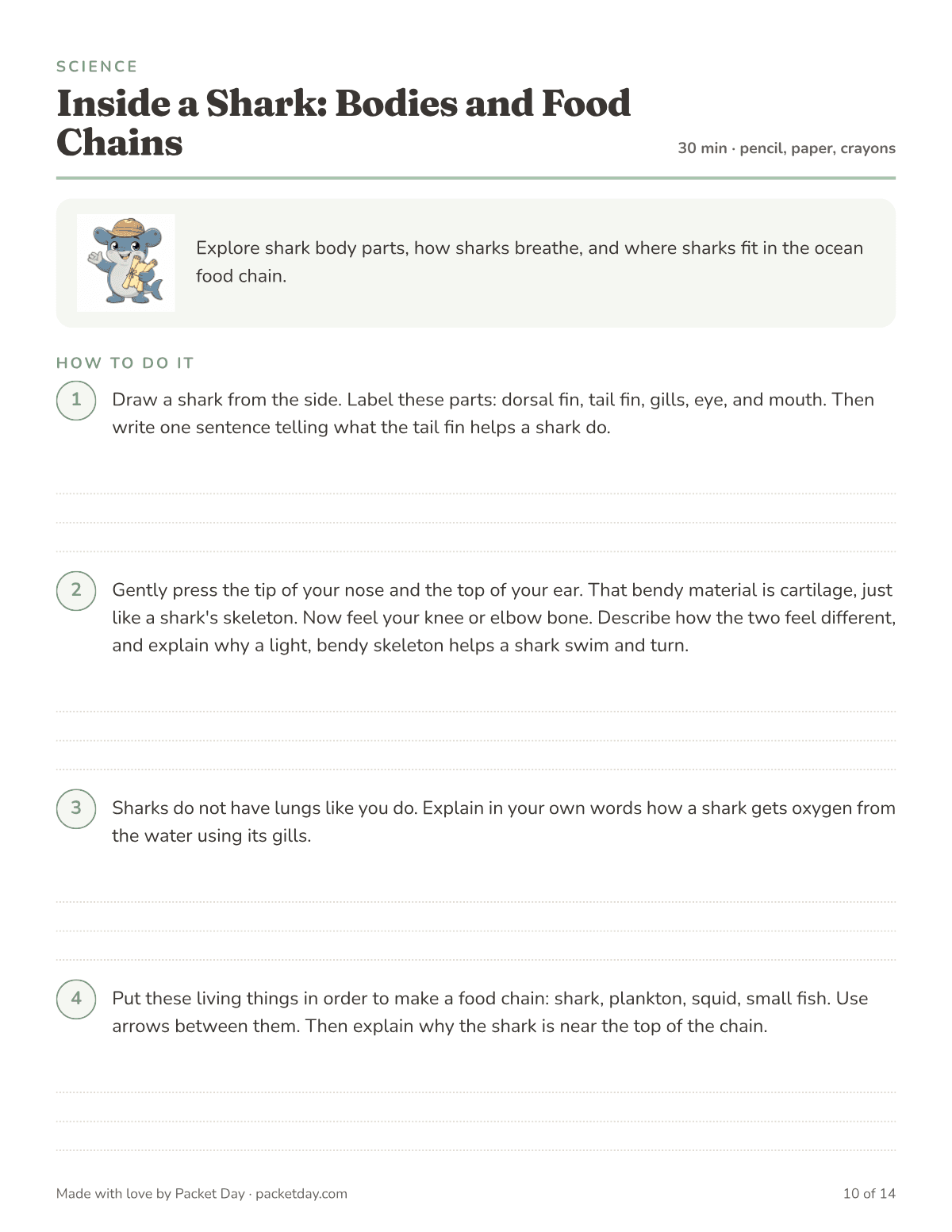
The page where your kid feels shark skeleton material on their own nose. 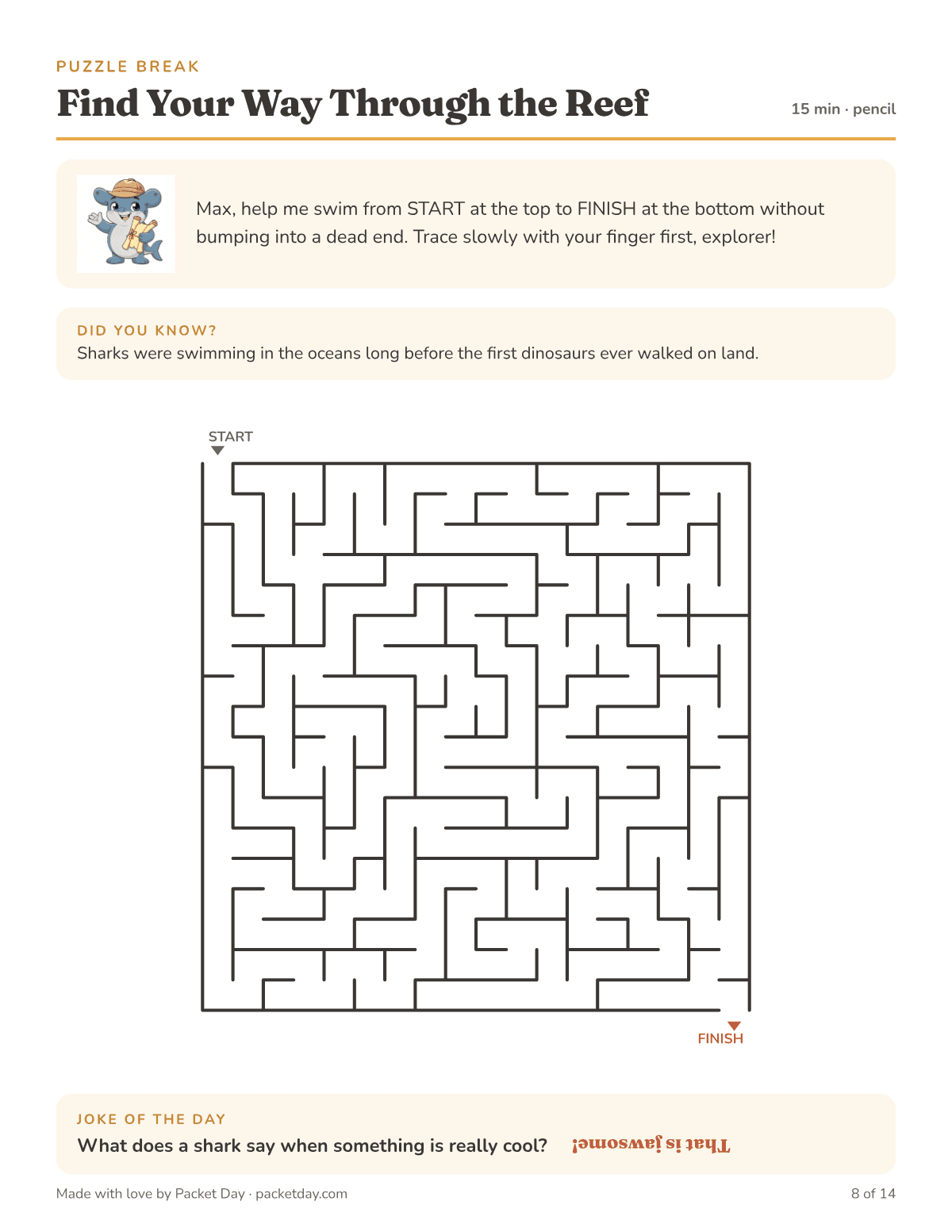
One path through the reef. Trace it with a finger first.
Does my state require this? 🏛️
Learning standards are written for public schools. Your state's homeschool law is a separate thing, and it varies a lot. Some states list the subjects you have to cover. Some ask for testing, and a few start in third grade.
In Georgia, for example, a standardized test is due at least every three years, starting at the end of third grade. Pennsylvania asks for tests in grades 3, 5 and 8. Your state's guide spells out what applies to you.
3rd grade homeschool FAQ 💬
Should my 3rd grader know all their times tables?
By the end of the year, that's the goal in the Common Core math standards: every product of two one digit numbers, known from memory. Early in the year, plenty of third graders are still working on it, and that's normal. A few minutes of practice a day beats a long drill.
Is my child behind in 3rd grade?
Probably not. Kids move through these skills at different speeds, and a gap in one subject is common. Worried your third grader is behind? Our post on what a 3rd grader should know has a calm checklist and simple ways to shore up the wobbles.
How many hours a day should I homeschool 3rd grade?
Less than a school day. Home doesn't have lining up, waiting or 25 other kids. Our guide to how many hours a homeschool day takes breaks it down by grade.
What does a 3rd grade homeschool day look like?
One simple rhythm: math and reading in the morning while brains are fresh, then writing, science or a project after a break. The sample packet above is one full day: math, reading, writing, science, a puzzle break and a movement break.
Do I have to follow Common Core to homeschool?
Only if your state's homeschool law asks for it. Learning standards are written for public schools, and homeschool laws are separate. Many states use Common Core in their public schools, and some, like Texas, Florida and Virginia, set their own standards. Check your state's guide to see what your state asks you to teach.
Want a 3rd grade day you don't have to plan? 🌿
Packet Day makes a printable day of learning around your child's grade and interests, for the days you need a backup plan. 11 to 17 pages, generated around your kiddo in a minute or two.
Sources 📖
- Common Core State Standards: Grade 3 Math introduction (checked )
- Common Core: Grade 3 Operations and Algebraic Thinking (checked )
- Common Core: Grade 3 Number and Operations in Base Ten (checked )
- Common Core: Grade 3 Number and Operations, Fractions (checked )
- Common Core: Grade 3 Measurement and Data (checked )
- Common Core: Grade 3 Reading, Foundational Skills (checked )
- Common Core: Grade 3 Reading, Literature (checked )
- Common Core: Grade 3 Reading, Informational Text (checked )
- Common Core: Grade 3 Writing (checked )
- NGSS: Grade 3 Forces and Interactions (checked )
- NGSS: Grade 3 Inheritance and Variation of Traits, Life Cycles and Traits (checked )
- NGSS: Grade 3 Weather and Climate (checked )
- NGSS: Grade 3 Interdependent Relationships in Ecosystems (checked )
- Texas Education Agency: Texas Essential Knowledge and Skills (TEKS) (checked )
- Florida Administrative Code: Rule 6A-1.09401, Student Performance Standards (B.E.S.T.) (checked )
- Code of Virginia: § 22.1-253.13:1, Standards of Learning (checked )
- Texas Education Agency: Home Schooling (checked )
Last verified October 2026. Standards are summarized from the sources above. Social studies isn't sourced because it varies so much by state.
This page summarizes public learning standards for general reference. Your state's homeschool law is what applies to your family, so check your state's guide or department of education before making decisions.
Keep exploring 🧭
Unit studies to try
- Sharks unit studyA printable shark unit study on cartilage skeletons, gills, denticles and the ocean food chain, shown as a grade 3 sample with a reef maze. Free to start.
 Outer Space unit studyA printable outer space unit study: the Sun, all eight planets, day and night and rocket math, shown here as a grade 2 sample. Free to start.
 Baking science unit studyA printable baking science unit study on yeast, gluten and oven heat, with a two cup yeast experiment and bakery math in a grade 4 sample. Free to start.
From the Packet Day blog
- What Should a 3rd Grader Know? (Without the Panic)Worried about what your 3rd grader should know? The real list (math, reading, and writing milestones), minus the panic and the jargon.
- How Many Hours of Homeschool a Day? Real Answers by GradeHow many hours of homeschool per day? Real answers by grade (K to 2, 3 to 5, and 6 to 8), plus why home learning needs fewer hours than school.
Homeschooling in a new state, or just starting out? Our homeschool requirements by state cover what to file and what to keep.
🗺️ Social studies
This one varies a lot from state to state.