
Outer Space Unit Study Packet for Kids
An outer space unit study packet is a printable school day about the Sun, the eight planets and rockets for kids in K to 8. This grade 2 sample has 14 pages plus a parent answer key: math, reading, writing, a shape sudoku, movement, science, coloring and a certificate. About 108 minutes of activities. Free to start.
By Natalie, homeschool mom and Packet Day co-founder
Updated October 2026Reviewed by Natalie
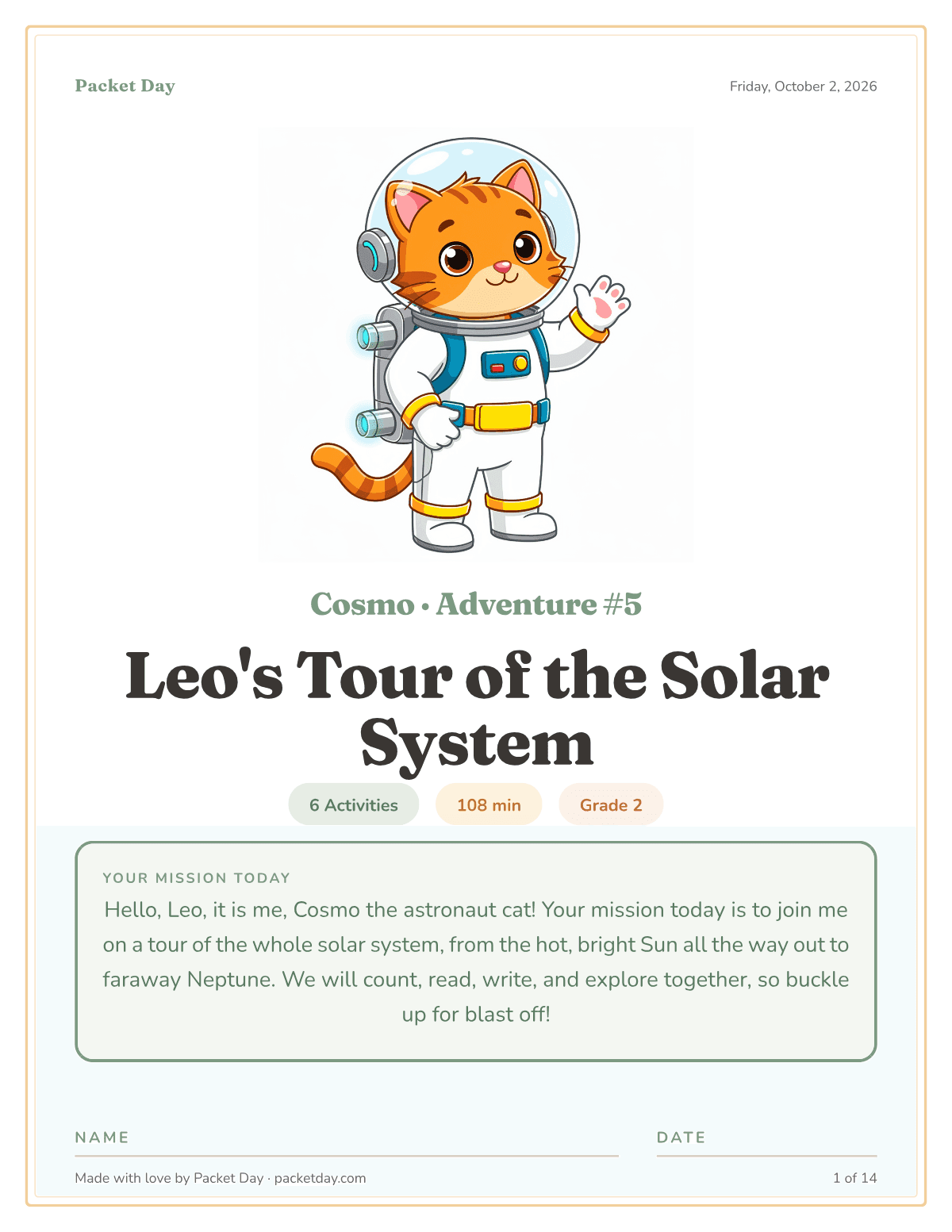
A sample packet made for a grade 2 learner named Leo
What is inside an outer space packet?
An outer space packet is a full school day on paper: 11 to 17 pages built around outer space, roughly 2 to 5 hours with breaks. This sample has 14 pages plus a parent answer key, and Cosmo the astronaut cat guides the whole day.
What does my child actually do?
Math
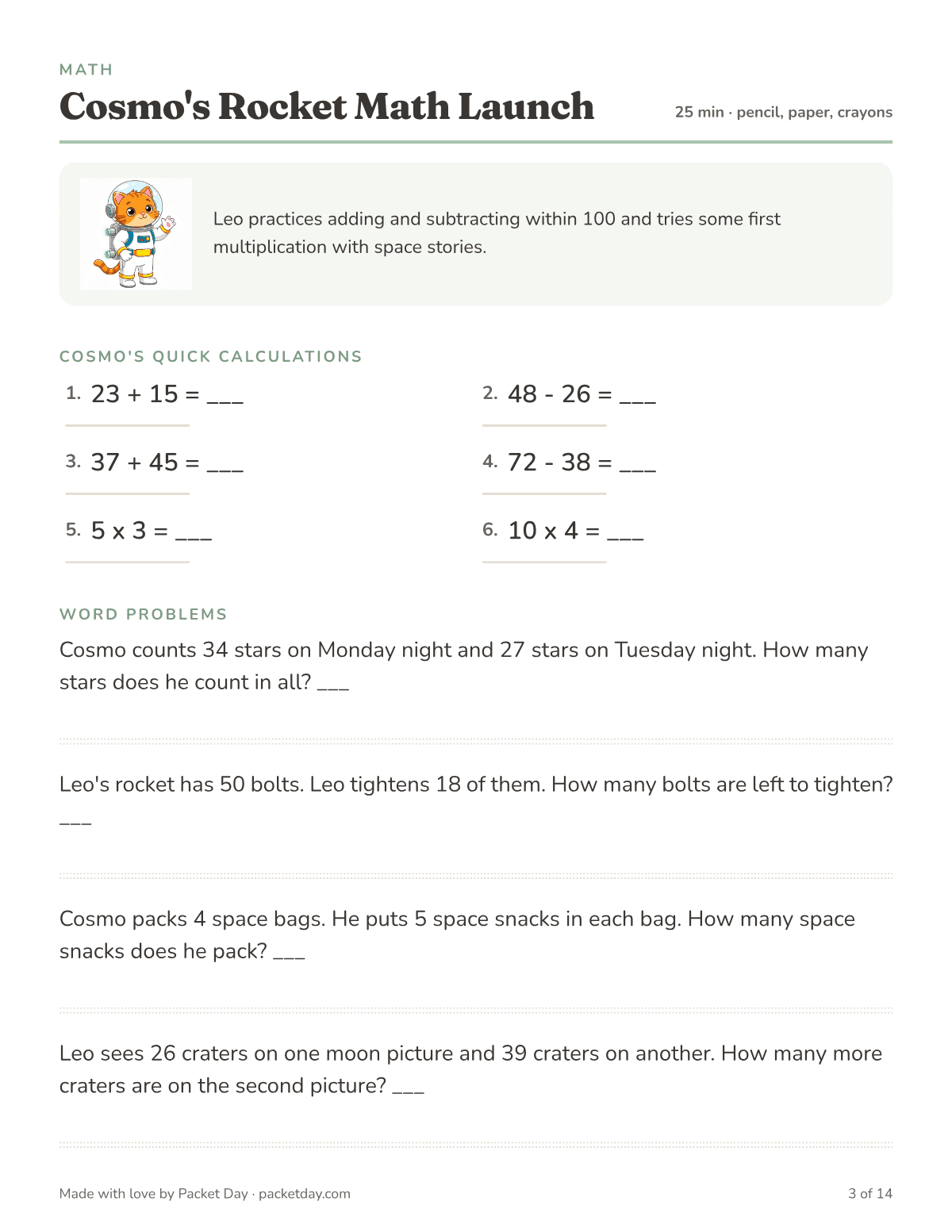
Cosmo's Rocket Math Launch
Six warm up problems, four word problems about counting stars and tightening rocket bolts, then drawing 3 rockets with 5 windows each to find 3 x 5.
Reading
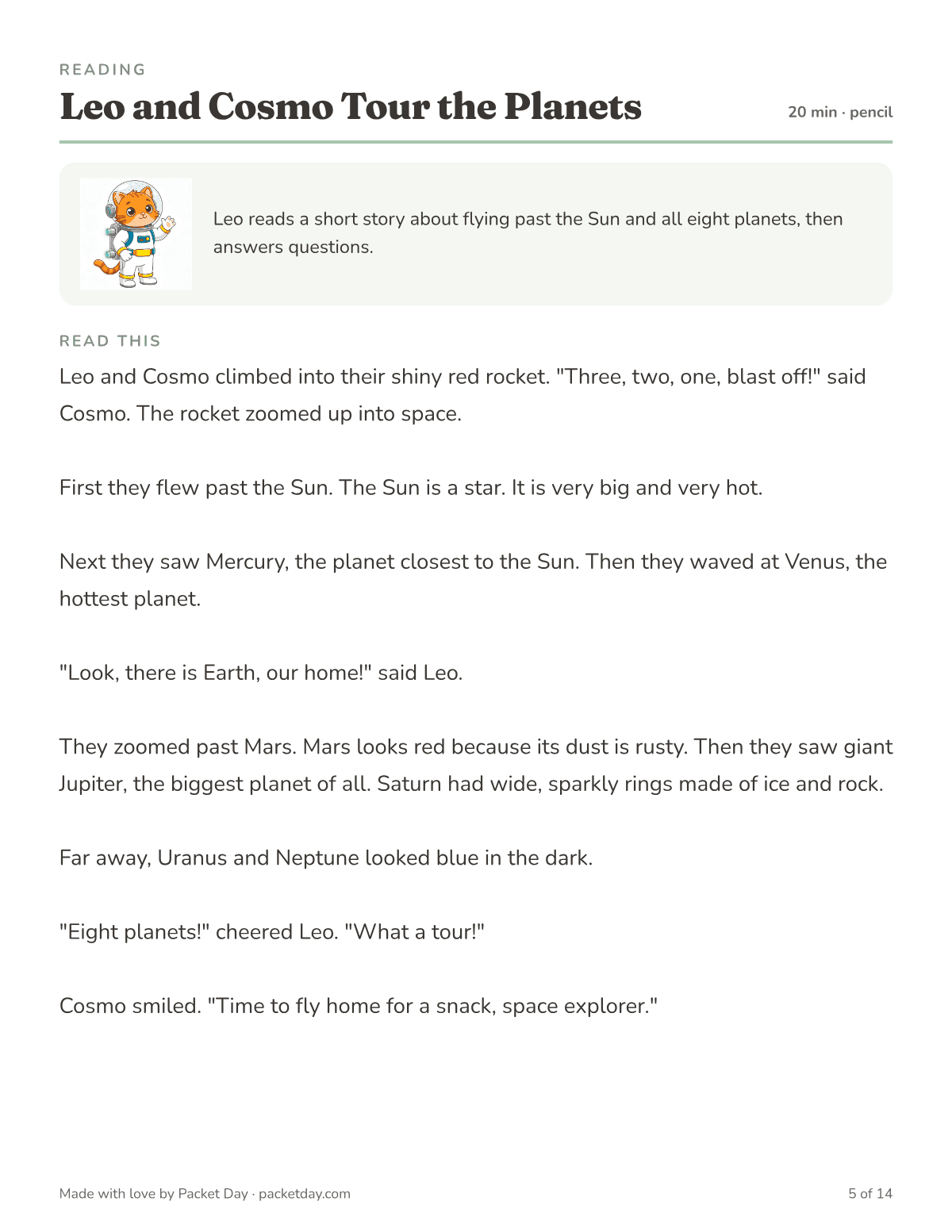
Leo and Cosmo Tour the Planets
A short story that flies past the Sun and all eight planets, then five questions, including what the word rusty means.
Writing
Packing for a Space Trip
Three to five sentences about a rocket trip: three things to pack and why, color words for the view, and a drawing of the landing.
Puzzle break
Leo's Space Shape Sudoku
A four by four grid filled with circles, squares, triangles and stars instead of numbers, plus a planet joke of the day.
Movement break
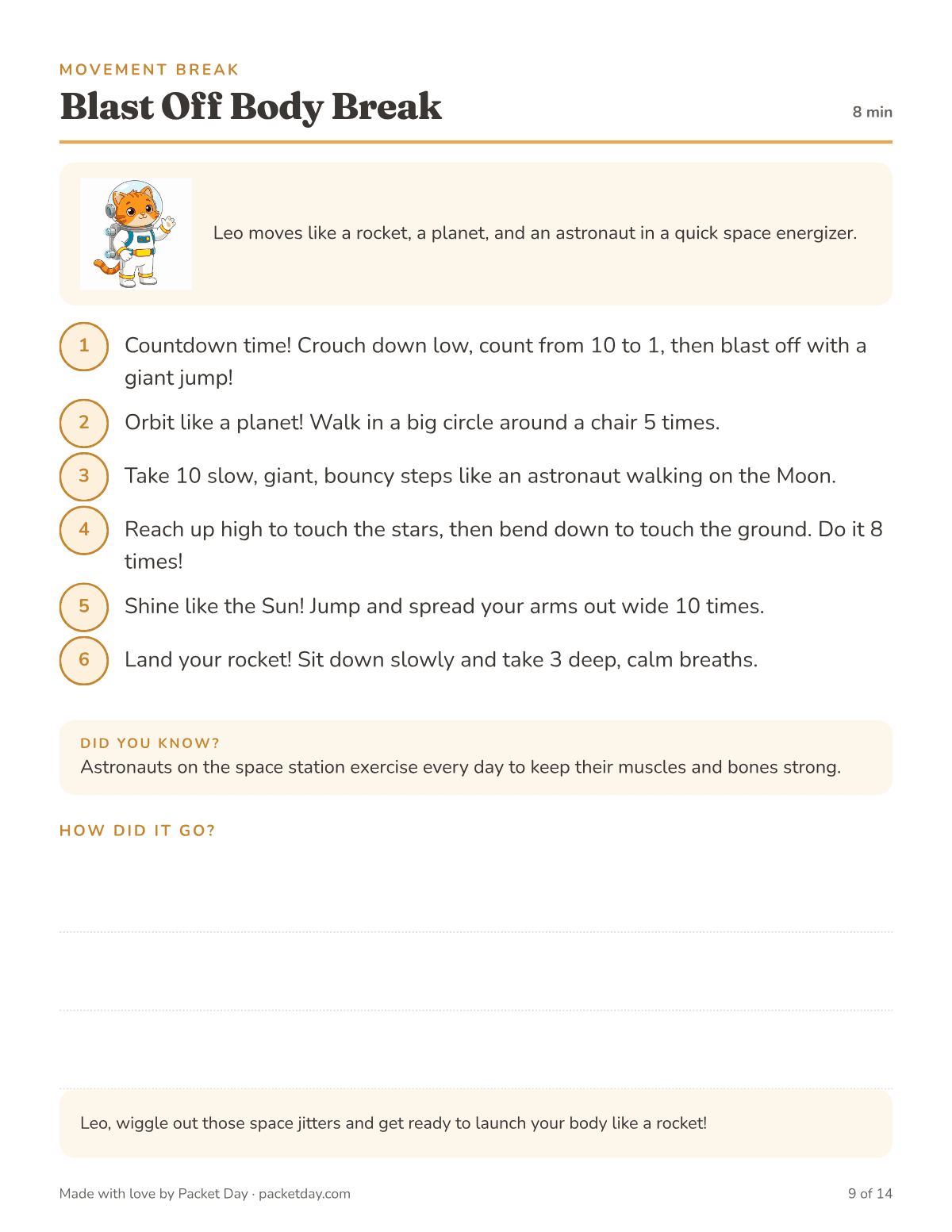
Blast Off Body Break
A countdown jump, five laps around a chair like a planet, slow Moon steps, star reaches and a calm rocket landing.
Science
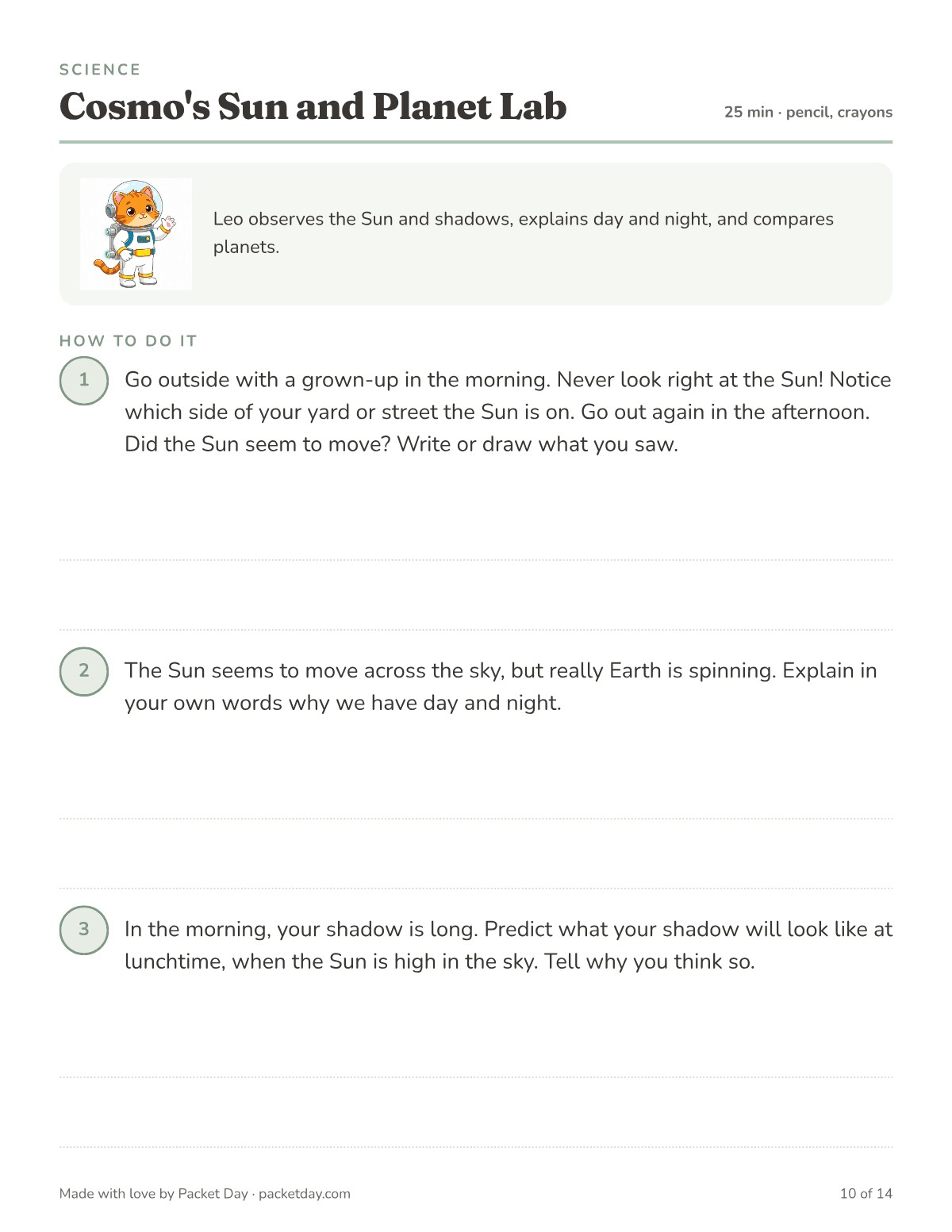
Cosmo's Sun and Planet Lab
Noticing where the Sun is in the morning and afternoon, explaining day and night, predicting shadows, and comparing Earth with Mars.
Meet Cosmo
Cosmo is an orange tabby in a white space suit and a round bubble helmet, and he is the pilot of the day. He opens the packet with a mission: tour the whole solar system, from the hot, bright Sun out to faraway Neptune.
He flies the red rocket in the reading story, packs the space snacks in the math problems and waves from the coloring page right next to Leo. The movement break even ends with Cosmo asking Leo to land the rocket and take three calm breaths.
For a second grader, a cat in a helmet does a lot of heavy lifting. Planets are big, abstract ideas. Cosmo makes them a trip you take with a friend.
What will my child learn?
Your child gets a full grade 2 day built around the solar system: adding and subtracting two digit numbers, a first look at multiplication as equal groups, reading a short story for details, writing a few connected sentences and some real observation outside.
The story names all eight planets in order and gives each one a simple fact a second grader can hold onto: Mercury is closest to the Sun, Jupiter is the biggest, Saturn's rings are ice and rock. Jupiter is so big that about 1,000 Earths could fit inside it.
In science, Leo learns that the Sun only seems to move across the sky because Earth is spinning. That one idea explains day and night, and the shadow question lets him test it at lunchtime.
Which grades is this for?
Grades K-2
This sample is grade 2, so we can be specific. The story is short, with one or two simple sentences per planet. Math stays within 100, with 3 x 5 drawn as rockets and windows. Writing asks for three to five sentences and a picture.
Grades 3-5
Older elementary kids get the same space theme with longer reading, harder vocabulary, math at their grade and more writing. Every packet is written fresh for your kid's exact grade.
Grades 6-8
Middle schoolers get planets and rockets too, with longer passages, tougher words, grade level math and longer written answers. Each packet is made new for the grade you choose.
A note from Natalie
Oli and Viv are blown away by how big space is, and honestly, so am I. It's hard to picture the size of our galaxy, let alone the whole universe.
Some of our favorite nights are spent with our little telescope, looking at craters on the Moon. And since they were babies, we've told them they're made of stardust. Ask them today what people are made of, and they'll tell you: stardust.
If the planets are brand new at your house, this is a gentle first lap around the solar system. It is short on reading, long on doing, and the yard counts as a classroom.
Questions parents ask about outer space packets
Is this space packet too hard for a second grader?
No, it is pitched right at grade 2. The math stays within 100, with two problems that introduce multiplication as equal groups. The reading story is short and names each planet with one simple fact. Writing asks for three to five sentences. If your kid is a younger second grader, you can read the story aloud together.
Is it safe to send my kid outside to look at the Sun?
Yes, because the packet never asks them to look at it. The science page says never look right at the Sun, and it asks a grown up to go outside too. Leo only notices which side of the yard or street the Sun is on, morning and afternoon, and watches how his shadow changes.
Why does the science page say the Sun only seems to move?
Because Earth is the one spinning. As it turns, the side facing the Sun has day and the side facing away has night, so the Sun looks like it crosses the sky. The packet asks Leo to explain that in his own words, then predict that his shadow will be shorter at lunchtime, when the Sun is high.
How is this different from the space packet on your sample page?
It is a separate packet with a different guide, a different kid and a younger grade. Our sample page lets you see a space packet at three grade levels, grade 1, grade 4 and grade 7, so you can compare. This one is the grade 2 tour, with Cosmo flying past every planet in one day.
What do I need besides paper and a pencil?
Not much. Crayons help with the writing picture and the coloring page. The movement break uses a chair to orbit around and a little open floor. The science page needs two short trips outside, one in the morning and one in the afternoon. That is the whole supply list, and most of it is already in your house.
Are these made by AI, and are they any good?
Yes, AI writes each packet fresh from your kid's grade and the theme you type. We test them on our own kids and check the facts on every sample we show. They are good and not perfect, so skim the reading before you hand it over. The answer key makes checking quick.
More unit study packets
Packets for the days you need one
Ready for your own outer space day?
Packet Day makes print ready, themed learning packets for kids in K to 8, built around whatever your kid is obsessed with.
Make your own outer space packet freeFree is 1 packet a month, no card needed. Unlimited is $9 a month billed annually ($108 a year) or $12 month to month.