
2nd Grade Homeschool Guide
Second grade is where reading gets smooth and math gets bigger. Kids add and subtract within 100, read numbers into the hundreds, count coins and tell time. Here's what that usually looks like, and how to teach it at your kitchen table.
Ages: usually 7 to 8. Age cutoffs vary by state.
Homeschool mom of two and co-founder of Packet Day
✓ Last verified against official learning standards
The short answer ⚡
Most second graders work on reading smoothly out loud, adding and subtracting within 100, knowing their addition facts by heart, place value up to 1,000, counting money and telling time to the nearest five minutes. That list comes from the learning standards many states use for public schools. Your state's homeschool law may not ask you to follow it, so treat it as a helpful map, not a rulebook.
The year at a glance 👀
What 2nd graders typically learn 📚
Here's what the standards ask for by the end of 2nd grade, in plain English. Kids get there at different speeds, and that's normal.
Math
Bigger numbers, facts from memory, and math with real coins and clocks.
- Adding and subtracting fluently within 100, using strategies based on place value.
- Knowing all the sums of two one digit numbers from memory by the end of the year.
- Solving one and two step word problems within 100.
- Place value to 1,000: seeing that 706 is 7 hundreds, 0 tens and 6 ones, and reading and writing numbers to 1,000 in numerals, words and expanded form.
- Adding and subtracting within 1,000 with models and drawings.
- Money: word problems with dollar bills, quarters, dimes, nickels and pennies.
- Telling time on analog and digital clocks to the nearest five minutes, with a.m. and p.m.
- Equal groups: telling odd from even, and finding the total in arrays with up to 5 rows and 5 columns by repeated addition.
At the kitchen table: Empty a coin jar and ask, "How many cents are here?" Start with dimes and pennies, then add nickels and quarters.
Reading
Reading smoothly, and thinking about what the story means.
- Using phonics and word skills to read grade level words, like telling long vowels from short ones.
- Reading grade level text out loud with accuracy, a good pace and expression, and getting smoother on a second or third read.
- Asking and answering who, what, where, when, why and how about the key details in a story.
- Retelling stories, including fables and folktales, and finding the central message, lesson or moral.
- Describing how characters respond to big events and challenges.
At the kitchen table: Read the same short page twice. Ask, "Which time sounded smoother?" They'll hear the difference.
Writing
Short pieces with a beginning, middle and end.
- Opinion pieces that state an opinion, give reasons, use linking words like because and also, and end with a closing line.
- Informative pieces that introduce a topic, use facts and definitions, and end with a closing line.
- Stories that tell a short series of events, with details about actions, thoughts and feelings, and words like first and then.
- Shared research and writing projects, like reading a few books on one topic and writing a report, or recording science observations.
At the kitchen table: Ask for an opinion with reasons: "What's the best pet, and why? Use the word because." Write down what they say, then let them copy it.
Science
Looking closely, testing and comparing.
- Testing different materials and using the results to decide which one works best for a job.
- Comparing the plants and animals that live in different habitats.
- Making a model of the shapes and kinds of land and bodies of water in an area.
- Finding where water is on Earth, and seeing that it can be solid or liquid.
- Comparing ways to slow down wind or water changing the shape of the land.
At the kitchen table: Test three materials as an umbrella for a toy: foil, cloth and paper. Spray a little water and see which keeps it dry.
Building reading fluency 🎵
Fluency means reading smoothly, with a good pace and some expression. The standards ask second graders to read grade level text out loud with accuracy, a comfortable speed and expression, and to get better on successive readings. So rereading is the real trick.
Here's an easy way to practice, in just a few minutes a day.
- Pick a short page they can mostly read.
- Read it out loud once, slowly.
- Read it again with expression, like a character in the story.
- Read it a third time and notice how much smoother it sounds.
If words still feel hard, go back to short books and enjoy them together. Reading aloud to them counts, too.
Money and time at home 🪙
Money and time are 2nd grade math that happens all day. The standards ask kids to solve word problems with dollar bills and coins, and to tell time to the nearest five minutes, with a.m. and p.m.
- Count coins at the kitchen table. Start with dimes and pennies, then add nickels and quarters.
- Play store. Put a price on a few toys and let them work out what they need to pay.
- Ask, "What time is it?" on an analog clock a few times a day, to the nearest five minutes.
- Talk about a.m. and p.m. when you plan the day: breakfast is a.m., dinner is p.m.
How 2nd grade fits in 🧩
Every year builds on the one before it. Here's what kids usually bring in, and what the next year picks up.
What they bring from 1st grade
- Adding and subtracting within 20.
- Sounding out words and reading short sentences and simple stories.
- Writing first sentences about something they know.
What's coming in 3rd grade
- Times tables, and multiplying and dividing within 100.
- Fractions as numbers on a number line.
- Reading for meaning and writing paragraphs with a point.
Where this list comes from 🧭
Many states teach public school math and English from the Common Core State Standards. That's where the math, reading and writing lists above come from. The science list comes from the Next Generation Science Standards. Every list links to the official standards in our sources at the bottom of this page.
Some states set their own standards instead, like Texas, Florida and Virginia. Not every state uses the science standards either. If you live in one of those states, its own standards are the better map, and the details and order may differ from what's here.
Homeschool rules are a separate thing. In Texas, for example, TEA points parents who are interested to its standards, the TEKS, as a resource. Check your state's guide for what applies where you live.
Easy 2nd grade activities for home 🏡
No prep, no printer needed. Each one fits in a spare half hour.
Addition facts on the go. Roll two dice and ask for the sum before the dice stop rolling. Keep a tally of the ones they know without counting.
Number of the day. Pick a three digit number, like 346. Have them write it as 3 hundreds, 4 tens and 6 ones, and then spell it out in words.
Coin store. Put prices in cents on a few toys. Let them pay with real coins and count the total out loud.
Read it twice. Read one short page two times in a row. Ask which time sounded smoother, and why.
Habitat hunt. Look under a log or a flowerpot. Draw what lives there, then compare it with a sunny spot on the lawn.
A real 2nd grade sample packet 🚀
Here are six pages from a real sample packet, made for a second grader we call Leo. Cosmo the astronaut cat leads Leo on a tour of the solar system, and every page is matched to grade level.
This sample has 14 pages, 6 activities and about 108 minutes of work, plus an answer key for you. The math page includes a first look at equal groups, like 3 rockets with 5 windows each. Most activities end with a quick How did it go? check. Every packet is made new for your child, so yours will look different.
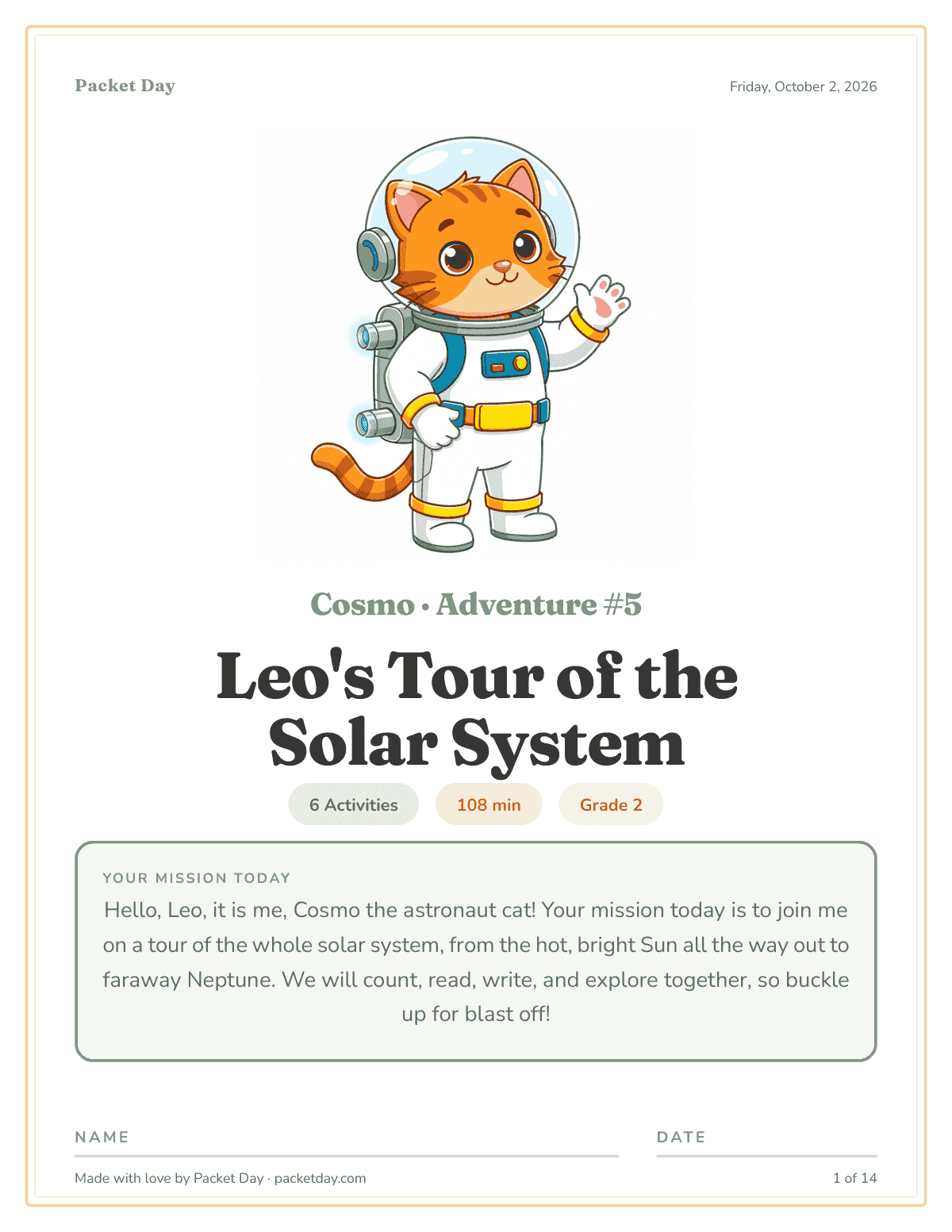
Cosmo the astronaut cat welcomes Leo aboard. 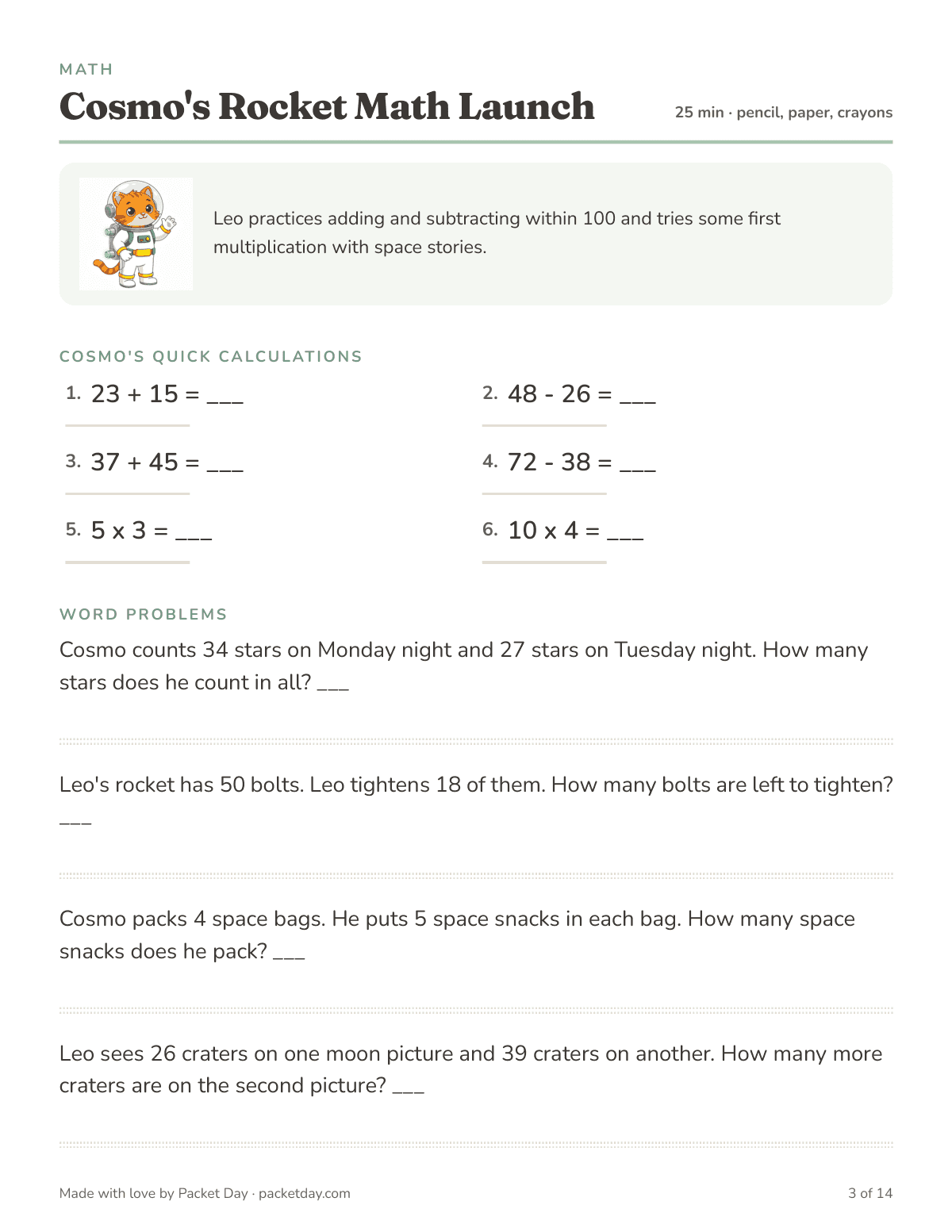
Adding and subtracting within 100, plus a first look at equal groups. 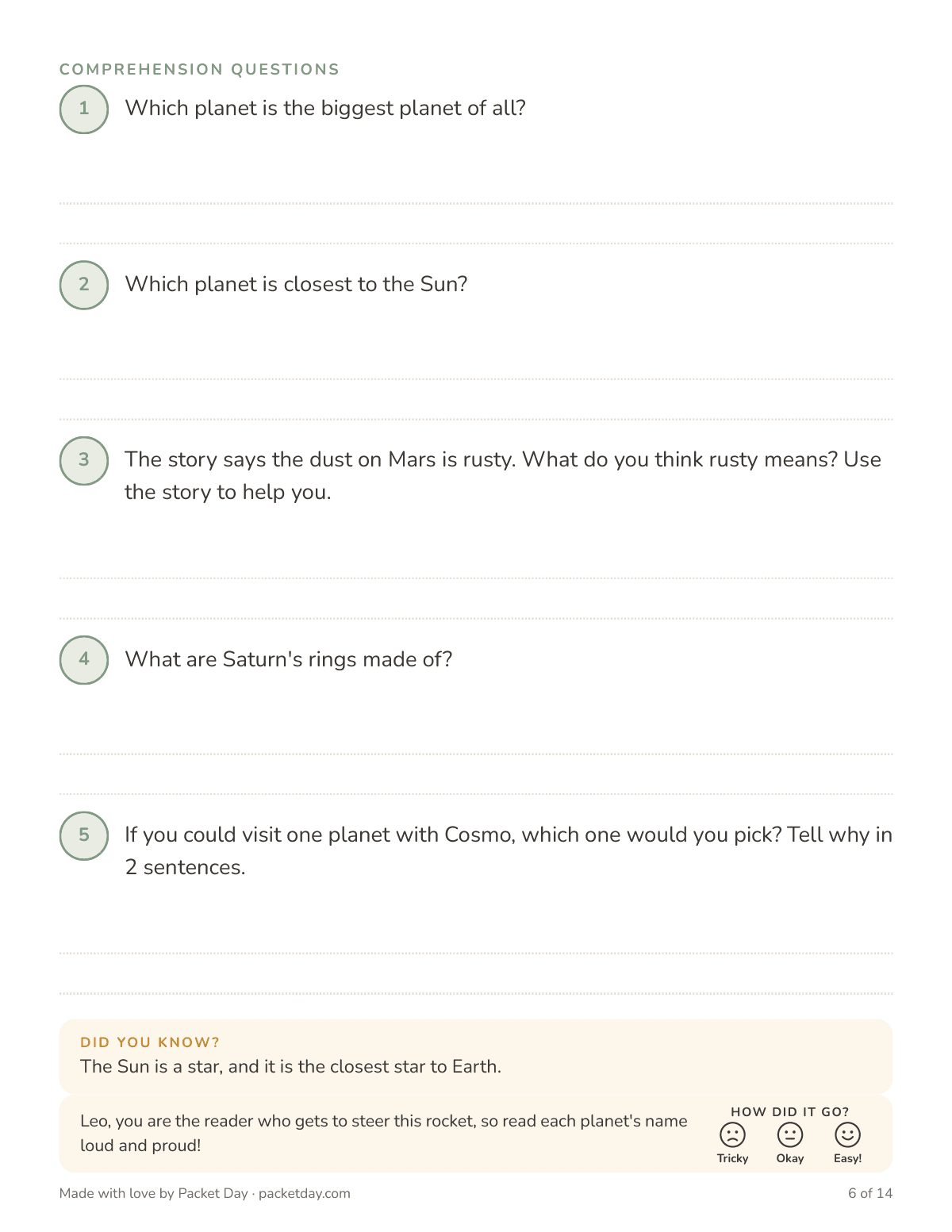
Questions about the story, and faces to circle at the end. 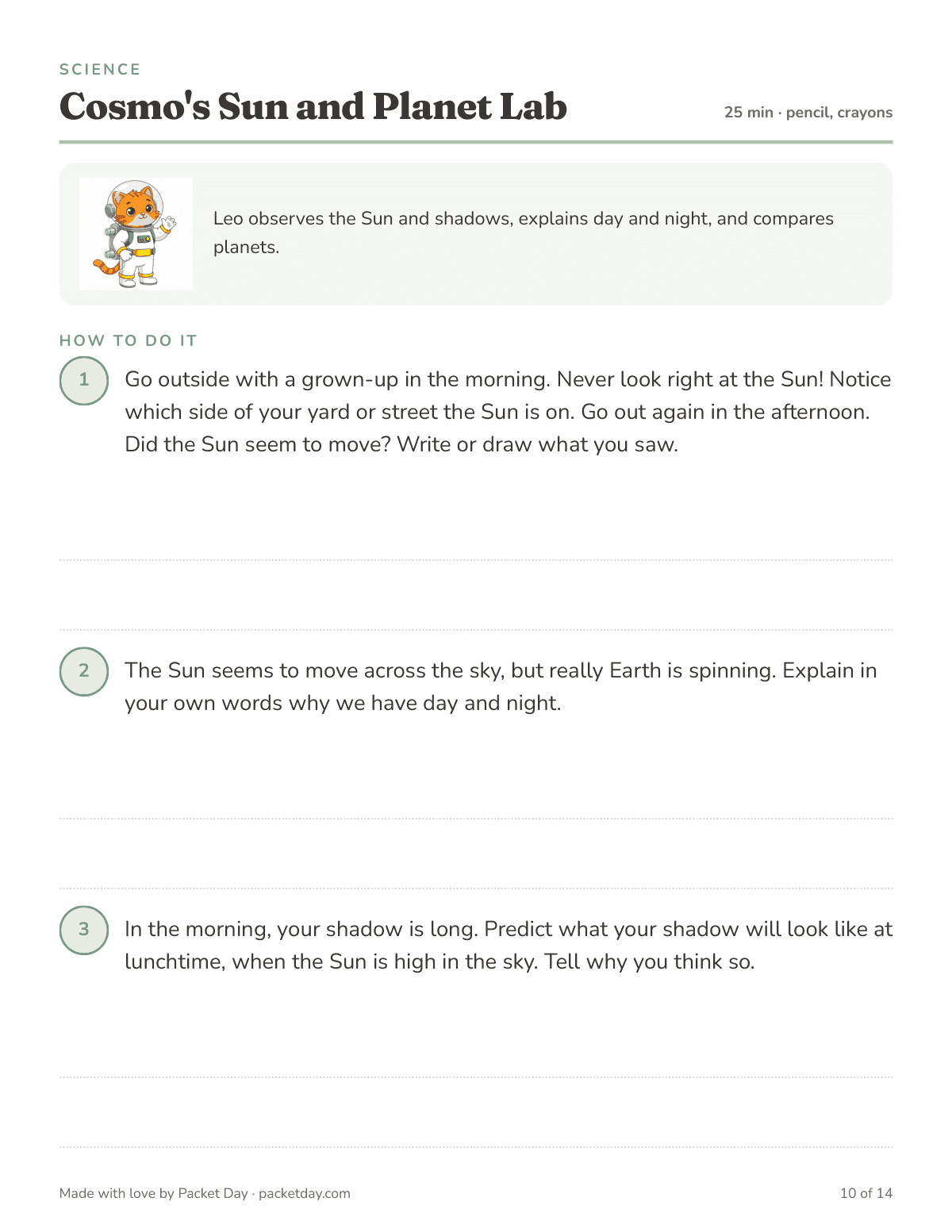
Watching the Sun and shadows outside, with a grown up. 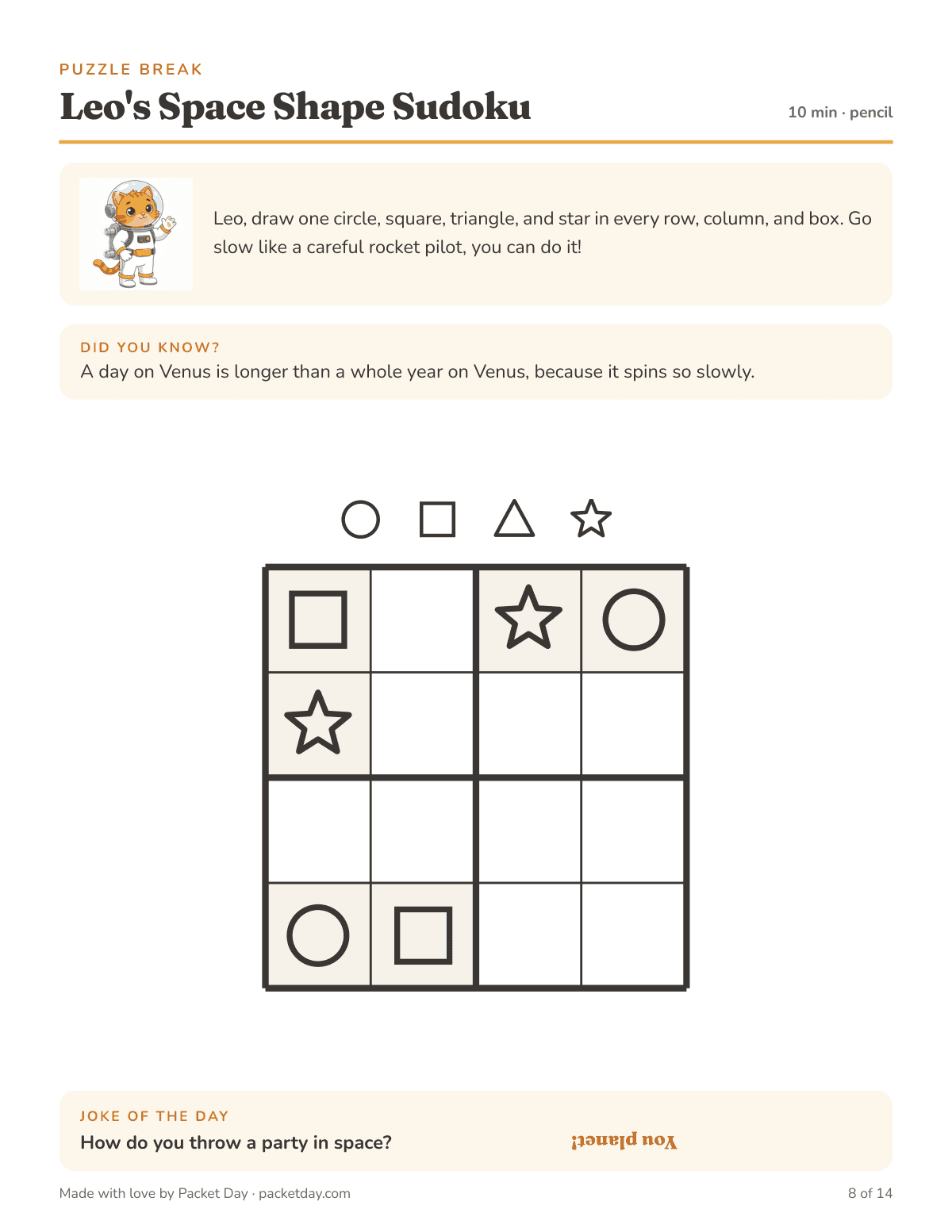
A shape sudoku, so new readers can do it too. 
Every packet ends with a certificate to sign and keep.
Does my state test in 2nd grade? 🏛️
Learning standards are written for public schools. Your state's homeschool law is a separate thing, and it varies a lot. Second grade usually comes before the grades states pick for testing.
Some states ask for a yearly check no matter the grade. North Carolina asks for a nationally standardized test every year. Virginia wants evidence of progress each year, either a test score or an evaluation, and Washington asks for a yearly test or assessment that you keep in your records. New York asks for an annual assessment, and in grades 1 to 3 a written narrative can stand in any year. Minnesota asks for a nationally norm referenced achievement test every year, starting at age 7.
Other states pick certain grades, and 2nd isn't one of them. Pennsylvania asks for tests in grades 3, 5 and 8, Tennessee tests in grades 5, 7 and 9, and Colorado tests in grades 3, 5, 7, 9 and 11. Georgia asks for a test every three years, starting at the end of grade 3. Arizona, California, Illinois and Ohio don't require one.
Your state's guide spells out what applies to you.
2nd grade homeschool FAQ 💬
Should my 2nd grader know their addition facts by heart?
That's the goal. The Common Core standards say that by the end of 2nd grade, kids should know from memory all the sums of two one digit numbers. Early in the year, many still count on their fingers, and that's normal. A few minutes of dice or card games a day beats a long drill.
My 2nd grader reads slowly. Is that normal?
Very often, yes. Kids get smoother at different speeds. The standards ask for accuracy, a good pace and expression, and for kids to improve on a second or third read, so rereading a short page is one of the best things you can do. If sounding out words is still the hard part, our 1st grade guide covers phonics.
Does my 2nd grader need to learn multiplication yet?
Not yet. In the standards, 2nd grade only lays the groundwork: working with equal groups, like arrays with up to 5 rows and 5 columns, and writing the total as repeated addition. Times tables start in 3rd grade.
How many hours a day should I homeschool 2nd grade?
Less than a school day. Home doesn't have lining up, waiting or a crowded classroom. Our guide to how many hours a homeschool day takes breaks it down by grade.
What does a 2nd grade homeschool day look like?
One simple rhythm: reading and math in the morning while brains are fresh, then writing, science or a project after a break. The sample packet above is one full day: math, reading, writing, a puzzle break, a movement break and science.
Do I have to follow Common Core to homeschool?
Only if your state's homeschool law asks for it. Learning standards are written for public schools, and homeschool laws are separate. Many states use Common Core in their public schools, and some, like Texas, Florida and Virginia, set their own standards. Check your state's guide to see what your state asks you to teach.
Want a 2nd grade day you don't have to plan? 🌿
Packet Day makes a printable day of learning around your child's grade and interests, for the days you need a backup plan. 11 to 17 pages, generated around your kiddo in a minute or two.
Sources 📖
- Common Core State Standards: Grade 2 Math introduction (checked )
- Common Core: Grade 2 Operations and Algebraic Thinking (checked )
- Common Core: Grade 2 Number and Operations in Base Ten (checked )
- Common Core: Grade 2 Measurement and Data (checked )
- Common Core: Grade 2 Reading, Foundational Skills (checked )
- Common Core: Grade 2 Reading, Literature (checked )
- Common Core: Grade 2 Writing (checked )
- NGSS: Grade 2 Structure and Properties of Matter (checked )
- NGSS: Grade 2 Interdependent Relationships in Ecosystems (checked )
- NGSS: 2-ESS2 Earth's Systems (checked )
- Common Core: Grade 1 Operations and Algebraic Thinking (checked )
- Common Core: Grade 3 Operations and Algebraic Thinking (checked )
- Texas Education Agency: Texas Essential Knowledge and Skills (TEKS) (checked )
- Florida Administrative Code: Rule 6A-1.09401, Student Performance Standards (B.E.S.T.) (checked )
- Code of Virginia: § 22.1-253.13:1, Standards of Learning (checked )
- Texas Education Agency: Home Schooling (checked )
Last verified October 2026. Standards are summarized from the sources above. Social studies isn't sourced because it varies so much by state.
This page summarizes public learning standards for general reference. Your state's homeschool law is what applies to your family, so check your state's guide or department of education before making decisions.
Keep exploring 🧭
Nearby grades and a unit study to try
- 1st Grade Homeschool GuideWhat first graders typically learn in reading, math, writing and science, with easy activities for home, a real grade 1 sample packet and official sources.
- 3rd Grade Homeschool GuideWhat third graders typically learn in math, reading, writing and science, with easy activities for home, a real grade 3 sample packet and official sources.
 Outer Space unit studyA printable outer space unit study: the Sun, all eight planets, day and night and rocket math, shown here as a grade 2 sample. Free to start.
From the Packet Day blog
- How Many Hours of Homeschool a Day? Real Answers by GradeHow many hours of homeschool per day? Real answers by grade (K to 2, 3 to 5, and 6 to 8), plus why home learning needs fewer hours than school.
- What Should a 3rd Grader Know? (Without the Panic)Worried about what your 3rd grader should know? The real list (math, reading, and writing milestones), minus the panic and the jargon.
Homeschooling in a new state, or just starting out? Our homeschool requirements by state cover what to file and what to keep.
🗺️ Social studies
This one varies a lot from state to state.