
1st Grade Homeschool Guide
First grade is the year reading takes off. Sounds turn into words, words turn into sentences, and kids start to feel like readers. Math moves from counting to adding and subtracting within 20. Here's what that usually looks like, and how to teach it at your kitchen table.
Ages: usually 6 to 7. Age cutoffs vary by state.
Homeschool mom of two and co-founder of Packet Day
✓ Last verified against official learning standards
The short answer ⚡
Most first graders work on phonics and reading simple books smoothly, adding and subtracting within 20, counting to 120, telling time to the hour and half hour, and writing a few sentences in order. That list comes from the learning standards many states use for public schools. Your state's homeschool law may not ask you to follow it, so treat it as a helpful map, not a rulebook.
The year at a glance 👀
What 1st graders typically learn 📚
Here's what the standards ask for by the end of 1st grade, in plain English. Kids get there at different speeds, and that's normal.
Reading
The year sounds turn into real reading.
- Knowing the sounds that letter pairs make, like sh, ch and th.
- Sounding out regularly spelled one syllable words.
- Using a silent e and vowel teams to read long vowel sounds, as in make and rain.
- Reading tricky words that don't follow the rules, like said and was.
- Reading with enough accuracy and fluency to understand what they read.
- Asking and answering questions about key details, and retelling stories with their central message.
At the kitchen table: Let them read out loud to a stuffed animal, a sibling or the dog. A friendly listener is great practice.
Math
From counting to real number sense.
- Adding and subtracting within 20, and knowing the facts within 10 quickly.
- Strategies like counting on and making ten, so 8 + 6 becomes 8 + 2 + 4.
- Word problems within 20, solved with objects, drawings and equations.
- Counting to 120, starting at any number.
- Seeing a two digit number as tens and ones.
- Adding within 100, like 34 + 5 or 34 + 20.
- Telling time to the hour and half hour.
At the kitchen table: Roll two dice and add them. Then cover one die and ask, "What number do I need to make this total?"
Writing
A few sentences, in order, with a finish.
- Opinion pieces that name a topic, state an opinion and give a reason.
- Informative writing that names a topic and shares some facts.
- Stories that tell two or more events in order, with some details.
- Starting a sentence with a capital letter and ending it with a mark.
At the kitchen table: A sentence a day works well. "Today I..." Check for a capital letter at the start and a period at the end.
Science
Little experiments with big "why" questions.
- Sound: how vibrating things make sound, and how sound can make other things vibrate.
- The sky: the sun, moon and stars follow patterns you can predict.
- Young plants and animals: they're like their parents, but not exactly like them.
- Copying nature: using how plants and animals use their body parts to help solve a human problem.
At the kitchen table: Hold a ruler over the edge of a desk, twang it and watch it shake. Then hum with a hand on your throat.
How reading takes off 🚀
In kindergarten, kids learn that letters make sounds. In 1st grade they use those sounds to read whole words and then whole sentences. That's phonics, and it's a big job.
Reading tends to build in steps. Here's the usual order.
- Letter sounds first: single letters, then pairs like sh and ch.
- Words next: short words they can sound out, then words with a silent e or a vowel team.
- Sentences after that: short books with simple words, read out loud.
- Smooth reading last: with practice, they read faster and understand more.
If sounding out feels slow, keep sessions short and keep reading aloud to them every day so stories stay fun.
How 1st grade fits in 🧩
Every year builds on the one before it. Here's what kids usually bring in, and what the next year picks up.
What they bring from Kindergarten
- Letter sounds, rhyming and a handful of sight words.
- Counting to 100, and adding and taking away within 10.
- Drawing with a few words to tell about something.
What's coming in 2nd grade
- Adding and subtracting within 20 with mental strategies, then within 100. By the end of 2nd grade, kids are asked to know all sums of two one digit numbers from memory.
- Writing opinion pieces with reasons and linking words, like because and also.
- Reading grade level text with purpose and understanding.
Where this list comes from 🧭
Many states teach public school math and English from the Common Core State Standards. That's where the math, reading and writing lists above come from. The science list comes from the Next Generation Science Standards. Every list links to the official standards in our sources at the bottom of this page.
Some states set their own standards instead, like Texas, Florida and Virginia. Not every state uses the science standards either. If you live in one of those states, its own standards are the better map, and the details and order may differ from what's here.
Homeschool rules are a separate thing. In Texas, for example, TEA points parents who are interested to its standards, the TEKS, as a resource. Check your state's guide for what applies where you live.
Easy 1st grade activities for home 🏡
No prep, no printer needed. Each one fits in a spare half hour.
Sound out a word a day. Write one simple word on a sticky note, like ship or mat. Have them tap the sounds, blend them and say the word. Stick it on the fridge.
Dice addition. Roll two dice and add them. Whoever gets the bigger total takes a point. Then try covering one die and finding the missing number.
Make ten with cards. Take out the face cards. Flip two number cards and ask, "How many more to make ten?" Use buttons or coins to check.
Clock helper. Ask them to tell you the time at the top of each hour and at half past. Let them set a toy clock to match.
Baby animal match. Name a baby animal, like a calf or a piglet, and have them name the grown up. Then switch and see who can stump who.
A real 1st grade sample packet 🐔
Here are five pages from a real sample packet, made for a first grader we call Sam. Penny the hen leads Sam on a golden egg hunt around the farm, and every page is matched to grade level.
This sample has 14 pages, 6 activities and about 93 minutes of work, plus an answer key for you. In this sample, the math stays within 10 and the story is short, with simple questions. Every packet is made new for your child, so yours will look different.
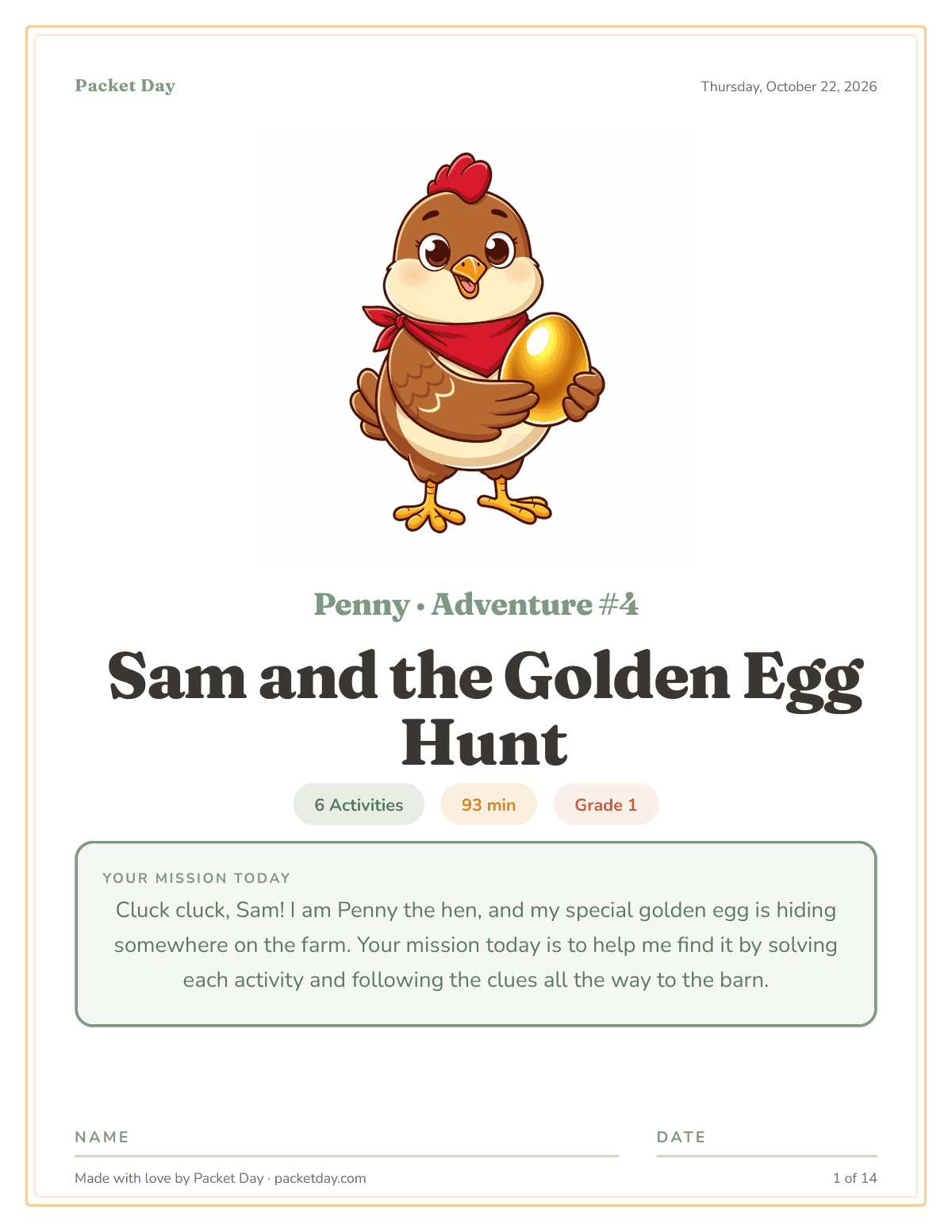
Penny the hen has hidden a golden egg, and Sam is on the case. 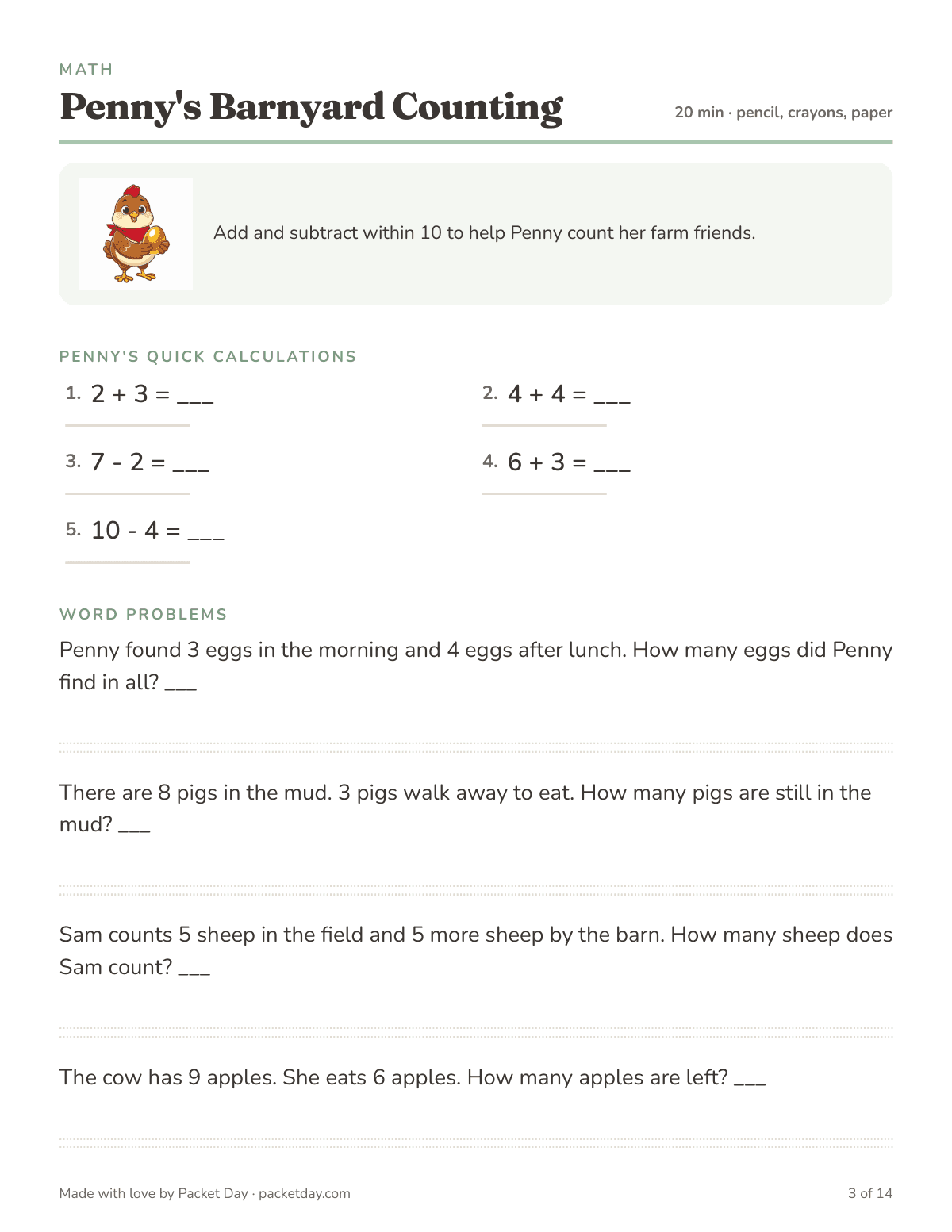
Adding and subtracting within 10, one farm animal at a time. 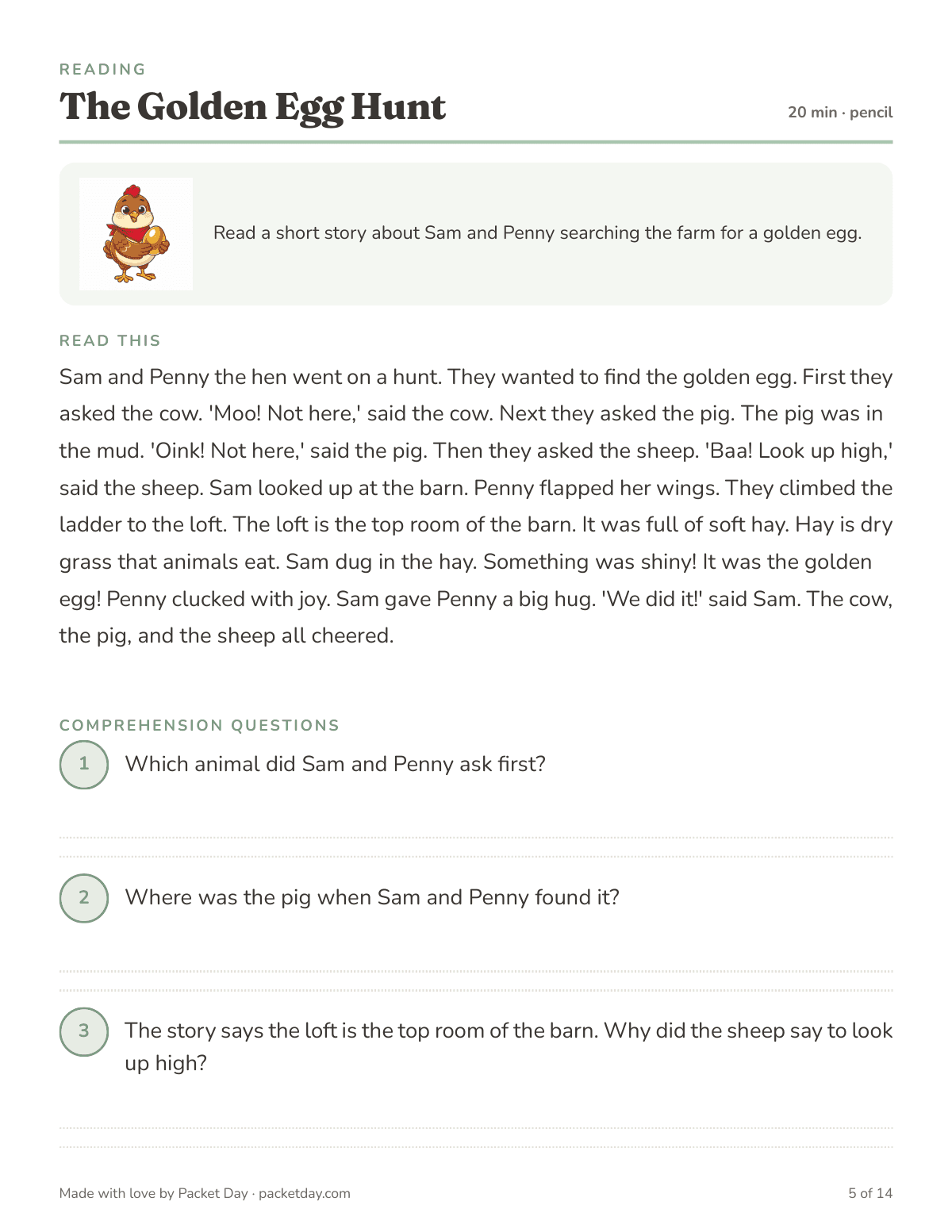
Short sentences, a few new words and a happy ending. 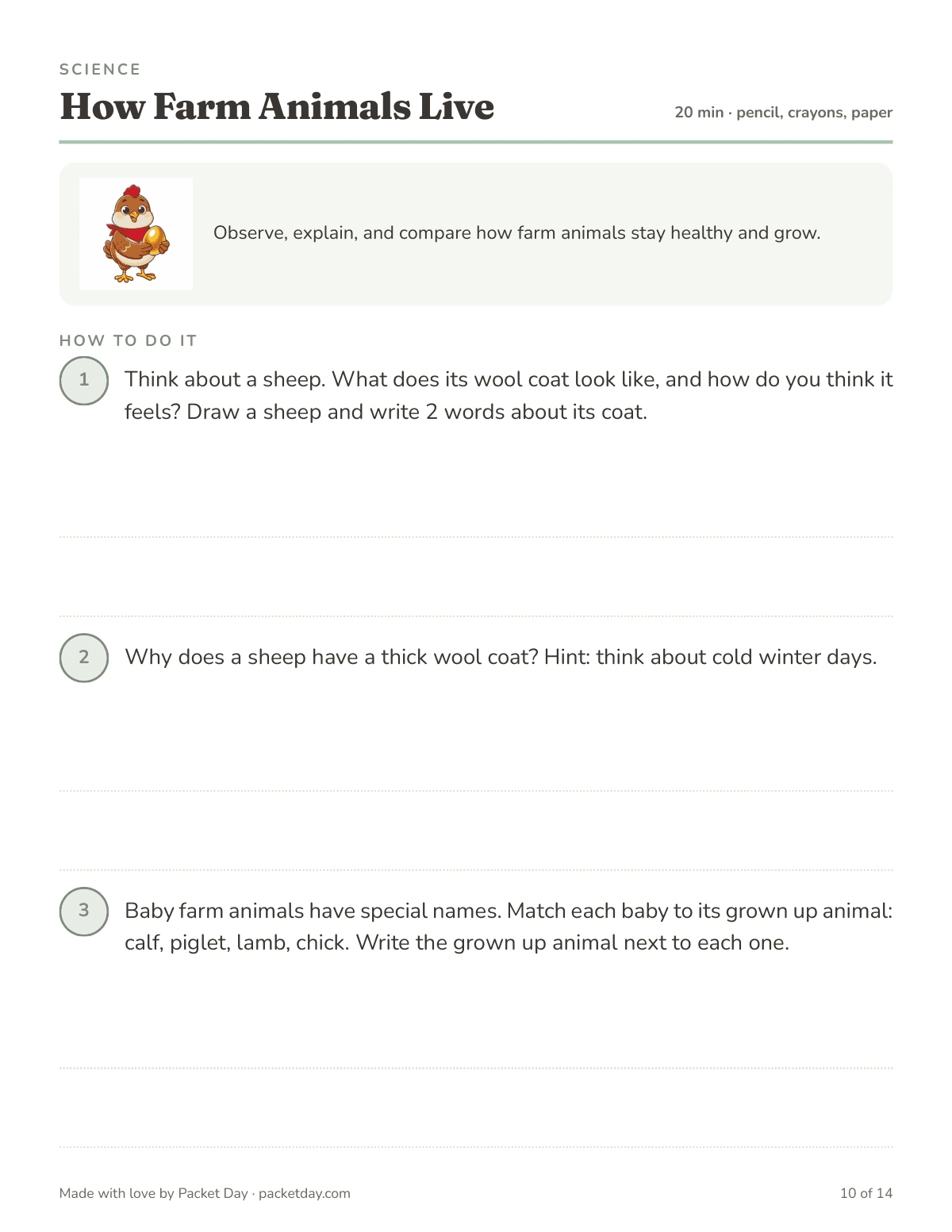
Why a sheep has a thick coat, and who the baby animals grow up to be. 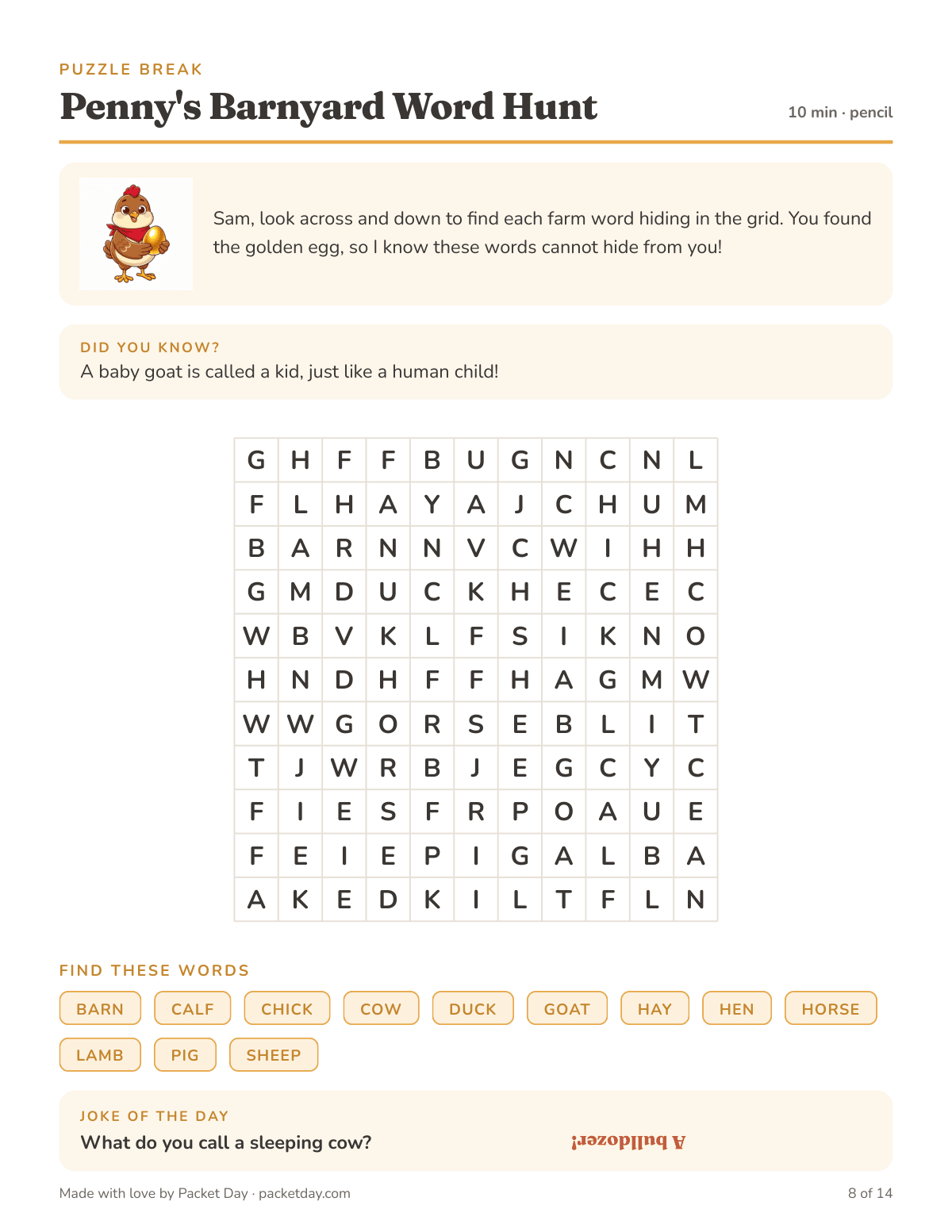
Twelve farm words, across and down only.
Does my state require this? 🏛️
Learning standards are written for public schools. Your state's homeschool law is a separate thing, and it varies a lot. Some states ask for a yearly test or check on progress, and others don't ask for one at all.
New York asks for an annual assessment, and in grades 1 to 3 you can file a written narrative any year instead of a test. Pennsylvania tests in grades 3, 5 and 8, and Georgia starts at the end of grade 3. In Illinois and Ohio, the homeschool laws don't ask for a test. Your state's guide spells out what applies to you.
1st grade homeschool FAQ 💬
My 1st grader is still sounding out every word. Is that normal?
Plenty of first graders are. Sounding out is how reading gets built, and it speeds up with practice. Keep sessions short, keep reading aloud to them, and let them read to someone friendly. If you're worried, a teacher or reading specialist can take a look.
Should my 1st grader know their addition and subtraction facts by heart?
Within 10, that's the goal. The Common Core math standards ask for adding and subtracting within 20 in 1st grade, with fluency within 10. Fluency within 20 comes in 2nd grade. Counting on is a normal strategy along the way, and that's okay.
How many hours a day should I homeschool 1st grade?
Less than a school day. Home doesn't have lining up, waiting or a crowded classroom. Our guide to how many hours a homeschool day takes breaks it down by grade.
What does a 1st grade homeschool day look like?
One simple rhythm: reading and math in the morning while brains are fresh, then writing, science or a project after a break. The sample packet above is one full day: math, reading, writing, a puzzle break, a movement break and science.
Does my 1st grader need to write a lot?
A few sentences is plenty. The standards ask for opinion pieces, facts about a topic, and short stories with two or more events in order. A sentence a day, with a capital letter and an ending mark, gets you there.
Do I have to follow Common Core to homeschool?
Only if your state's homeschool law asks for it. Learning standards are written for public schools, and homeschool laws are separate. Many states use Common Core in their public schools, and some, like Texas, Florida and Virginia, set their own standards. Check your state's guide to see what your state asks you to teach.
Want a 1st grade day you don't have to plan? 🌿
Packet Day makes a printable day of learning around your child's grade and interests, for the days you need a backup plan. 11 to 17 pages, generated around your kiddo in a minute or two.
Sources 📖
- Common Core State Standards: Grade 1 Math introduction (checked )
- Common Core: Grade 1 Operations and Algebraic Thinking (checked )
- Common Core: Grade 1 Number and Operations in Base Ten (checked )
- Common Core: Grade 1 Measurement and Data (checked )
- Common Core: Grade 1 Reading, Foundational Skills (checked )
- Common Core: Grade 1 Reading, Literature (checked )
- Common Core: Grade 1 Writing (checked )
- Common Core: Kindergarten Counting and Cardinality (checked )
- Common Core: Kindergarten Operations and Algebraic Thinking (checked )
- Common Core: Grade 2 Operations and Algebraic Thinking (checked )
- Common Core: Grade 2 Number and Operations in Base Ten (checked )
- Common Core: Grade 2 Reading, Foundational Skills (checked )
- Common Core: Grade 2 Writing (checked )
- NGSS: Grade 1 Waves, Light and Sound (checked )
- NGSS: Grade 1 Space Systems, Patterns and Cycles (checked )
- NGSS: Grade 1 Structure, Function and Information Processing (checked )
- Texas Education Agency: Texas Essential Knowledge and Skills (TEKS) (checked )
- Florida Administrative Code: Rule 6A-1.09401, Student Performance Standards (B.E.S.T.) (checked )
- Code of Virginia: § 22.1-253.13:1, Standards of Learning (checked )
- Texas Education Agency: Home Schooling (checked )
Last verified October 2026. Standards are summarized from the sources above. Social studies isn't sourced because it varies so much by state.
This page summarizes public learning standards for general reference. Your state's homeschool law is what applies to your family, so check your state's guide or department of education before making decisions.
Keep exploring 🧭
Nearby grades and a unit study to try
- Kindergarten Homeschool GuideWhat kindergartners typically learn, how to tell if your child is ready, easy play based activities for home and a real kindergarten sample packet.
- 2nd Grade Homeschool GuideWhat second graders typically learn in math, reading, writing and science, with easy activities for home, a real grade 2 sample packet and official sources.
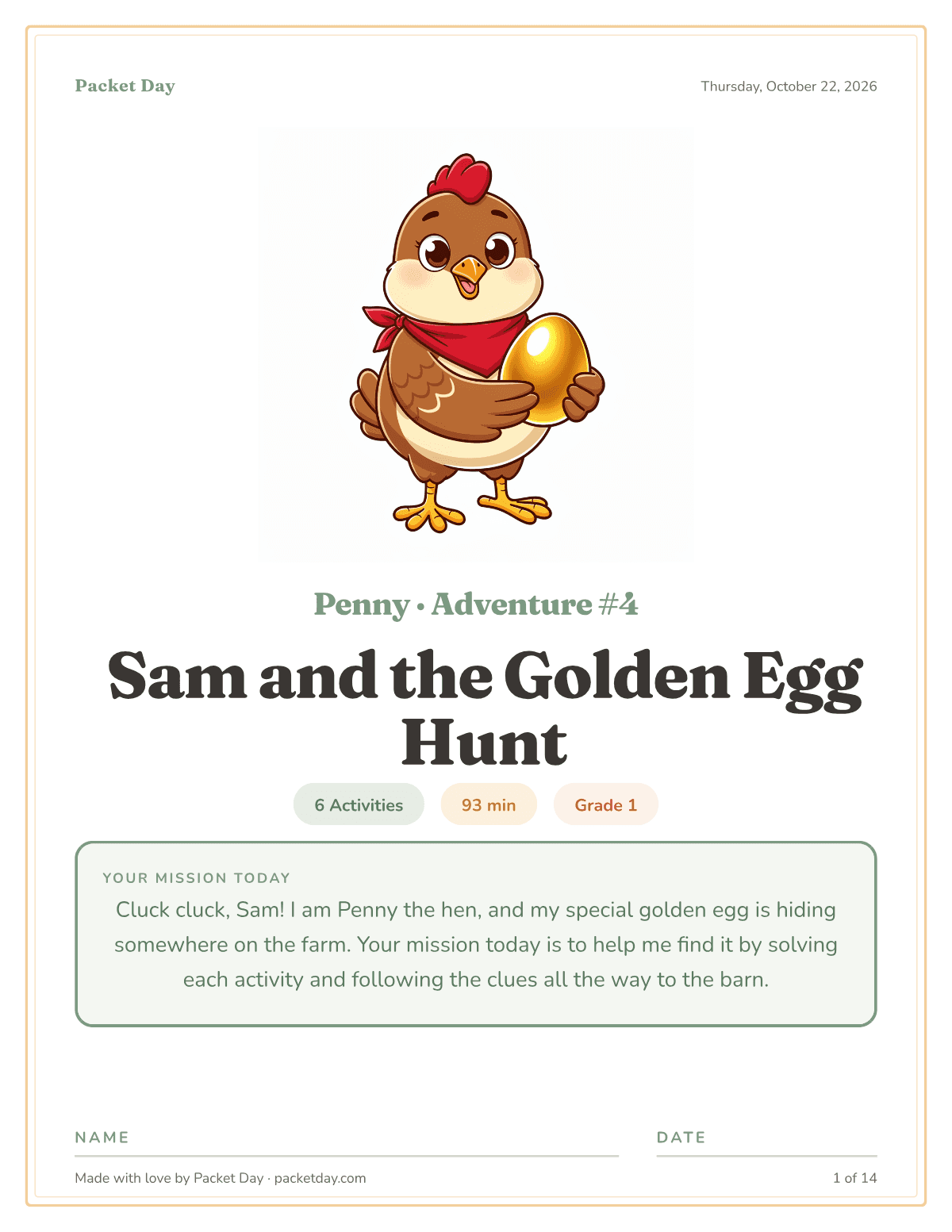 Farm Animals unit studyA printable farm animal unit study on baby animal names, wool, hay and what animals need, shown as a grade 1 sample with a golden egg hunt. Free to start.
From the Packet Day blog
- How Many Hours of Homeschool a Day? Real Answers by GradeHow many hours of homeschool per day? Real answers by grade (K to 2, 3 to 5, and 6 to 8), plus why home learning needs fewer hours than school.
- How to Keep Learning Going on a "Bad Day"Bad days happen: sick kids, rough mornings, derailed plans. Here's how to keep a thread of learning alive without forcing a full school day.
Homeschooling in a new state, or just starting out? Our homeschool requirements by state cover what to file and what to keep.
🗺️ Social studies
This one varies a lot from state to state.