
Kindergarten Homeschool Guide
Kindergarten is where learning gets to be playful. Kids match letters to sounds, count past 20 and tell stories with pictures. Here's what that usually looks like, and how to do it at your kitchen table in short, gentle days.
Ages: usually 5 to 6. Age cutoffs vary by state.
Homeschool mom of two and co-founder of Packet Day
✓ Last verified against official learning standards
The short answer ⚡
Most kindergartners work on letter sounds, counting to 100, adding and taking away small numbers, naming shapes, and telling stories with drawings and a few words. That list comes from the learning standards many states use for public schools. Your state's homeschool law may not ask you to follow it, so treat it as a helpful map, not a rulebook. Short days are normal, too.
The year at a glance 👀
What kindergartners typically learn 📚
Here's what the standards ask for by the end of kindergarten, in plain English. Kids get there at different speeds, and that's normal. Some parts, like retelling a story, are done with your help.
Letters and reading
Sounds first, then words. Stories every day.
- Following words left to right, top to bottom, and page by page.
- Hearing and playing with the sounds in spoken words: rhymes, syllables and the sounds inside a word.
- Matching letters to sounds: the main sound for each consonant, and the long and short sounds of the five vowels.
- Reading common sight words like the, of, to, you and my.
- Reading simple books made for beginners.
- Listening to stories and answering questions about the key details, with your help, and retelling familiar stories.
At the kitchen table: Read one picture book a day. Stop and ask, "What just happened?" Then let them tell it back in their own words.
Math
Counting, counting and more counting.
- Counting to 100 by ones and by tens.
- Counting forward from any number, not just from 1.
- Writing the numbers 0 to 20 and counting out that many objects.
- Pairing each object with one number name when counting.
- Adding and taking away within 10 using objects, drawings and fingers. Within 5, kids work toward knowing the answers quickly.
- Naming shapes, no matter how they're turned or how big they are.
At the kitchen table: Count snacks. Put 7 crackers on a plate, eat 2, and ask how many are left.
Writing
A picture, a few words and a big idea.
- Using drawing, dictating and writing together to share an opinion, like "My favorite book is..."
- Using drawing, dictating and writing to share information about a topic.
- Using drawing, dictating and writing to tell about an event, in order, with a reaction.
At the kitchen table: Let them draw first, then write a word or a sentence. You can write down what they say if their hands get tired.
Science
Look closely, ask questions and go outside.
- Pushes and pulls: comparing how different strengths and directions change an object's motion.
- Sunlight: noticing how it affects the ground, sand and water, like which is warmer or cooler.
- Weather: sharing observations of local weather to describe patterns over time.
- Needs and places: what different plants and animals need, and the places they live.
At the kitchen table: Put one pebble in the sun and one in the shade. After a while, touch both. Which feels warmer?
Is my child ready for kindergarten? 🌱
The learning standards list what kids work toward by the end of kindergarten. They don't say what a child must know to start. Kids begin at different places, and that's normal.
Here are a few things many parents watch for. None of them is a pass or a fail.
- They can listen to a short story, wiggles and all.
- They're curious about letters, numbers or how things work.
- They can hold a crayon or pencil and make marks, even messy ones.
- They can follow a simple two step direction, like "Get your shoes and meet me at the door."
- They can tell you about their day, even if it takes a while.
If a few of these aren't there yet, you haven't missed anything. You can go slower, start with play, or wait. Age cutoffs vary by state, so see the state ages below and check your state's guide.
Play based learning and short days 🧸
Kindergarten at home can be small. Our guide to how many hours a homeschool day takes breaks it down by grade, and the youngest grades need the least.
Short, playful sessions work well at this age. A quick round of letter sounds, a snack that doubles as counting, a drawing, then outside. Stop while it's still fun. When you're ready to look ahead, our homeschool 1st grade guide shows what comes next.
- Letter sounds in the car, on cereal boxes and on street signs.
- Counting stairs, steps, blocks and bites.
- Drawing and telling a story about the picture.
- A walk to look for one thing that's moving and one thing that's still.
How kindergarten fits in 🧩
Every year builds on the one before it. Here's what kids usually bring in, and what the next year picks up.
What they bring from Preschool
- Kids arrive with all kinds of experience. Some know every letter. Some have never held a pencil. Both are normal starting points.
- The kindergarten standards begin with letter sounds, counting and drawing with a few words. A head start is nice, not required.
What's coming in 1st grade
- Phonics grows into reading whole sentences. The 1st grade standards ask kids to decode regularly spelled one syllable words and read with enough accuracy and fluency to understand.
- Counting stretches to 120, and adding and subtracting grows to within 20.
- Writing grows from drawing with a few words to telling two or more events in order.
Where this list comes from 🧭
Many states teach public school math and English from the Common Core State Standards. That's where the math, reading and writing lists above come from. The science list comes from the Next Generation Science Standards. Every list links to the official standards in our sources at the bottom of this page.
Some states set their own standards instead, like Texas, Florida and Virginia. Not every state uses the science standards either. If you live in one of those states, its own standards are the better map, and the details and order may differ from what's here.
Homeschool rules are a separate thing. In Texas, for example, TEA points parents who are interested to its standards, the TEKS, as a resource. Check your state's guide for what applies where you live.
Easy kindergarten activities for home 🏡
No prep, no printer needed. Each one fits in a spare half hour, or in pieces.
Letter sound hunt. Pick a sound, like the one at the start of ball. Walk around the house and collect things that start with it. Say each word out loud.
Counting snacks. Count out raisins or crackers onto a plate. Add 2 more, then eat 1. How many now? They can touch each one as they count.
Shape walk. Go outside or around the house and find a circle, a square and a triangle. A stop sign, a window and a roof will all work.
Draw and tell. Ask them to draw their favorite part of the day. Then ask, "Tell me about it," and write down what they say under the picture.
Sun and shade. Set one pebble in the sun and one in the shade. Wait a while, then touch both. Talk about which is warmer and why.
A real kindergarten sample packet 🐞
Here are five pages from a real sample packet, made for a kindergartner we call Ivy. Dot the ladybug leads Ivy on a backyard bug safari, and every page is matched to grade level.
This sample has 14 pages, 6 activities and about 80 minutes of work, plus an answer key for you. In this sample, the parent note suggests reading the story aloud together. Every packet is made new for your child, so yours will look different.
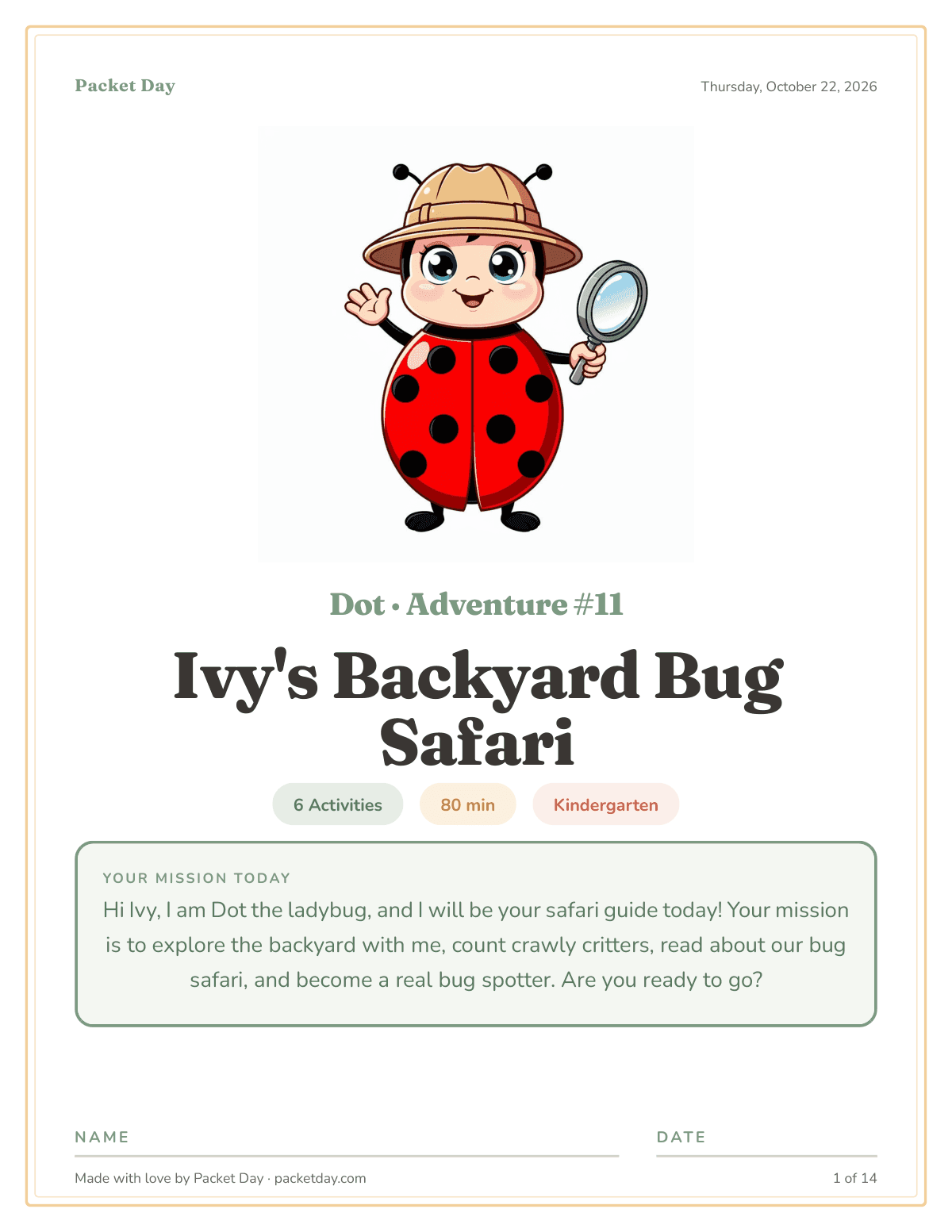
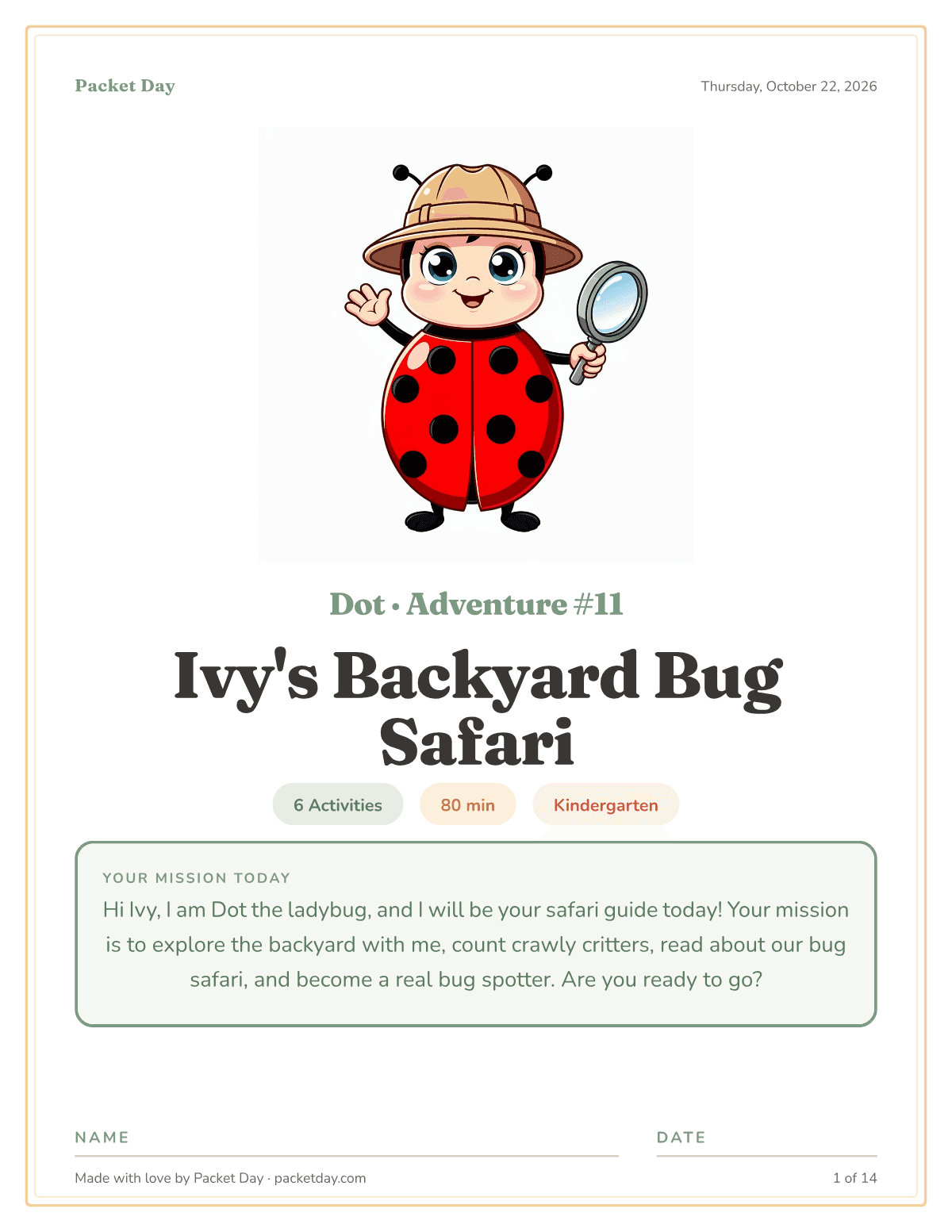
Dot the ladybug welcomes Ivy to a backyard bug safari. 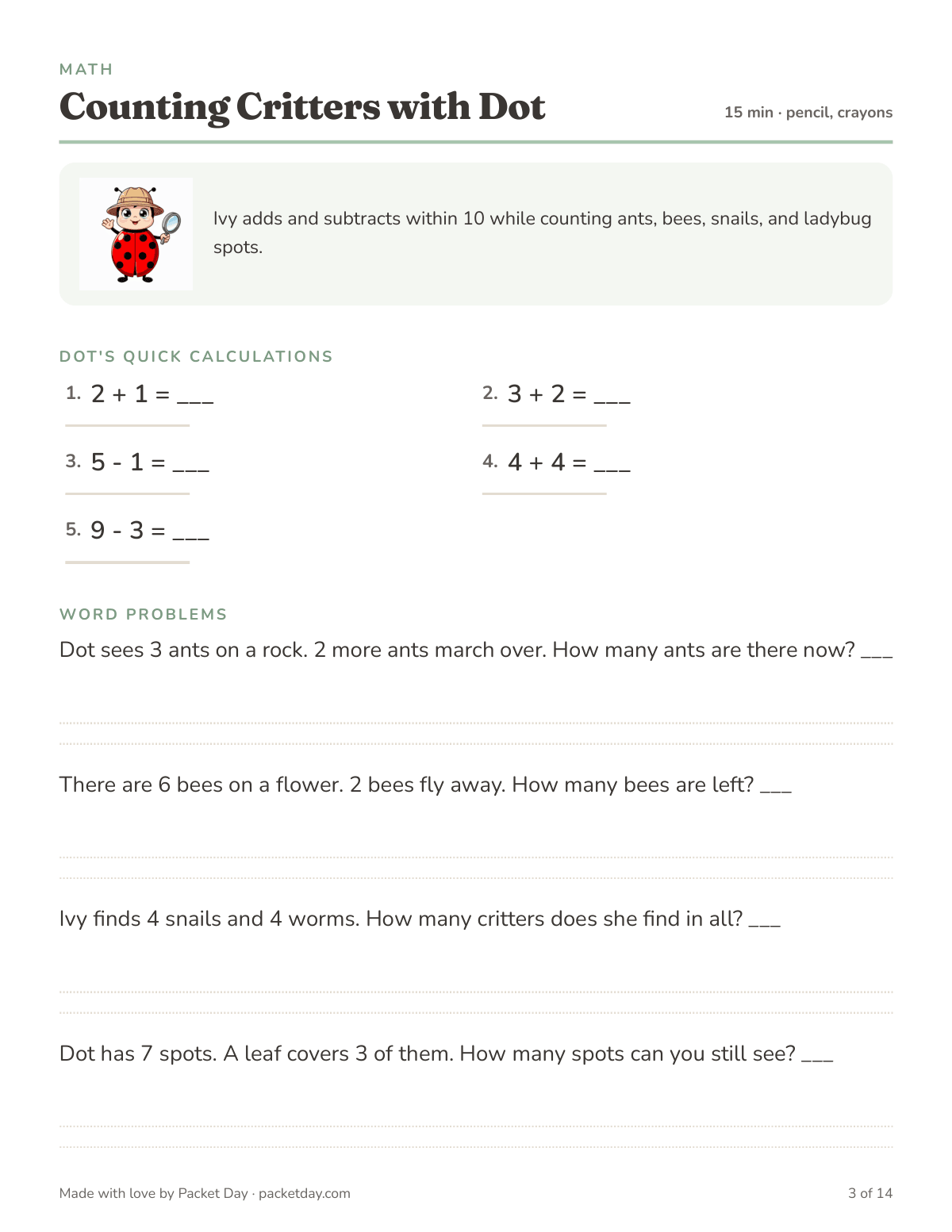
Adding and subtracting within 10, with critters to count. 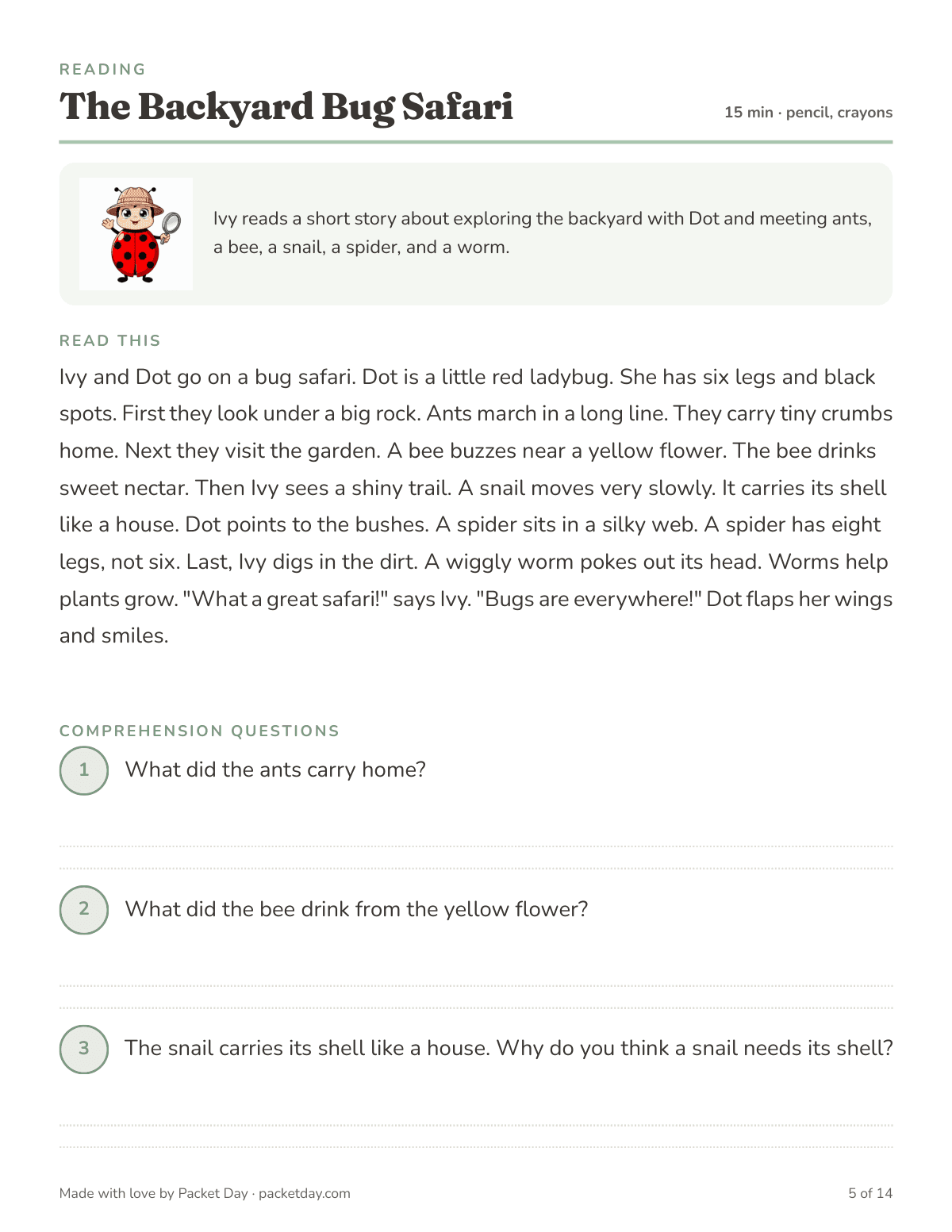
Short sentences, made to read aloud together. 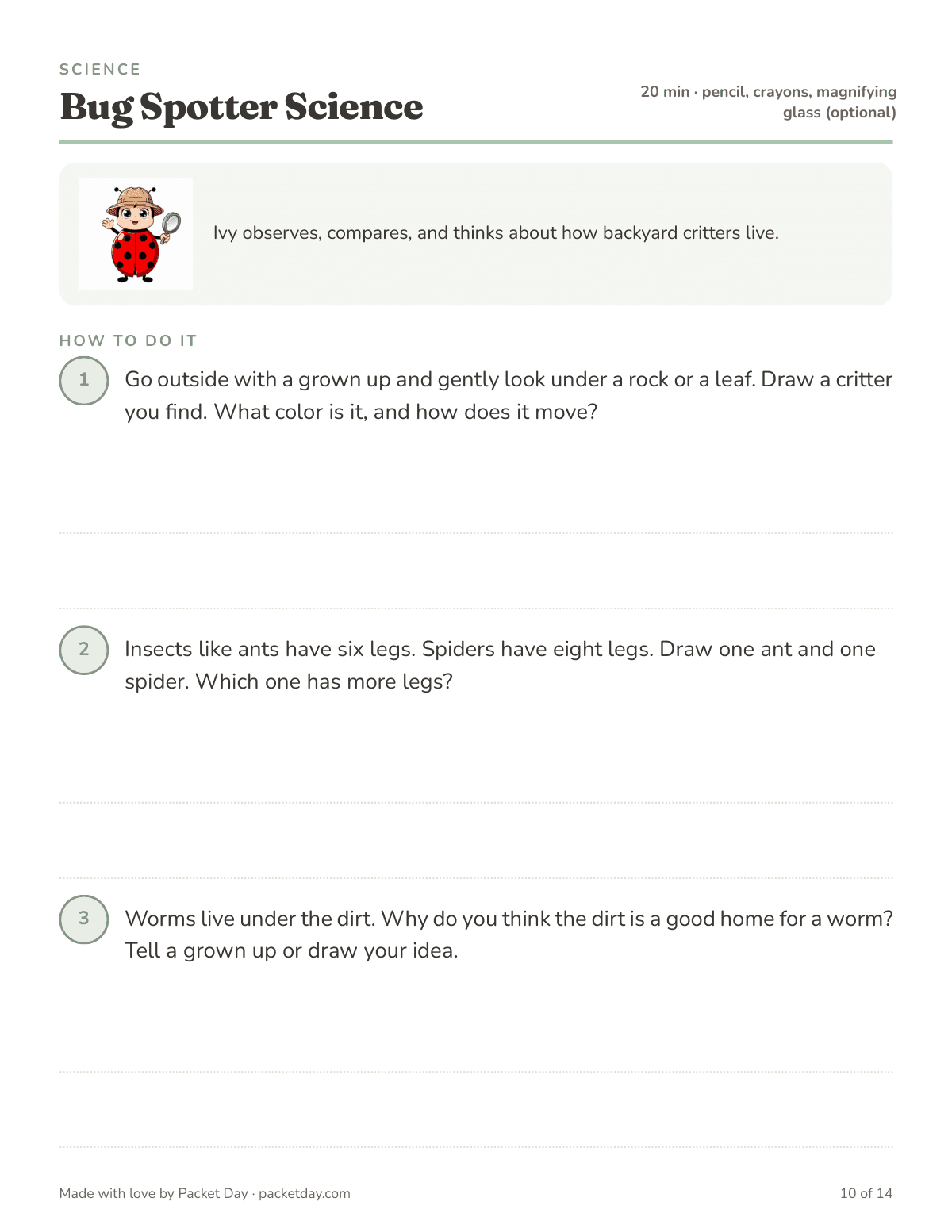
A short trip outside with a grown up and a pencil. 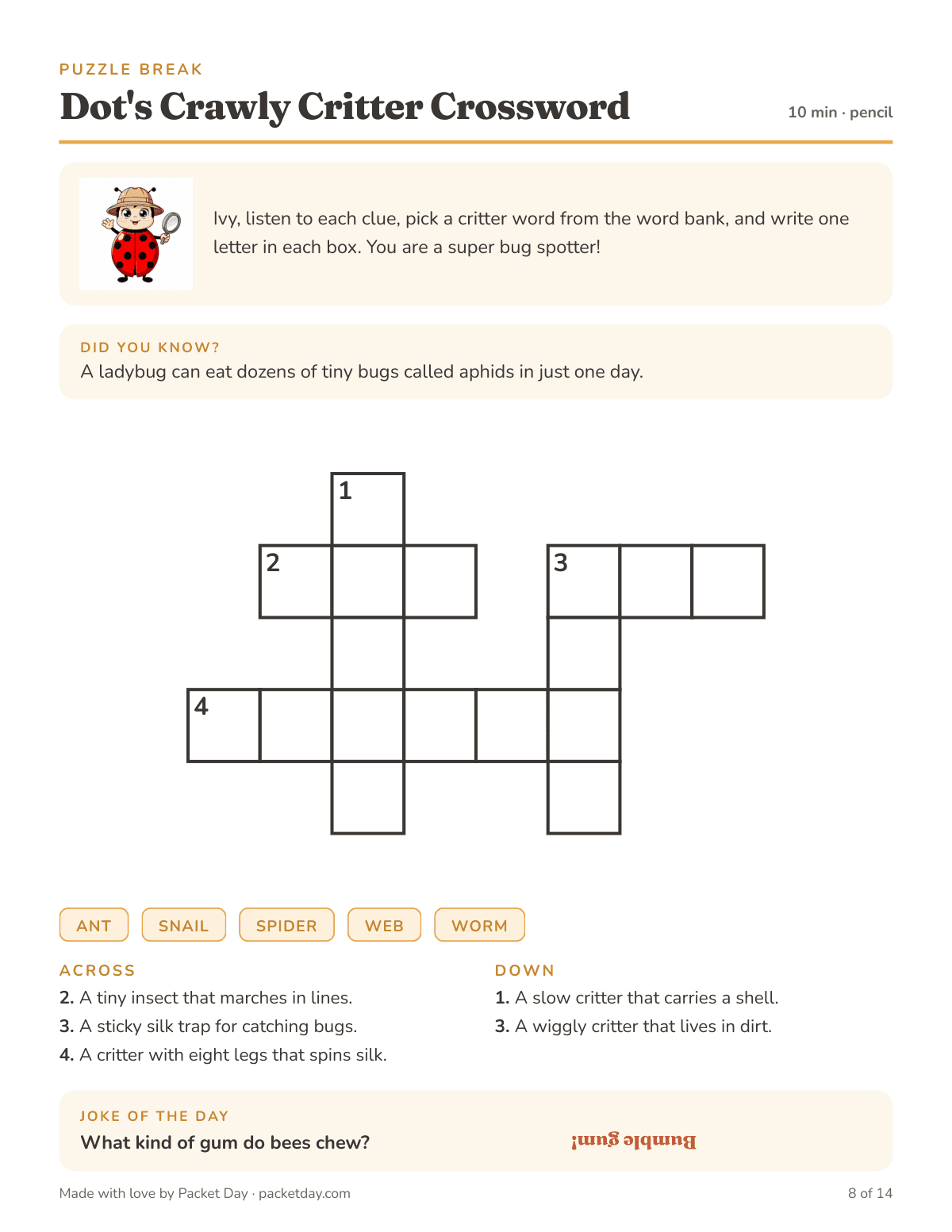
A crossword with a word bank, so new readers can do it.
Does my state require kindergarten? 🏛️
It depends on your state's compulsory attendance age, and those ages differ a lot. Learning standards are written for public schools. Your state's homeschool law is a separate thing.
Here's what our state guides say. Virginia starts at age 5 by September 30, with a one year delay option. Georgia, Massachusetts and Michigan start at 6. Arizona starts at 6 too, and you can file an affidavit to wait until 8. North Carolina starts at 7, and Washington starts at 8.
For any other state, start with your state's guide and check with your department of education.
Kindergarten homeschool FAQ 💬
Is kindergarten required where I live?
It depends on your state's compulsory attendance age. In our state guides it runs from age 5 in Virginia to age 8 in Washington. See the state ages above, and check your state's guide.
Is my child ready for kindergarten?
There's no single test, and the learning standards don't define readiness. Our list above is a gentle place to start. If you're unsure, begin with play and short days. You can always go faster later.
How long should a kindergarten homeschool day be?
Short. Our guide to how many hours a homeschool day takes breaks it down by grade. The sample packet above is one full day with breaks built in, and you can do it in pieces.
What should a kindergartner know by the end of the year?
The standards point to letter sounds, a few sight words, counting to 100, adding and taking away within 10, naming shapes, and telling stories with drawings and a few words. A child who's close on most of these is in good shape.
My kindergartner doesn't want to write. Is that okay?
It's very common. The standards ask kids to use drawing, dictating and writing together, so drawing counts, and you can write down their words. Keep it short and let the pencil work come in small doses.
Do I have to follow Common Core to homeschool?
Only if your state's homeschool law asks for it. Learning standards are written for public schools, and homeschool laws are separate. Many states use Common Core in their public schools, and some, like Texas, Florida and Virginia, set their own standards. Check your state's guide to see what your state asks you to teach.
Want a kindergarten day you don't have to plan? 🌿
Packet Day makes a printable day of learning around your child's grade and interests, for the days you need a backup plan. 11 to 17 pages, generated around your kiddo in a minute or two.
Sources 📖
- Common Core State Standards: Kindergarten Math introduction (checked )
- Common Core: Kindergarten Counting and Cardinality (checked )
- Common Core: Kindergarten Operations and Algebraic Thinking (checked )
- Common Core: Kindergarten Geometry (checked )
- Common Core: Kindergarten Reading, Foundational Skills (checked )
- Common Core: Kindergarten Reading, Literature (checked )
- Common Core: Kindergarten Writing (checked )
- Common Core: Grade 1 Operations and Algebraic Thinking (checked )
- Common Core: Grade 1 Number and Operations in Base Ten (checked )
- Common Core: Grade 1 Reading, Foundational Skills (checked )
- Common Core: Grade 1 Writing (checked )
- NGSS: Kindergarten Forces and Interactions, Pushes and Pulls (checked )
- NGSS: Kindergarten Weather and Climate (checked )
- NGSS: Kindergarten Interdependent Relationships in Ecosystems, Animals, Plants and Their Environment (checked )
- Texas Education Agency: Texas Essential Knowledge and Skills (TEKS) (checked )
- Florida Administrative Code: Rule 6A-1.09401, Student Performance Standards (B.E.S.T.) (checked )
- Code of Virginia: § 22.1-253.13:1, Standards of Learning (checked )
- Texas Education Agency: Home Schooling (checked )
Last verified October 2026. Standards are summarized from the sources above. Social studies isn't sourced because it varies so much by state.
This page summarizes public learning standards for general reference. Your state's homeschool law is what applies to your family, so check your state's guide or department of education before making decisions.
Keep exploring 🧭
Nearby grades and a unit study to try
- 1st Grade Homeschool GuideWhat first graders typically learn in reading, math, writing and science, with easy activities for home, a real grade 1 sample packet and official sources.
- 2nd Grade Homeschool GuideWhat second graders typically learn in math, reading, writing and science, with easy activities for home, a real grade 2 sample packet and official sources.
 Bugs and Backyard Critters unit studyA printable bug unit study on ants, spiders, snails and worms, shown as a kindergarten sample with a real outdoor bug hunt and a crossword. Free to start.
From the Packet Day blog
- How Many Hours of Homeschool a Day? Real Answers by GradeHow many hours of homeschool per day? Real answers by grade (K to 2, 3 to 5, and 6 to 8), plus why home learning needs fewer hours than school.
- How to Keep Learning Going on a "Bad Day"Bad days happen: sick kids, rough mornings, derailed plans. Here's how to keep a thread of learning alive without forcing a full school day.
Homeschooling in a new state, or just starting out? Our homeschool requirements by state cover what to file and what to keep.
🗺️ Social studies
This one varies a lot from state to state.