
Dinosaur Unit Study Packet for Kids
A dinosaur unit study packet is a printable school day about Tyrannosaurus rex, Triceratops and how fossils form, for kids in K to 8. This grade 5 sample has 14 pages plus a parent answer key: math, reading, writing, a number sudoku, movement, science, coloring and a certificate. About 132 minutes of activities. Free to start.
By Natalie, homeschool mom and Packet Day co-founder
Updated October 2026Reviewed by Natalie
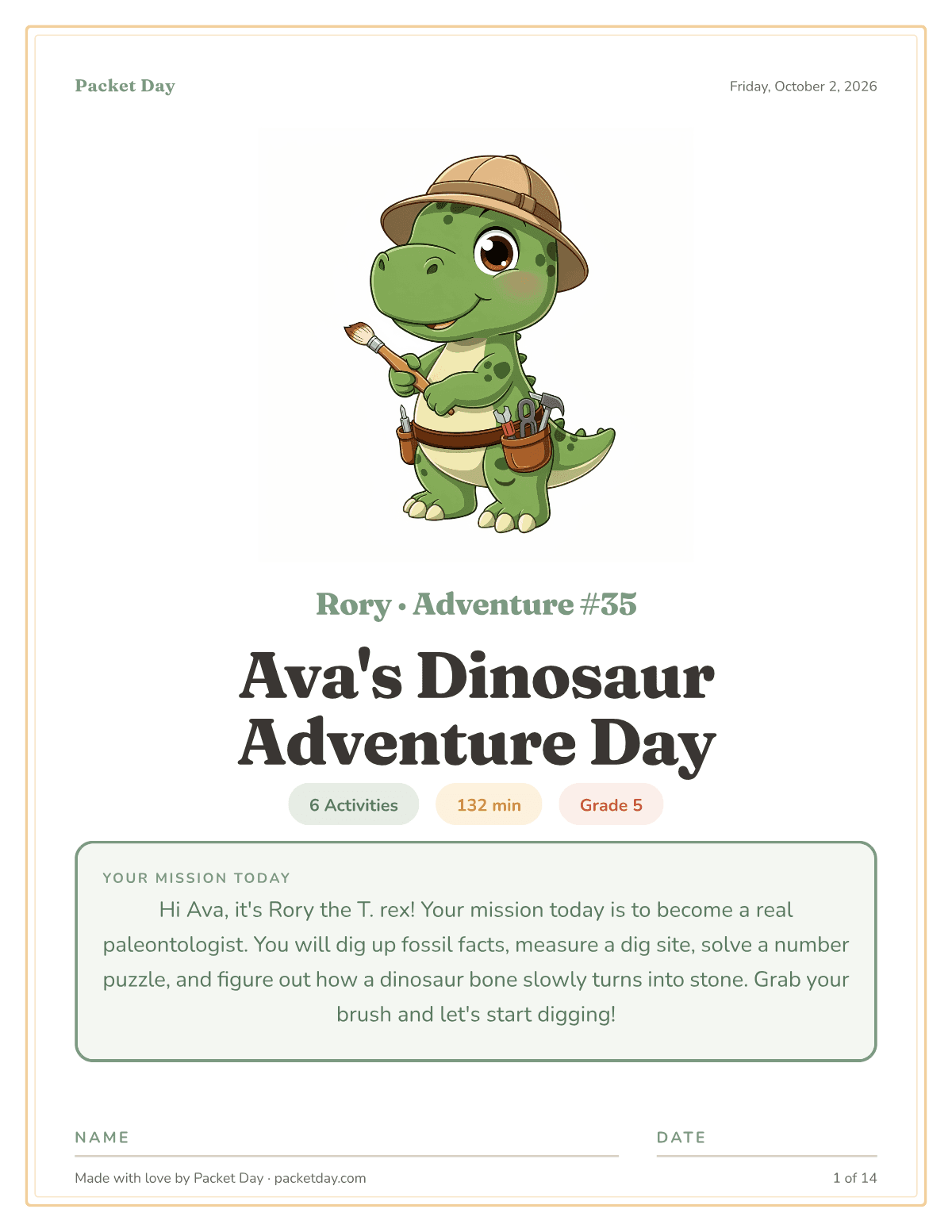
A sample packet made for a grade 5 learner named Ava
What is inside a dinosaur packet?
A dinosaur packet is a full school day on paper: 11 to 17 pages built around dinosaurs, roughly 2 to 5 hours with breaks. This sample has 14 pages plus a parent answer key, and Rory the T. rex guides the whole day.
What does my child actually do?
Math
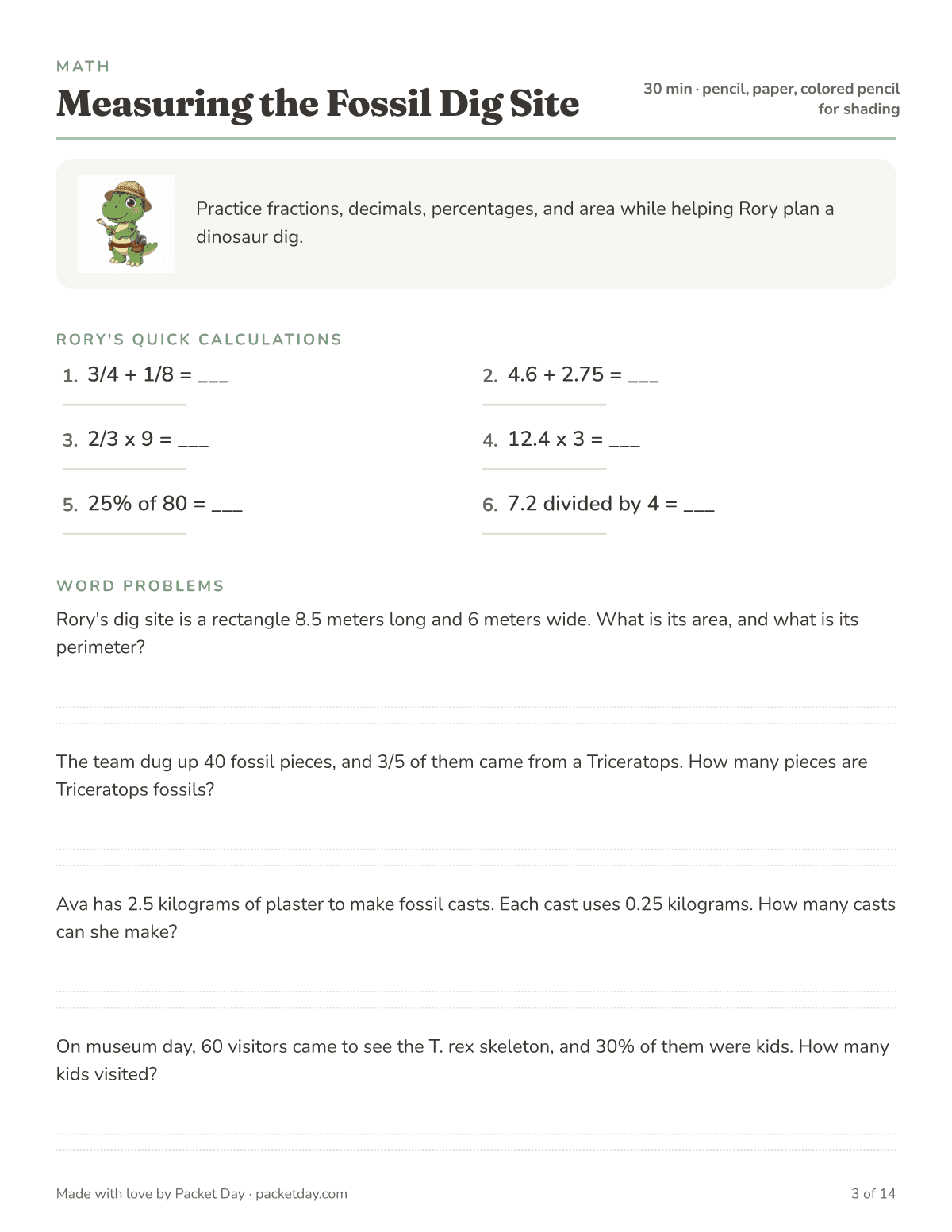
Measuring the Fossil Dig Site
Fractions, decimals and percents, the area and perimeter of a dig site, then shading 3/4 of a 7 by 4 grid of squares.
Reading
Secrets in the Stone
A story about uncovering a T. rex tooth and a Triceratops frill on a dusty hillside, then six questions about sediment, rock layers and fossils.
Writing
My Paleontologist Field Journal
Two full paragraphs: the dig site, the tools and weather, the fossil you find and the clues that tell you which dinosaur it came from.
Puzzle break
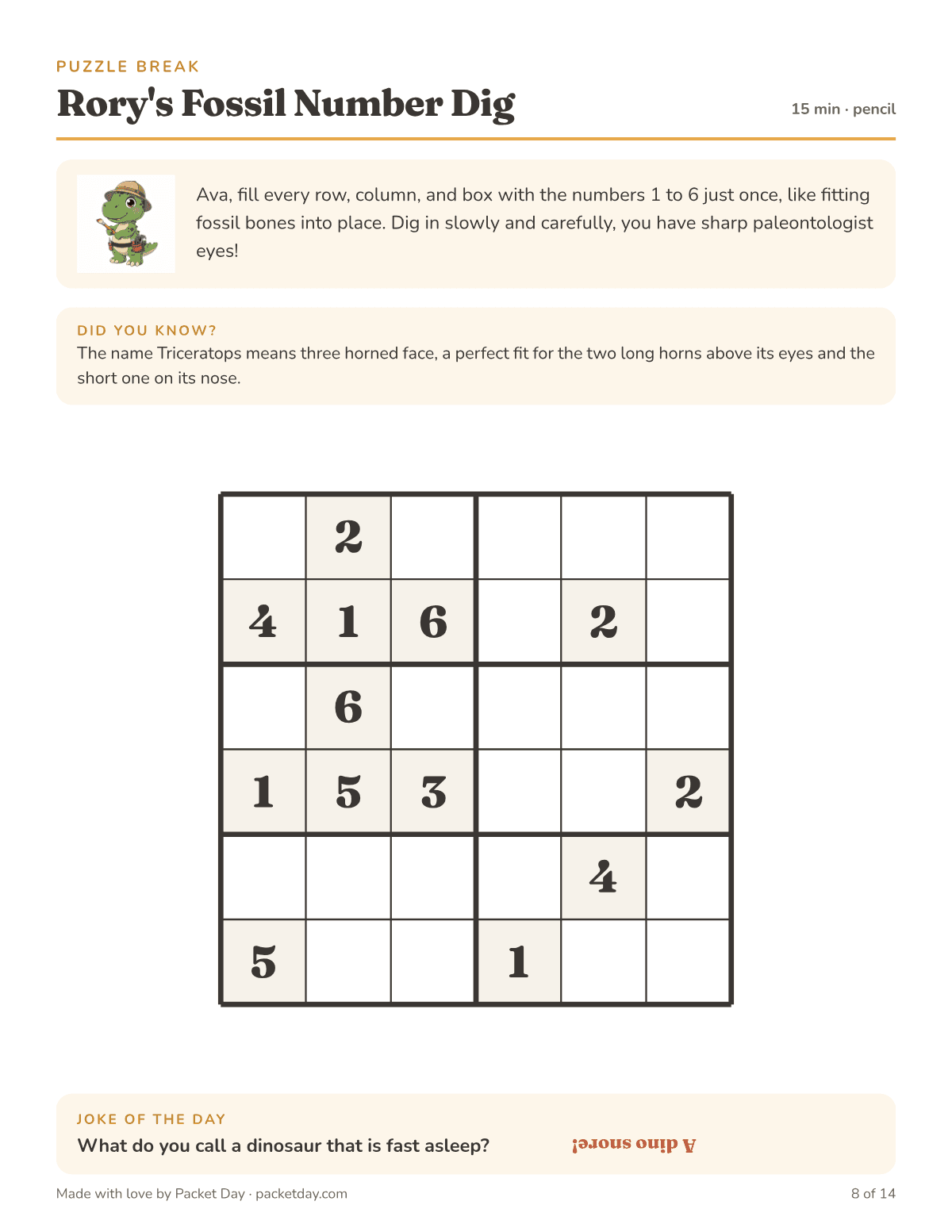
Rory's Fossil Number Dig
A six by six number sudoku, the meaning of the name Triceratops and a joke about a sleeping dinosaur.
Movement break
Dinosaur Stomp and Stretch
T. rex stomps, tiny arm flaps with a roar, a slow Triceratops crawl with horn nods, dig and jump squats and a tall stretch.
Science
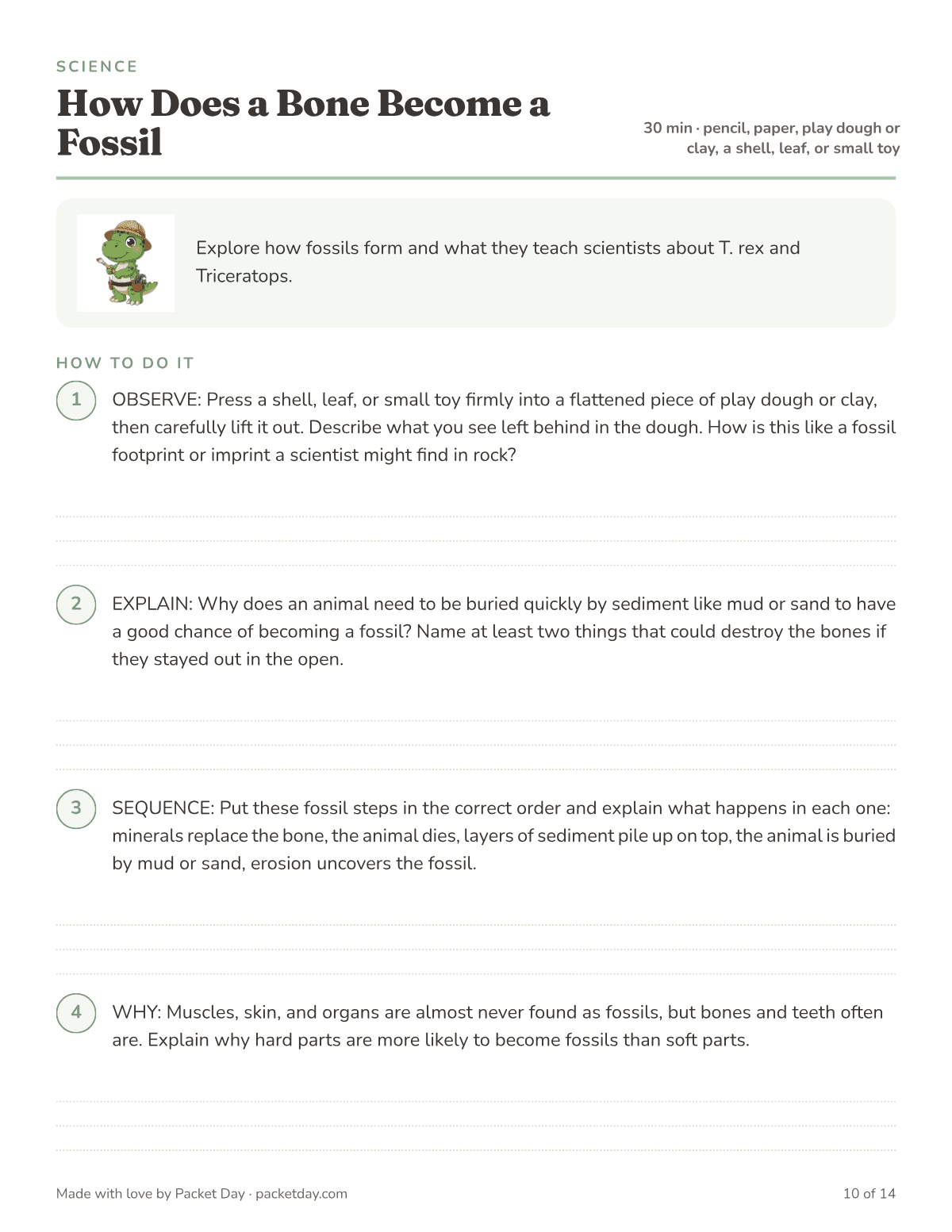
How Does a Bone Become a Fossil
A play dough imprint, why quick burial matters, the fossil steps in order, what teeth tell us about diet and which rock layer is older.
Meet Rory
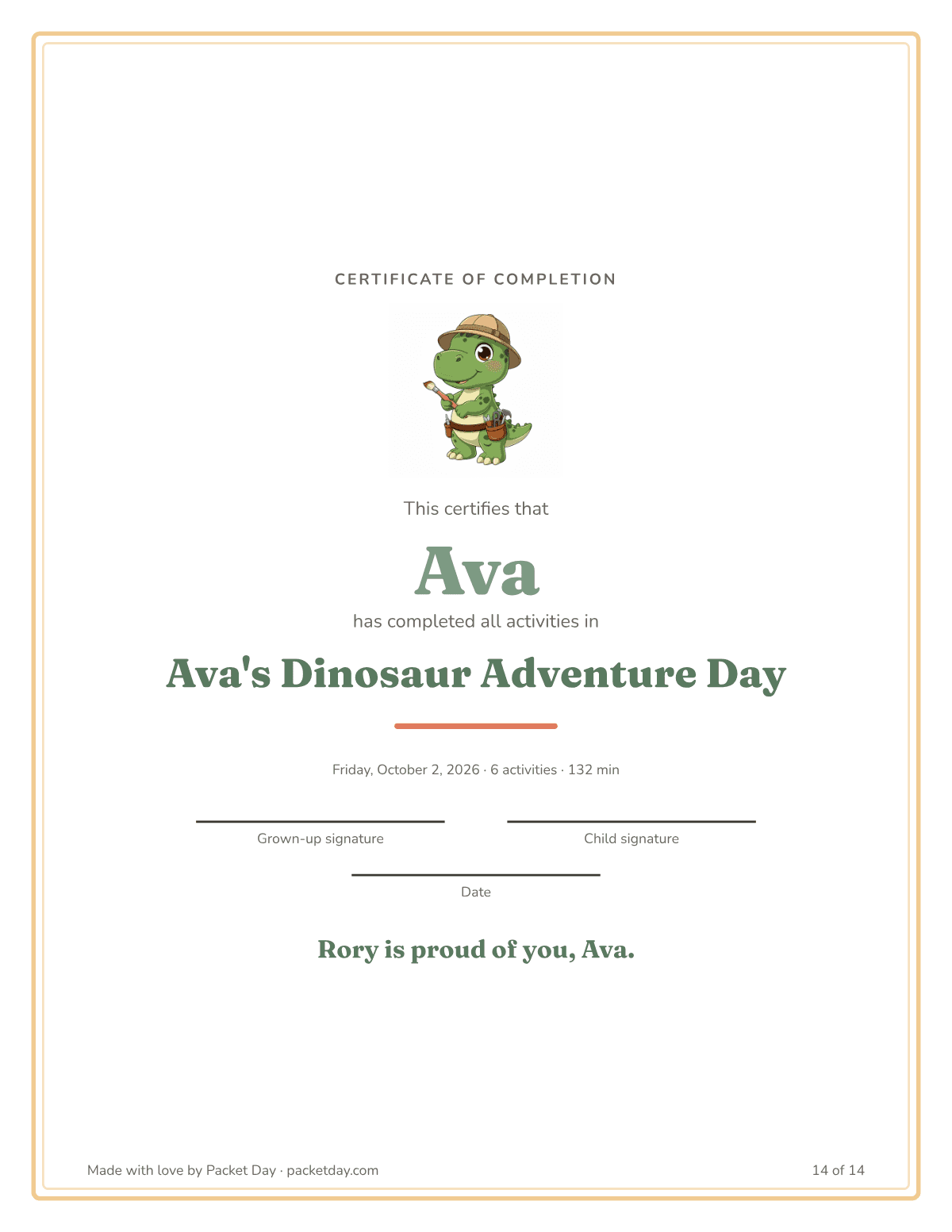
Rory is a young T. rex in a safari hat, holding a brush, with a tool belt slung around his middle. He is not a dinosaur on display. He is a dinosaur who digs, which is a fun twist for a kid who already knows every name in the museum.
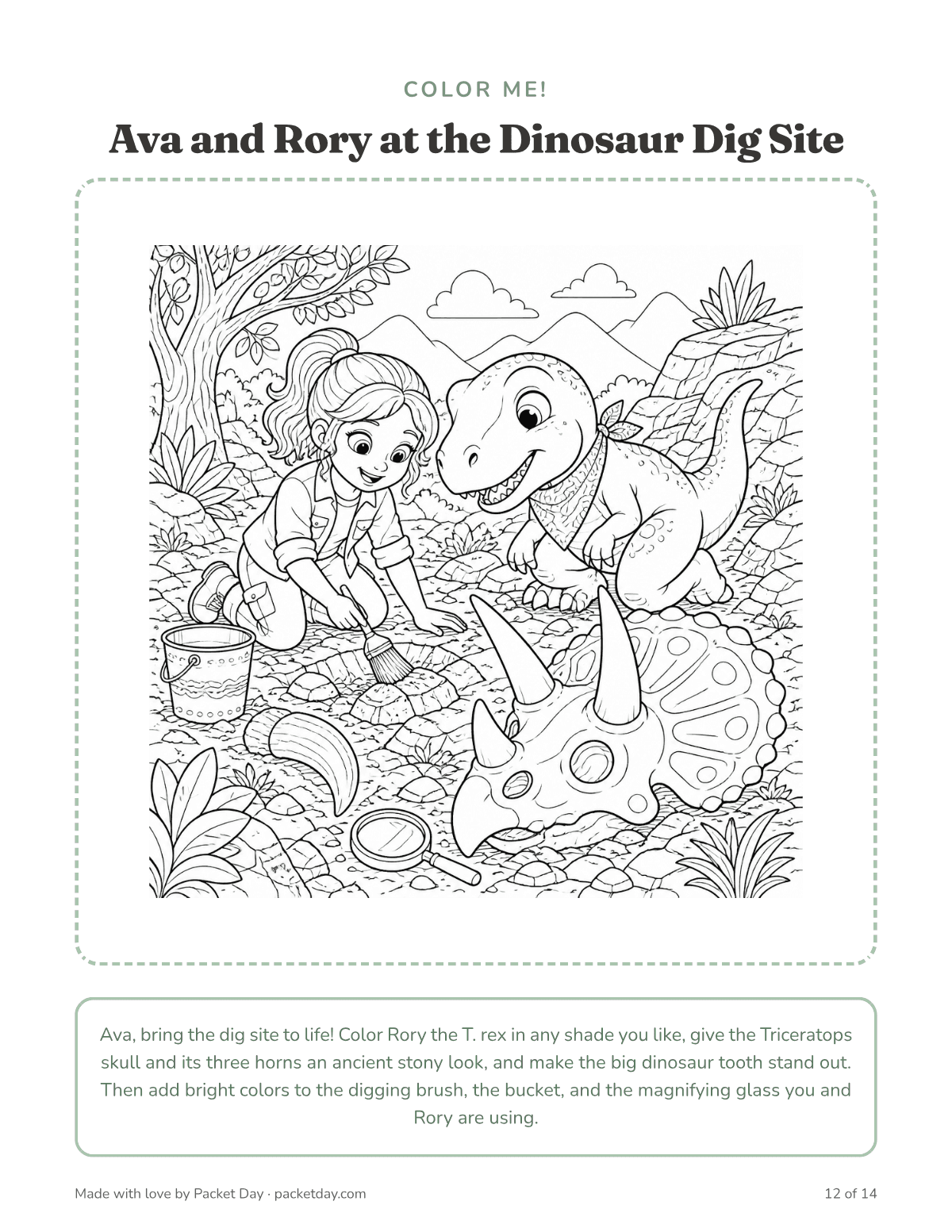
He plans the dig site in the math problems, walks the hillside with Ava in the reading story and explains how a buried bone slowly fills with minerals. He kneels next to her on the coloring page, right beside a Triceratops skull.
Rory keeps a fifth grade day light without making it babyish. The science is real. The guide just happens to be wearing a hat.
What will my child learn?
Your child gets a full grade 5 day: adding fractions with unlike denominators, working with decimals and percents, finding area and perimeter, reading closely for vocabulary, writing two organized paragraphs and explaining a real science process step by step.
The heart of the day is fossilization. An animal dies, is buried quickly by mud or sand, more layers pile on top, and water seeping through the ground carries minerals into the bone until it turns to stone. Ava puts those steps in order, explains why soft parts almost never fossilize, and uses tooth shapes to tell a meat eater from a plant eater.
The rock layer question introduces a big idea in plain words: deeper layers are usually older, so the fossil lower down is most likely the older one.
Which grades is this for?
Grades K-2
The youngest dinosaur fans get the same theme with shorter reading, simpler words, math at their grade and lighter writing. Every packet is built from scratch for your kid's grade, kindergarten included.
Grades 3-5
This sample is grade 5, so we can be specific. The story is about 300 words, with the word sediment explained right in the text. The math reaches fractions with unlike denominators, decimals, percents, area and perimeter. The journal asks for two full paragraphs.
Grades 6-8
For middle school, the dinosaur theme comes with longer passages, harder vocabulary, math at their grade and more writing. Each packet is written fresh for the exact grade you pick.
A note from Natalie
Oli went through a big dinosaur phase. He had a basket of about a dozen plastic dinosaurs, all different kinds, and it went everywhere with him.
His favorite game was having us hide them all over the house so he could find them. He counted each one as he put it back in his basket.
If you have a dinosaur kid, you already know the facts are not the hard part. They know the facts. This packet gives them something to do with them: measure, sort, explain and write it all down like a real scientist would.
Questions parents ask about dinosaur packets
Did T. rex and Triceratops really live at the same time?
Yes. Both lived in the same part of western North America near the very end of the age of dinosaurs, about 66 million years ago. That is why the reading story can put a T. rex tooth and a Triceratops frill on the same hillside.
How does a bone turn into a fossil?
The animal has to be buried quickly by mud or sand, called sediment, before scavengers and weather break it down. Soft parts rot away, leaving the hard bones. More layers pile on top, and water seeping through the ground carries minerals into the bone. The minerals fill its tiny spaces and harden it into stone. The science page walks through each step.
What hands on activity is in the science section?
Your kid presses a shell, a leaf or a small toy into flattened play dough or clay, lifts it out and describes the print it leaves behind. Then they connect it to fossil footprints and imprints found in rock. Have the play dough and one small object ready before you start, and the rest is pencil and paper.
Is grade 5 dinosaur math actually grade 5 math?
Yes. The dinosaurs are the setting, not a shortcut. Ava adds 3/4 and 1/8, multiplies 12.4 by 3, divides 2.5 kilograms of plaster into 0.25 kilogram casts, finds 30 percent of 60 visitors and works out the area and perimeter of an 8.5 by 6 meter dig site. The answer key shows every answer.
What does Triceratops mean?
Triceratops means three horned face. It had two long horns above its eyes and a shorter one on its nose, plus the big bony frill Ava uncovers in the story. It was a plant eater, and the science page asks your kid to explain how its rows of plant chewing teeth prove it, next to the jagged meat eating teeth of T. rex.
Are these made by AI, and are they any good?
Yes, AI writes every packet new, around your kid's grade and the theme you choose. We are a homeschool family, we try them on our own kids, and we fact check every sample we put on this site. They are good and not perfect, so read the story first. The answer key keeps the math quick.
More unit study packets
Packets for the days you need one
Ready for your own dinosaur day?
Packet Day makes print ready, themed learning packets for kids in K to 8, built around whatever your kid is obsessed with.
Make your own dinosaur packet freeFree is 1 packet a month, no card needed. Unlimited is $9 a month billed annually ($108 a year) or $12 month to month.