
5th Grade Homeschool Guide
Fifth grade is the last stretch of elementary school, and it's a big one. Kids add fractions with different bottom numbers, work with decimals, find volume and write longer research pieces. Here's what that usually looks like, and how to get ready for middle school.
Ages: usually 10 to 11. Age cutoffs vary by state.
Homeschool mom of two and co-founder of Packet Day
✓ Last verified against official learning standards
The short answer ⚡
Most fifth graders work on adding and subtracting fractions with unlike denominators, decimals, volume, writing longer pieces with research, reading for theme and main ideas, and science like matter, ecosystems and Earth's systems. That list comes from the learning standards many states use for public schools. Your state's homeschool law may not ask you to follow it, so treat it as a helpful map, not a rulebook.
The year at a glance 👀
What 5th graders typically learn 📚
Here's what the standards ask for by the end of 5th grade, in plain English. Kids get there at different speeds, and that's normal.
Math
Fractions and decimals get a lot more useful.
- Adding and subtracting fractions with unlike denominators by swapping in equivalent fractions, like 2/3 + 5/4 = 8/12 + 15/12 = 23/12.
- Multiplying a fraction or a whole number by a fraction.
- Dividing a whole number by a unit fraction, and a unit fraction by a whole number.
- Reading, writing and comparing decimals to thousandths.
- Adding, subtracting, multiplying and dividing decimals to hundredths, using models and place value strategies.
- Dividing with two digit divisors.
- Volume: relating it to multiplication and addition, and solving real world problems with it.
At the kitchen table: Double a recipe that has fractions in it, like 3/4 cup. Then cut it in half. Let them do the math before you measure.
Reading
Reading with a pencil in hand, and proof for every answer.
- Quoting accurately from a text to explain what it says and to back up an inference.
- Finding the theme of a story, drama or poem from details in the text, and summarizing it.
- Finding two or more main ideas in nonfiction and explaining how key details support them.
- Summarizing what they read in their own words.
At the kitchen table: After a chapter, ask, "What's the theme, and which line proves it?" Have them copy the line exactly.
Writing
Longer pieces, and real research.
- Opinion pieces that support a point of view with reasons and information.
- Informative writing that examines a topic and conveys ideas and information clearly.
- Short research projects that use several sources to build knowledge about a topic.
- Taking notes from print and digital sources, putting them in their own words, and listing the sources.
At the kitchen table: Pick a topic they love. Find two sources, take notes on index cards in their own words, and write a one page report with a list of sources.
Science
Models, data and evidence.
- Matter: what things are made of, and how their properties tell materials apart.
- Ecosystems: modeling how matter moves among plants, animals, decomposers and the environment.
- Earth's systems: modeling how the geosphere, biosphere, hydrosphere and atmosphere interact.
- Space: graphing patterns in shadows, day and night, and the stars we see through the year.
At the kitchen table: Measure a shadow outside every hour on a sunny day. Mark the tip with chalk, then graph the lengths.
Getting ready for middle school 🎒
Sixth grade changes the feel of math. The 6th grade standards bring in ratios and rates, negative numbers and expressions with letters, and they finish up dividing with fractions. Fifth grade is the runway.
These are good signs, not rules. If most are true, your child is in great shape.
- Fractions and decimals feel comfortable. 6th grade leans on both.
- Multiplication facts come quickly. Ratios and equations get harder when facts are slow.
- They can write a few connected paragraphs. Middle school asks for arguments with evidence.
- They can take notes from a source in their own words.
- They can work on one task for 20 or 30 minutes without checking in.
If a few of these aren't there yet, that's okay. Summer and the first weeks of 6th grade are good times to catch up. Our 6th grade guide shows what's next.
How 5th grade fits in 🧩
Every year builds on the one before it. Here's what kids usually bring in, and what the next year picks up.
What they bring from 4th grade
- Multiplying numbers with up to four digits by one digit, and multiplying two two digit numbers.
- Equivalent fractions, and adding and subtracting fractions that share a denominator.
- Decimals for tenths and hundredths.
- Longer writing with reasons and details, and short research projects.
What's coming in 6th grade
- Ratios and rates, negative numbers, and expressions with letters.
- Dividing multi digit numbers with the standard algorithm.
- Writing arguments with clear reasons and evidence.
Where this list comes from 🧭
Many states teach public school math and English from the Common Core State Standards. That's where the math, reading and writing lists above come from. The science list comes from the Next Generation Science Standards. Every list links to the official standards in our sources at the bottom of this page.
Some states set their own standards instead, like Texas, Florida and Virginia. Not every state uses the science standards either. If you live in one of those states, its own standards are the better map, and the details and order may differ from what's here.
Homeschool rules are a separate thing. In Texas, for example, TEA points parents who are interested to its standards, the TEKS, as a resource. Check your state's guide for what applies where you live.
Easy 5th grade activities for home 🏡
No prep, no printer needed. Each one fits in a spare half hour.
Fraction pizza night. Cut a pizza into 8 slices. Ask, "If we eat 1/2 and then 1/8 more, how much is gone?" Switch to common denominators to check.
Decimal price tags. Look at grocery prices like $2.49. Ask them to compare, add and round a few items before you check out.
Box volume. Find a shoebox. Measure the length, width and height, multiply to get the volume, then fill it with small cubes or blocks to check.
Theme detective. After a chapter or a short story, have them state the theme and copy one line from the text that proves it.
One page research. Pick a topic, find two sources, take notes in their own words and write a one page report with a list of sources.
A real 5th grade sample packet 🦖
Here are six pages from a real sample packet, made for a fifth grader we call Ava. Rory the T. rex turns Ava into a paleontologist for the day, and every page is matched to grade level.
This sample has 14 pages, 6 activities and about 132 minutes of work, plus an answer key for you. Most activities end with a quick How did it go? check, where kids color in up to three stars. Every packet is made new for your child, so yours will look different.
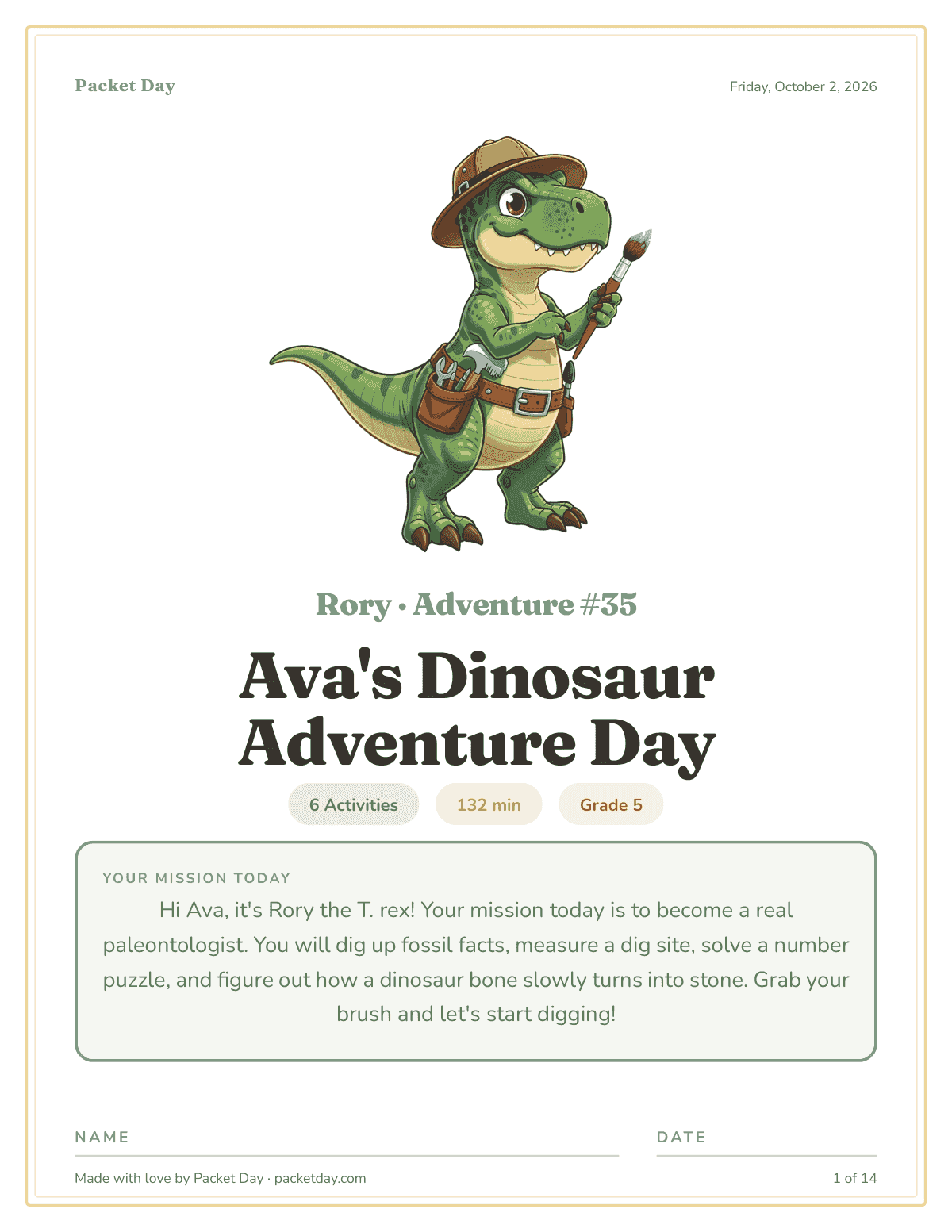
Rory the T. rex turns Ava into a paleontologist. 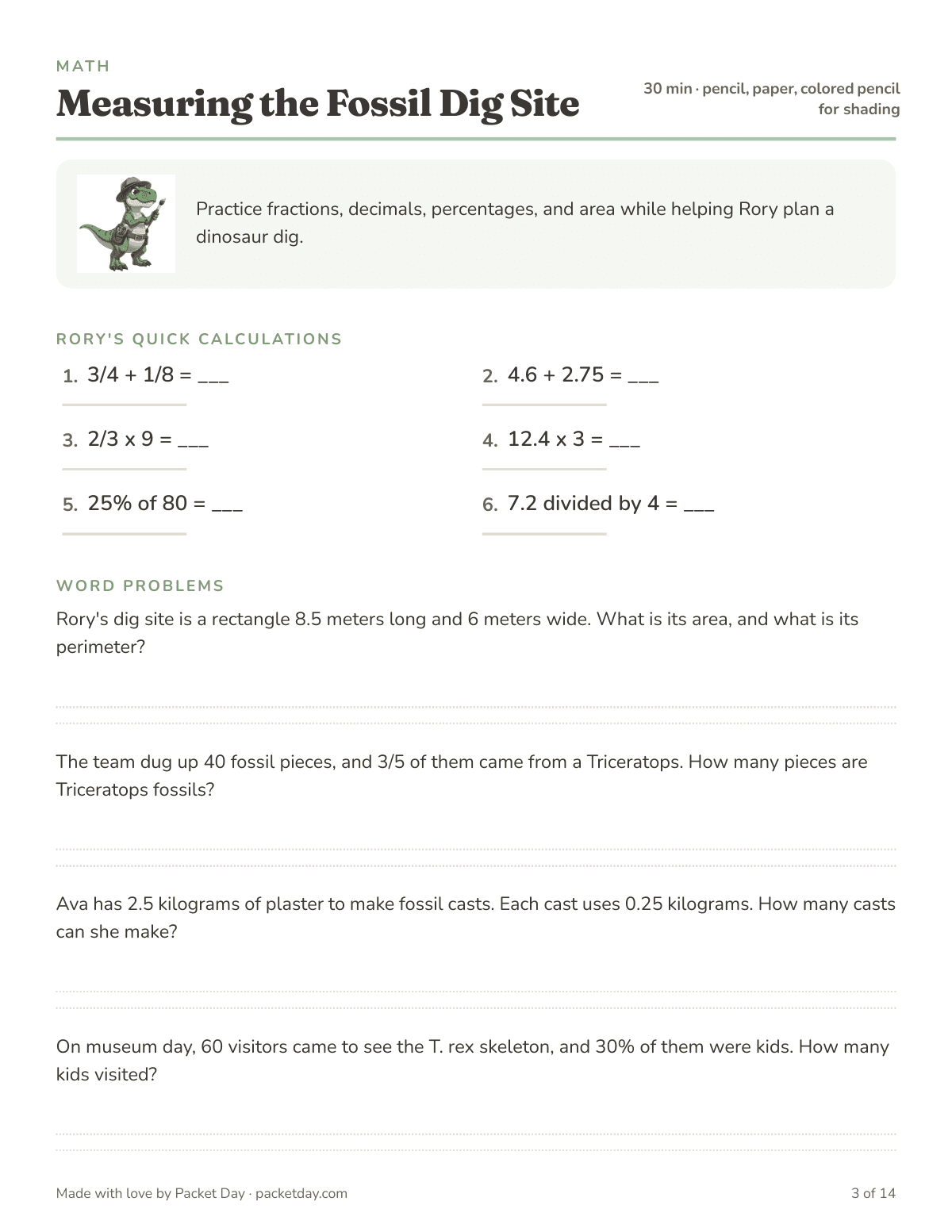
Fractions, decimals and area, all set at a dig site. 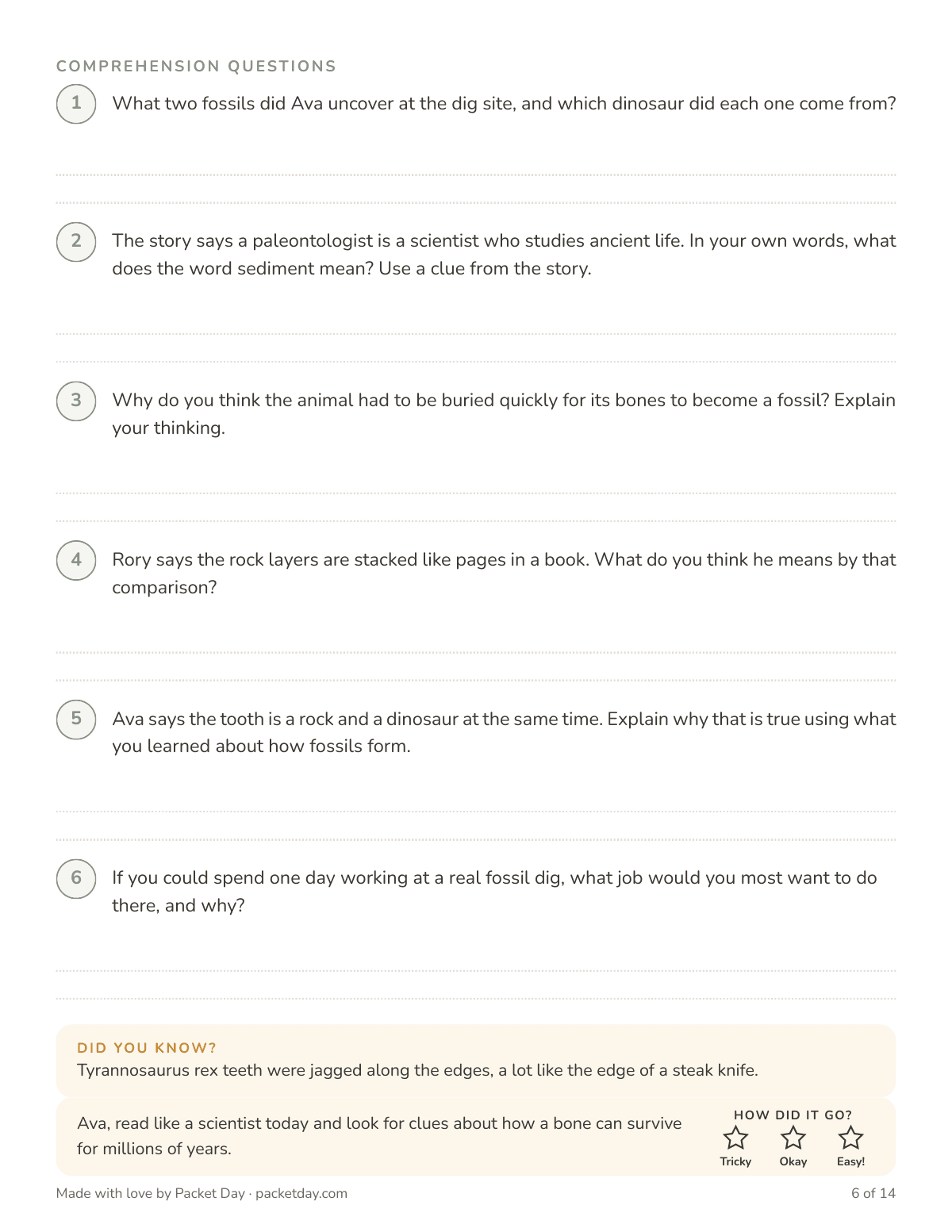
Questions that ask for reasons, and stars to color at the end. 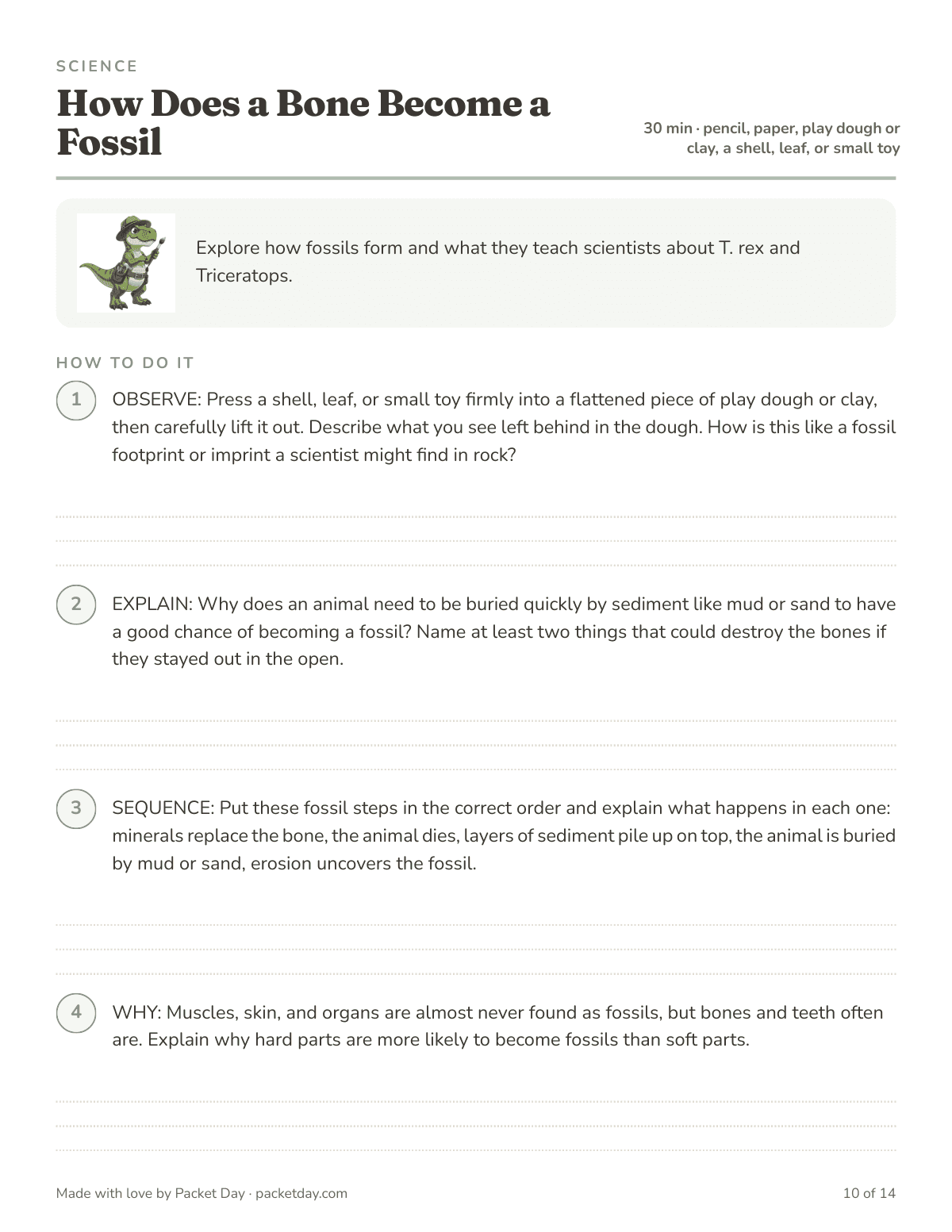
A play dough fossil, then the story of how a bone turns to stone. 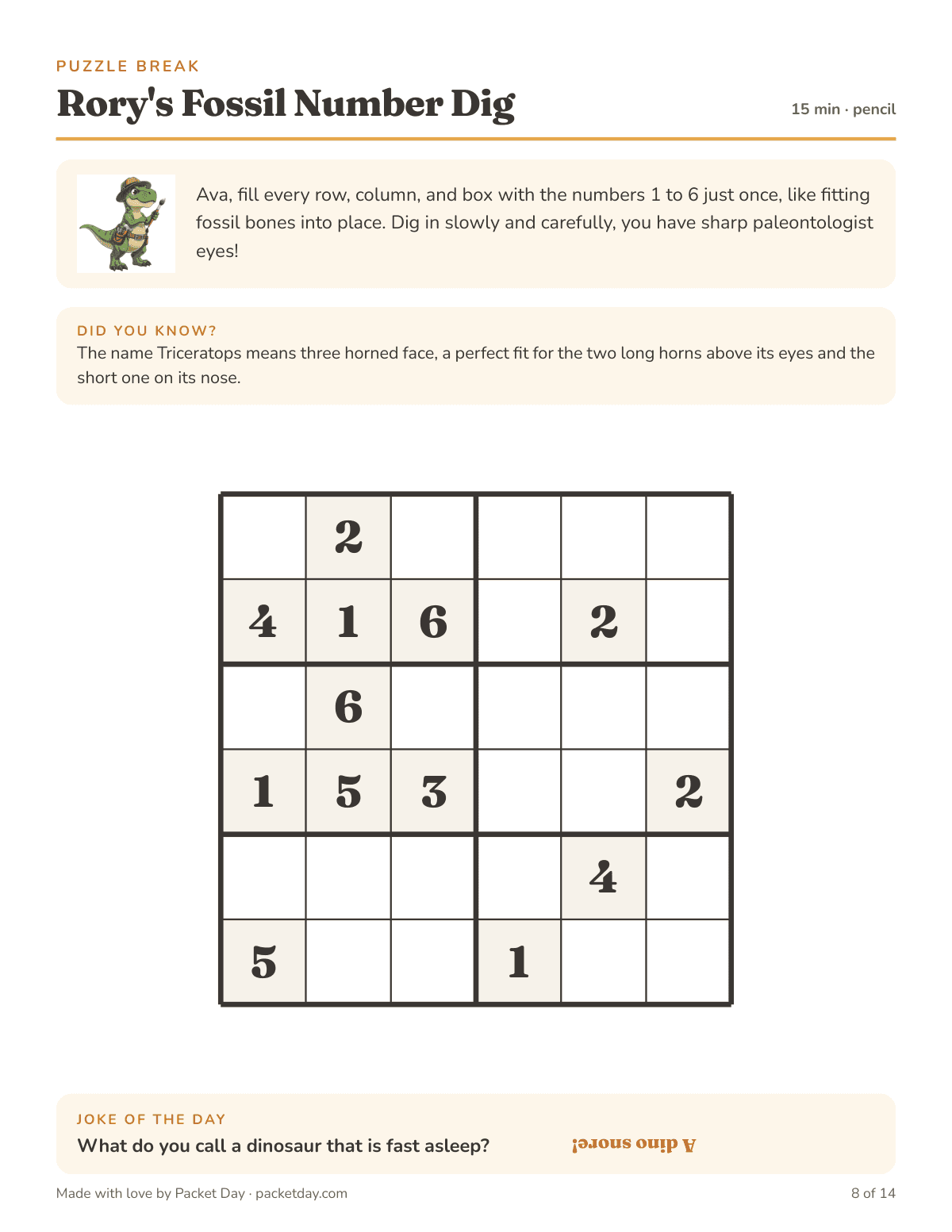
A number sudoku for a quick brain break. 
Every packet ends with a certificate to sign and keep.
Does my state test in 5th grade? 🏛️
Learning standards are written for public schools. Your state's homeschool law is a separate thing, and it varies a lot. Fifth grade is a test year in some states.
Pennsylvania asks for tests in grades 3, 5 and 8, reading and language arts plus math, and a parent can't give the test. Tennessee tests in grades 5, 7 and 9. Colorado asks for a national test or an evaluation in grades 3, 5, 7, 9 and 11.
Other states ask for a yearly check, so 5th grade is included. North Carolina asks for a nationally standardized test every year. New York asks for an annual assessment, and in grades 4 to 8 a written narrative can stand in for a test every other year. Virginia wants evidence of progress each year, either a test score or an evaluation, and Washington asks for a yearly test or assessment that you keep in your records. Minnesota asks for a nationally norm referenced achievement test every year.
Georgia asks for a test every three years, starting at the end of grade 3. Arizona, California, Illinois and Ohio don't require one. Your state's guide spells out what applies to you.
5th grade homeschool FAQ 💬
Should my 5th grader be able to add fractions with different denominators?
That's the big goal of 5th grade. The Common Core standards ask kids to add and subtract fractions with unlike denominators by swapping in equivalent fractions. If it feels wobbly, equivalent fractions are usually the missing piece, and our 4th grade guide covers them.
Do 5th graders learn decimals to thousandths?
They read, write and compare decimals to thousandths. For adding, subtracting, multiplying and dividing, the standards stop at hundredths. So 0.125 is fair game to read and compare, and 1.5 times 2.4 is the kind of problem they'll work.
Is my child ready for middle school?
There's no single test. Check the list in the getting ready section above. If most are true, you're in good shape. If not, you have time. Our 6th grade guide shows what comes next.
How long should a 5th grade research report be?
The standards don't set a length. They ask for short research projects that use several sources, with notes in the child's own words and a list of sources. A page or two is a good place to start.
How many hours a day should I homeschool 5th grade?
Less than a school day. Home doesn't have lining up, waiting or a crowded classroom. Our guide to how many hours a homeschool day takes breaks it down by grade.
What does a 5th grade homeschool day look like?
One simple rhythm: math and reading in the morning while brains are fresh, then writing, science or a project after a break. The sample packet above is one full day: math, reading, writing, a puzzle break, a movement break and science.
Do I have to follow Common Core to homeschool?
Only if your state's homeschool law asks for it. Learning standards are written for public schools, and homeschool laws are separate. Many states use Common Core in their public schools, and some, like Texas, Florida and Virginia, set their own standards. Check your state's guide to see what your state asks you to teach.
Want a 5th grade day you don't have to plan? 🌿
Packet Day makes a printable day of learning around your child's grade and interests, for the days you need a backup plan. 11 to 17 pages, generated around your kiddo in a minute or two.
Sources 📖
- Common Core State Standards: Grade 5 Math introduction (checked )
- Common Core: Grade 5 Number and Operations in Base Ten (checked )
- Common Core: Grade 5 Number and Operations, Fractions (checked )
- Common Core: Grade 5 Measurement and Data (checked )
- Common Core: Grade 5 Reading, Literature (checked )
- Common Core: Grade 5 Reading, Informational Text (checked )
- Common Core: Grade 5 Writing (checked )
- Common Core: Grade 4 Number and Operations in Base Ten (checked )
- Common Core: Grade 6 Math introduction (checked )
- Common Core: Grade 6 The Number System (checked )
- Common Core: Grade 6 Ratios and Proportional Relationships (checked )
- Common Core: Grade 6 Expressions and Equations (checked )
- NGSS: Grade 5 Structure and Properties of Matter (checked )
- NGSS: Grade 5 Matter and Energy in Organisms and Ecosystems (checked )
- NGSS: 5-ESS2 Earth's Systems (checked )
- NGSS: Grade 5 Space Systems, Stars and the Solar System (checked )
- Texas Education Agency: Texas Essential Knowledge and Skills (TEKS) (checked )
- Florida Administrative Code: Rule 6A-1.09401, Student Performance Standards (B.E.S.T.) (checked )
- Code of Virginia: § 22.1-253.13:1, Standards of Learning (checked )
- Texas Education Agency: Home Schooling (checked )
Last verified October 2026. Standards are summarized from the sources above. Social studies isn't sourced because it varies so much by state.
This page summarizes public learning standards for general reference. Your state's homeschool law is what applies to your family, so check your state's guide or department of education before making decisions.
Keep exploring 🧭
Nearby grades and a unit study to try
- 4th Grade Homeschool GuideWhat fourth graders typically learn in math, reading, writing and science, with easy activities for home, a real grade 4 sample packet and official sources.
- 6th Grade Homeschool GuideWhat sixth graders typically learn, how to teach arguing with evidence, easy activities for home and a real grade 6 sample packet.
 Dinosaurs unit studyA printable dinosaur unit study on T. rex, Triceratops and how a bone turns into a fossil, shown as a grade 5 sample with dig site math. Free to start.
Packets and guides that fit
- How Many Hours of Homeschool a Day? Real Answers by GradeHow many hours of homeschool per day? Real answers by grade (K to 2, 3 to 5, and 6 to 8), plus why home learning needs fewer hours than school.
- Pennsylvania homeschool requirementsHow to homeschool legally in Pennsylvania: file an affidavit by August 1, keep a portfolio, test in grades 3, 5 and 8, and get an evaluation by June 30.
Homeschooling in a new state, or just starting out? Our homeschool requirements by state cover what to file and what to keep.
🗺️ Social studies
This one varies a lot from state to state.