
6th Grade Homeschool Guide
Sixth grade is the first year of middle school, and math takes a big step. Kids work with ratios and rates, meet negative numbers and start using letters in expressions. Writing shifts toward arguing with evidence. Here's what that usually looks like, and how to teach it at home.
Ages: usually 11 to 12. Age cutoffs vary by state.
Homeschool mom of two and co-founder of Packet Day
✓ Last verified against official learning standards
The short answer ⚡
Most sixth graders work on ratios and rates, negative numbers, expressions and simple equations, writing arguments with evidence, reading for central ideas, and a broad middle school science band. That list comes from the learning standards many states use for public schools. Your state's homeschool law may not ask you to follow it, so treat it as a helpful map, not a rulebook.
The year at a glance 👀
What 6th graders typically learn 📚
Here's what the standards ask for by the end of 6th grade, in plain English. Kids get there at different speeds, and that's normal.
Math
Three big new ideas, all in one year.
- Ratios: using ratio language to compare two amounts, like 2 wings for every 1 beak.
- Unit rates, like $5 per hamburger, and percent as a rate per 100.
- Dividing fractions by fractions, with visual models and equations.
- Dividing multi digit numbers with the standard algorithm.
- Negative numbers: using positive and negative numbers together for things like temperatures above and below zero, and ordering them and finding absolute value.
- Expressions with letters: writing, reading and evaluating them.
- Solving simple equations of the form x + p = q and px = q.
- Statistical thinking: describing and comparing sets of data.
At the kitchen table: Pick a recipe that serves 4 and ask for the ratio of flour to sugar. Then scale it to serve 6 and check the ratio stays the same.
Reading
Reading closely, and judging what's backed up.
- Citing textual evidence to support what a text says and what it suggests.
- Finding a central idea and summarizing the text without adding personal opinions.
- Tracing an argument in a text and telling claims that have reasons and evidence from claims that don't.
At the kitchen table: Read a short opinion article together. Ask, "What does the writer claim? Which claim has real evidence, and which is just a feeling?"
Writing
Taking a side, and proving it.
- Arguments that support claims with clear reasons and relevant evidence.
- Using credible sources and showing an understanding of the topic.
- Informative writing that examines a topic and organizes relevant content.
- Short research projects that answer a question from several sources, and refocus the question when needed.
At the kitchen table: Pick a question with two sides, like whether school should start later. Write a claim, two reasons and one piece of evidence for each.
Science
Middle school science works differently. There's no separate list for each grade.
- The Next Generation Science Standards write middle school science as one band for grades 6 to 8. Kindergarten through 5th grade get a list for each grade. Grades 6 to 8 share one set of expectations.
- Physical science: matter and chemical reactions, forces and interactions, energy, and waves.
- Life science: how living things are built and work, growth and reproduction, how matter and energy move through ecosystems, how living things depend on each other, heredity, and natural selection.
- Earth and space science: the solar system and space, the history of Earth, Earth's systems, weather and climate, and how people change the planet.
- Engineering design runs through all of it: define a problem, test ideas and improve them.
- Schools split these topics across the three years in different ways. Some mix physical, life and Earth science every year. Some give each year its own science. Neither is wrong, so don't worry if a topic lands in a different year than your neighbor's.
At the kitchen table: Roll a ball down a ramp made of a book, then repeat on a rug and on a smooth floor. Measure how far it goes each time and talk about what changed.
Arguing with evidence, at home 🗣️
In 6th grade, "because I said so" turns into "because the evidence says so." The standards ask kids to write arguments with clear reasons and relevant evidence from credible sources, and to tell which claims in a text are backed up and which aren't.
Practice out loud first. A kitchen table debate counts. Here's a simple way to run one.
- Pick a question with two sides, like whether your family should get a dog.
- Say one clear claim, like "We should get a dog."
- Give two reasons, and one piece of evidence for each.
- Say what someone on the other side would argue, then answer it.
When it feels easy out loud, move it to paper. Three short paragraphs is plenty.
How 6th grade fits in 🧩
Every year builds on the one before it. Here's what kids usually bring in, and what the next year picks up.
What they bring from 5th grade
- Adding and subtracting fractions with unlike denominators.
- Decimals to thousandths, and volume.
- Short research projects with notes and a list of sources.
What's coming in 7th grade
- Proportional relationships, and operations with negative numbers.
- Solving equations and inequalities.
- Writing arguments and research with several pieces of evidence.
Where this list comes from 🧭
Many states teach public school math and English from the Common Core State Standards. That's where the math, reading and writing lists above come from. The science list comes from the Next Generation Science Standards. Every list links to the official standards in our sources at the bottom of this page.
Some states set their own standards instead, like Texas, Florida and Virginia. Not every state uses the science standards either. If you live in one of those states, its own standards are the better map, and the details and order may differ from what's here.
Homeschool rules are a separate thing. In Texas, for example, TEA points parents who are interested to its standards, the TEKS, as a resource. Check your state's guide for what applies where you live.
Easy 6th grade activities for home 🏡
No prep, no printer needed. Each one fits in a spare half hour.
Ratio recipe. Scale a recipe up and down. Ask for the ratio of two ingredients each time, and check that it stays the same.
Below zero. Track the temperature outside for a week, including any days below zero. Order the days from coldest to warmest on a number line.
Unit price showdown. At the store, find the price per ounce for two sizes of the same food. Which one is the better deal, and by how much?
Claim, reason, evidence. Pick a question with two sides. Write a claim, two reasons and one piece of evidence for each, then swap sides and write the other case.
Ramp experiment. Roll a toy car down a ramp onto two different floors. Predict, measure how far it goes and explain the difference.
A real 6th grade sample packet 🎮
Here are five pages from a real sample packet, made for a sixth grader we call Laurel. Glitch the robot fox helps Laurel solve a mystery about a hidden level in a video game she's designing, and every page is matched to grade level.
This sample has 16 pages, 6 activities and about 148 minutes of work, plus an answer key for you. In this sample, the parent asked for math a grade ahead, so we left that page out and show the others. Most activities end with a Still learning, Getting there or Nailed it check. Every packet is made new for your child, so yours will look different.
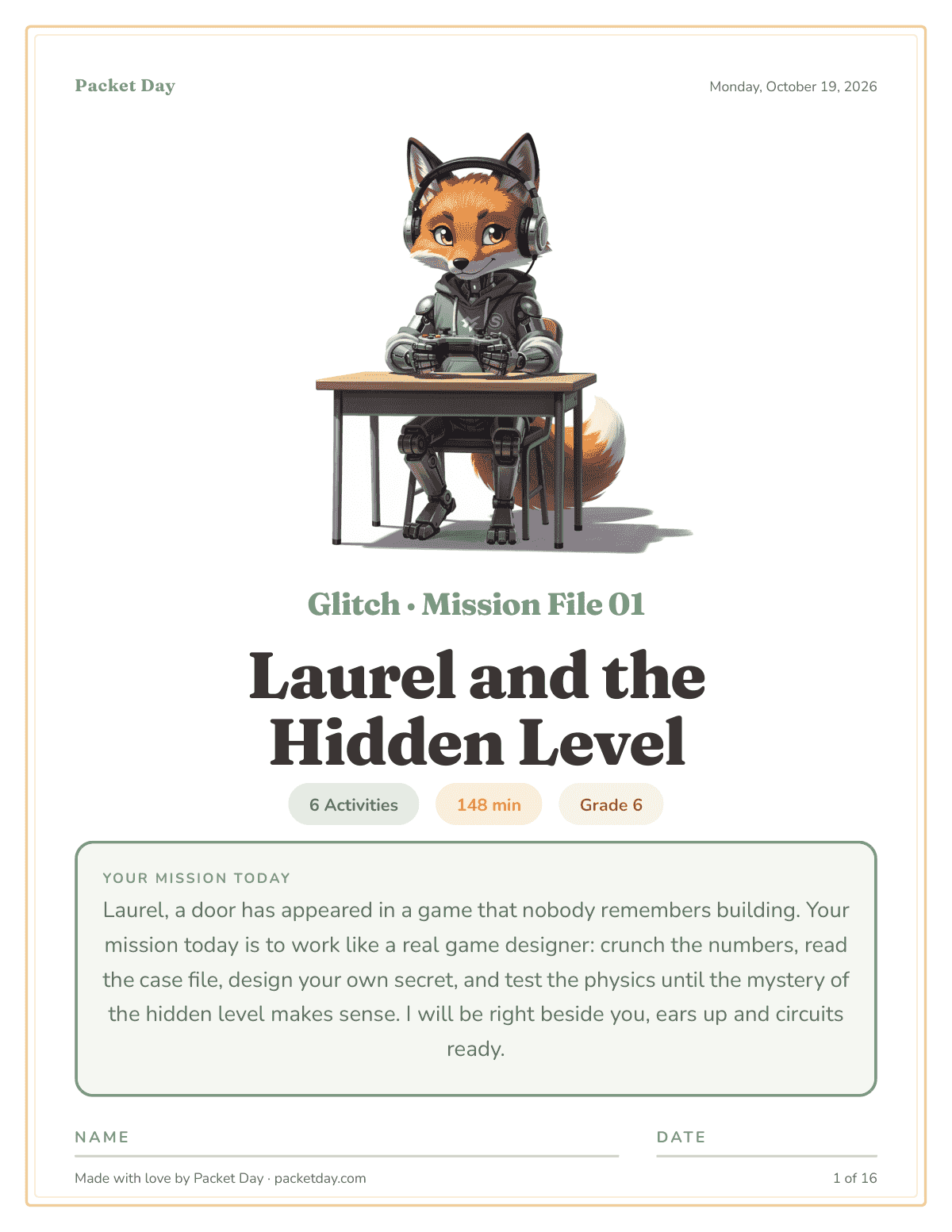
Glitch the robot fox opens a mystery about a hidden level. 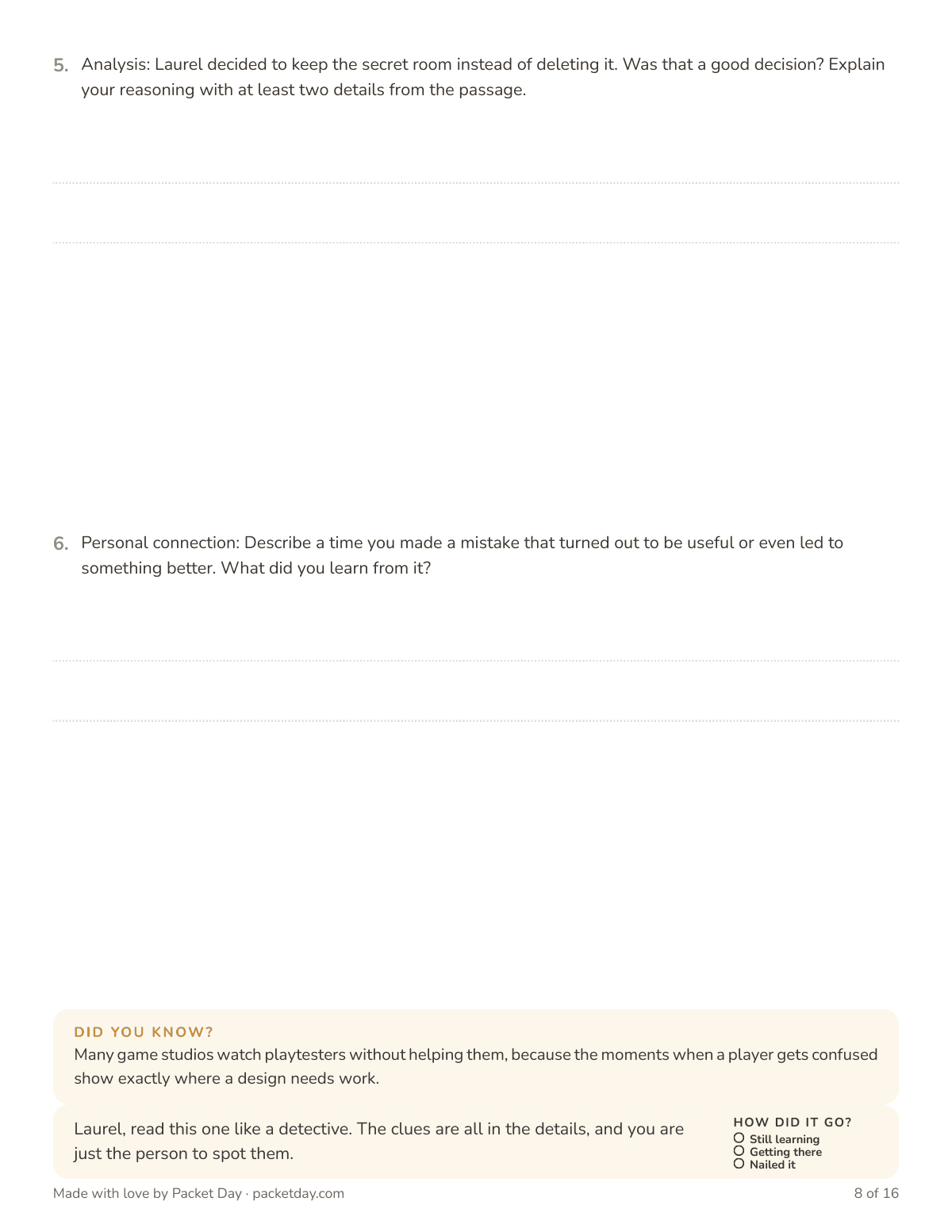
Questions that ask for reasons, and a 1 to 3 check at the end. 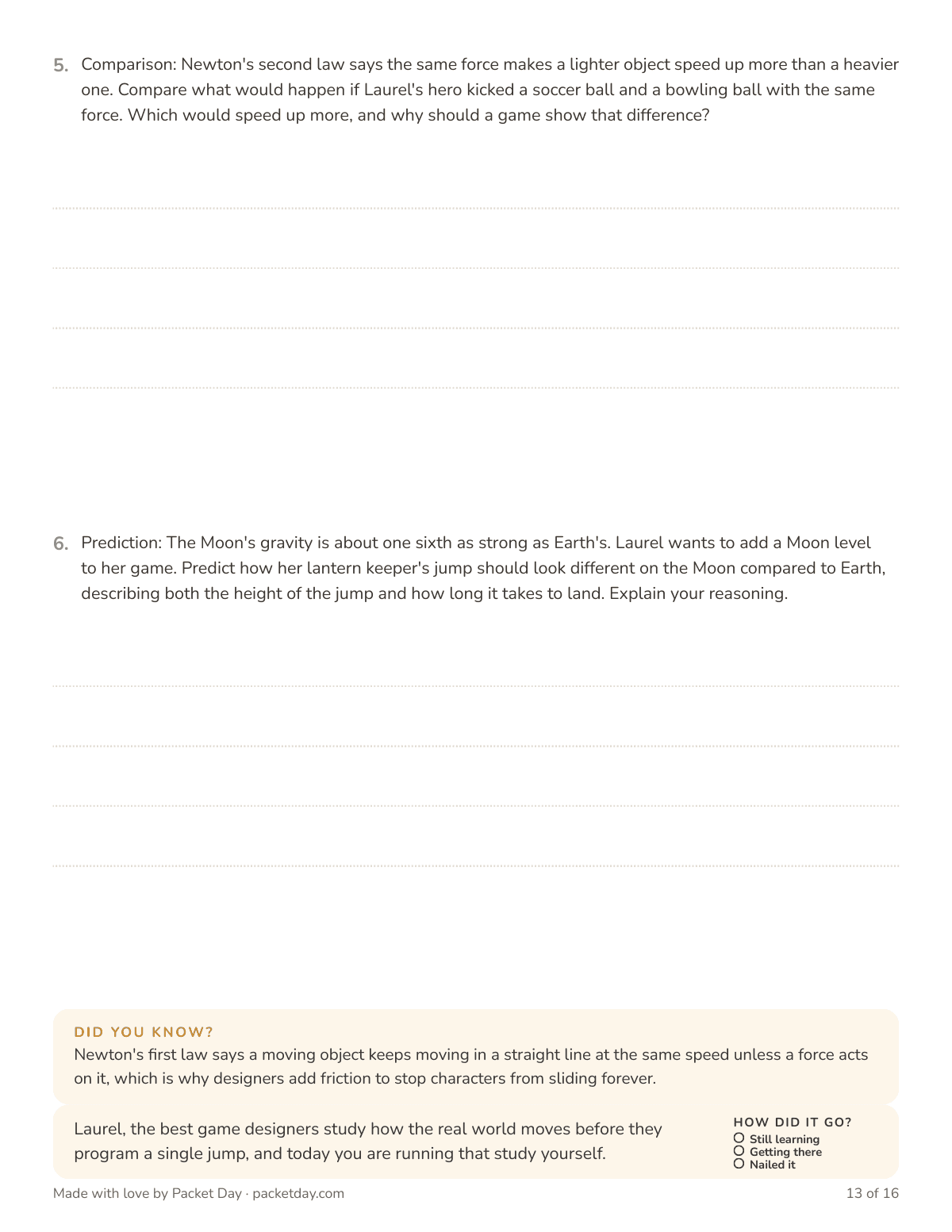
Game physics: forces, mass and a jump on the Moon. 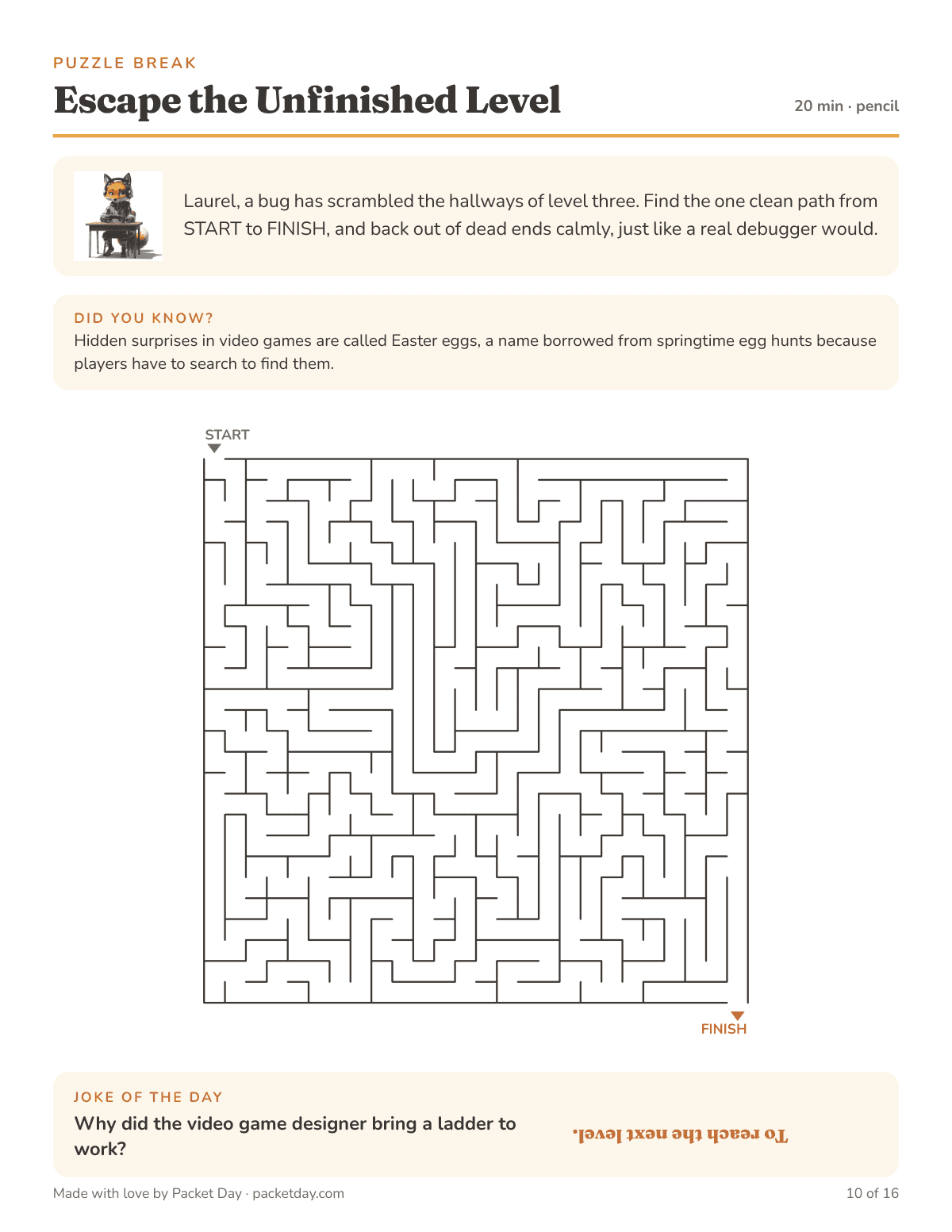
A maze for a brain break between design sessions. 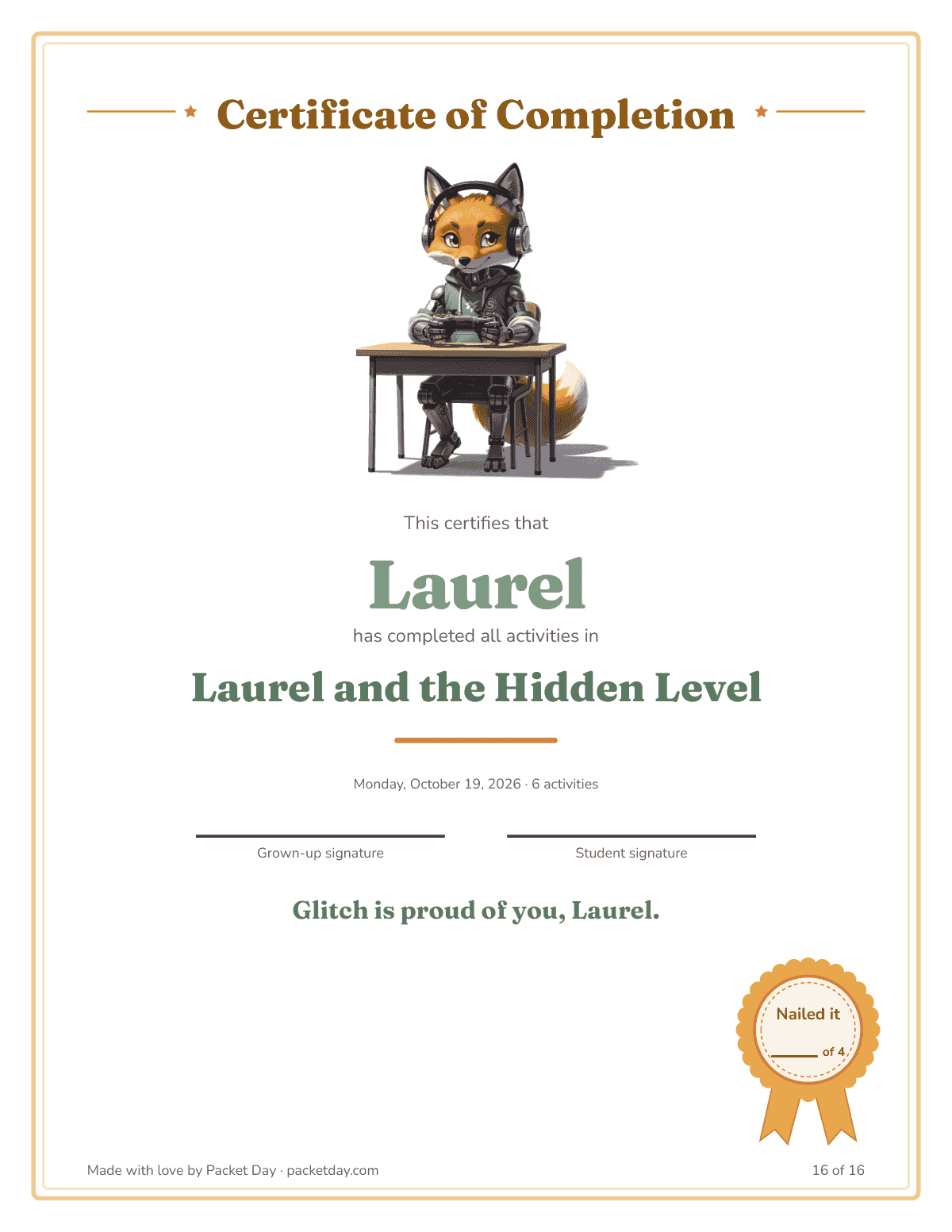
Every packet ends with a certificate to sign and keep.
Does my state test in 6th grade? 🏛️
Learning standards are written for public schools. Your state's homeschool law is a separate thing, and it varies a lot. Some states ask for a yearly check no matter the grade.
North Carolina asks for a nationally standardized test every year. New York asks for an annual assessment, and in grades 4 to 8 a written narrative can stand in for a test every other year. Virginia wants evidence of progress each year, either a test score or an evaluation, and Washington asks for a yearly test or assessment that you keep in your records. Minnesota asks for a nationally norm referenced achievement test every year.
Other states pick certain grades. Georgia asks for a test at the end of grade 3 and at least every three years after that, which puts one by the end of 6th grade. 6th isn't a test grade in Pennsylvania (grades 3, 5 and 8), Tennessee (grades 5, 7 and 9) or Colorado (grades 3, 5, 7, 9 and 11). Arizona, California, Illinois and Ohio don't require one.
Georgia also opens some doors in middle school. Districts that offer exams like the PSAT must open them to home study students in grades 6 to 12, and students in grades 6 to 12 can join sports and activities at their resident public school.
Your state's guide spells out what applies to you.
6th grade homeschool FAQ 💬
Is 6th grade math really that much harder?
It's a big step, because ratios, negative numbers and expressions with letters all show up in one year. But each one builds on 5th grade fractions and decimals. If those feel shaky, a quick review with our 5th grade guide is a good first step.
What science should my 6th grader learn?
The Next Generation Science Standards write middle school science as one band for grades 6 to 8, not one list per grade. Schools split the topics across the three years in different ways. See the science section above for the main areas.
Is my child behind in 6th grade?
Probably not. Kids move through these skills at different speeds, and a gap in one subject is common. Look at the 5th grade skills first, since 6th grade math leans on fractions and decimals.
How many hours a day should I homeschool 6th grade?
Less than a school day. Home doesn't have lining up, waiting or a crowded classroom. Our guide to how many hours a homeschool day takes breaks it down by grade.
What does a 6th grade homeschool day look like?
One simple rhythm: math and reading in the morning while brains are fresh, then writing, science or a project after a break. The sample packet above is one full day: math, reading, writing, a puzzle break, a movement break and science.
How do I teach my 6th grader to argue with evidence?
Start out loud. Have them say a claim, give two reasons and say what would prove each one. Then write it in three short paragraphs. The arguing with evidence section above has a simple four step version.
Do I have to follow Common Core to homeschool?
Only if your state's homeschool law asks for it. Learning standards are written for public schools, and homeschool laws are separate. Many states use Common Core in their public schools, and some, like Texas, Florida and Virginia, set their own standards. Check your state's guide to see what your state asks you to teach.
Want a 6th grade day you don't have to plan? 🌿
Packet Day makes a printable day of learning around your child's grade and interests, for the days you need a backup plan. 11 to 17 pages, generated around your kiddo in a minute or two.
Sources 📖
- Common Core State Standards: Grade 6 Math introduction (checked )
- Common Core: Grade 6 Ratios and Proportional Relationships (checked )
- Common Core: Grade 6 The Number System (checked )
- Common Core: Grade 6 Expressions and Equations (checked )
- Common Core: Grade 6 Statistics and Probability (checked )
- Common Core: Grade 6 Reading, Informational Text (checked )
- Common Core: Grade 6 Writing (checked )
- Common Core: Grade 5 Number and Operations, Fractions (checked )
- Common Core: Grade 7 Math introduction (checked )
- NGSS Appendix K: Model Course Mapping in Middle and High School (checked )
- NGSS: Middle School Structure and Properties of Matter (checked )
- NGSS: Middle School Chemical Reactions (checked )
- NGSS: Middle School Forces and Interactions (checked )
- NGSS: Middle School Energy (checked )
- NGSS: Middle School Waves and Electromagnetic Radiation (checked )
- NGSS: Middle School Structure, Function and Information Processing (checked )
- NGSS: Middle School Growth, Development and Reproduction of Organisms (checked )
- NGSS: Middle School Matter and Energy in Organisms and Ecosystems (checked )
- NGSS: Middle School Interdependent Relationships in Ecosystems (checked )
- NGSS: MS-LS3 Heredity, Inheritance and Variation of Traits (checked )
- NGSS: Middle School Natural Selection and Adaptations (checked )
- NGSS: Middle School Space Systems (checked )
- NGSS: Middle School History of Earth (checked )
- NGSS: Middle School Earth's Systems (checked )
- NGSS: Middle School Weather and Climate (checked )
- NGSS: Middle School Human Impacts (checked )
- NGSS: Middle School Engineering Design (checked )
- Texas Education Agency: Texas Essential Knowledge and Skills (TEKS) (checked )
- Florida Administrative Code: Rule 6A-1.09401, Student Performance Standards (B.E.S.T.) (checked )
- Code of Virginia: § 22.1-253.13:1, Standards of Learning (checked )
- Texas Education Agency: Home Schooling (checked )
Last verified October 2026. Standards are summarized from the sources above. Social studies isn't sourced because it varies so much by state.
This page summarizes public learning standards for general reference. Your state's homeschool law is what applies to your family, so check your state's guide or department of education before making decisions.
Keep exploring 🧭
Nearby grades and a unit study to try
- 5th Grade Homeschool GuideWhat fifth graders typically learn, how to get ready for middle school, easy activities for home and a real grade 5 sample packet.
- 7th Grade Homeschool GuideWhat seventh graders typically learn, how to hand over more independent work, easy activities for home and a real grade 7 sample packet.
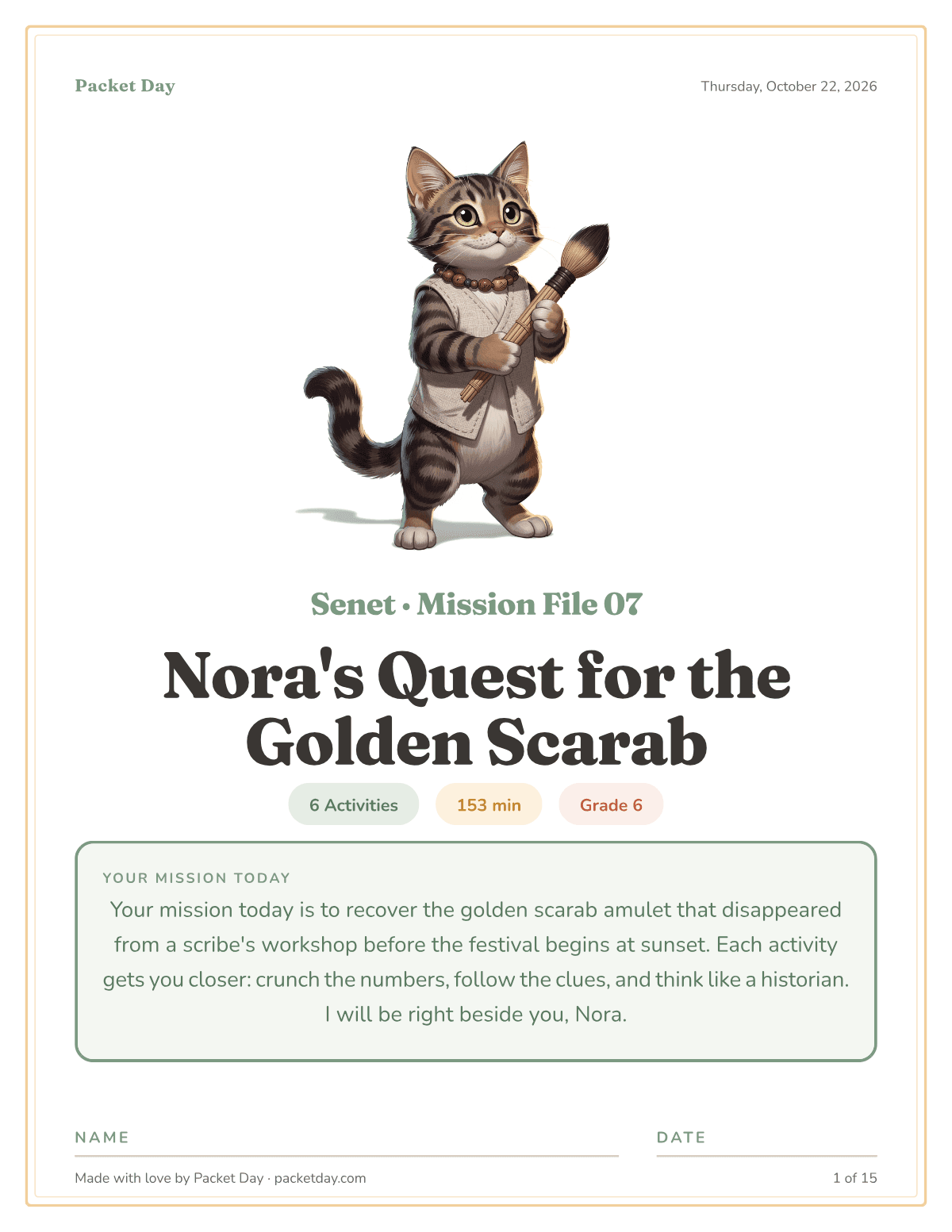 Ancient Egypt unit studyA printable ancient Egypt unit study on the Nile, hieroglyphs and the Rosetta Stone, shown as a grade 6 sample with a scarab mystery. Free to start.
Packets and guides that fit
- How Many Hours of Homeschool a Day? Real Answers by GradeHow many hours of homeschool per day? Real answers by grade (K to 2, 3 to 5, and 6 to 8), plus why home learning needs fewer hours than school.
- New York homeschool requirementsHow to homeschool legally in New York: notice by July 1, an IHIP, quarterly reports, and an annual assessment, with every deadline in one place. Plain English.
Homeschooling in a new state, or just starting out? Our homeschool requirements by state cover what to file and what to keep.
🗺️ Social studies
This one varies a lot from state to state.