
Ancient Egypt Unit Study Packet for Kids
An ancient Egypt unit study packet is a printable school day about the Nile, hieroglyphs and the Rosetta Stone, for kids in K to 8. This grade 6 sample has 15 pages plus a parent answer key: math, reading, history, writing, a word search, a workout, an art page and a certificate. About 153 minutes of activities. Free to start.
By Natalie, homeschool mom and Packet Day co-founder
Updated November 2026Reviewed by Natalie
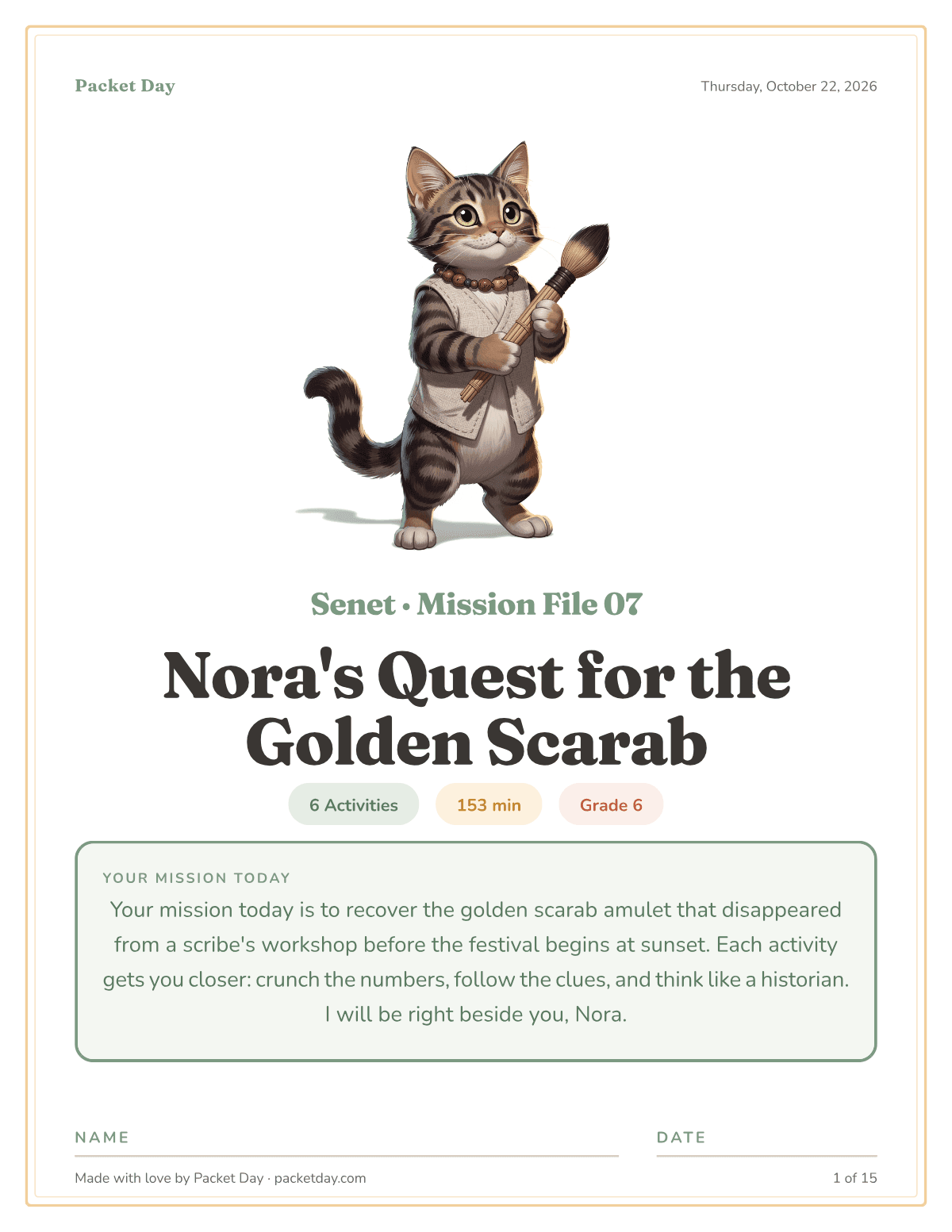
A sample packet made for a grade 6 learner named Nora
What is inside an ancient Egypt packet?
An ancient Egypt packet is a full school day on paper: 11 to 17 pages built around ancient Egypt, roughly 2 to 5 hours with breaks. This sample has 15 pages plus a parent answer key, and Senet the cat guides the whole day.
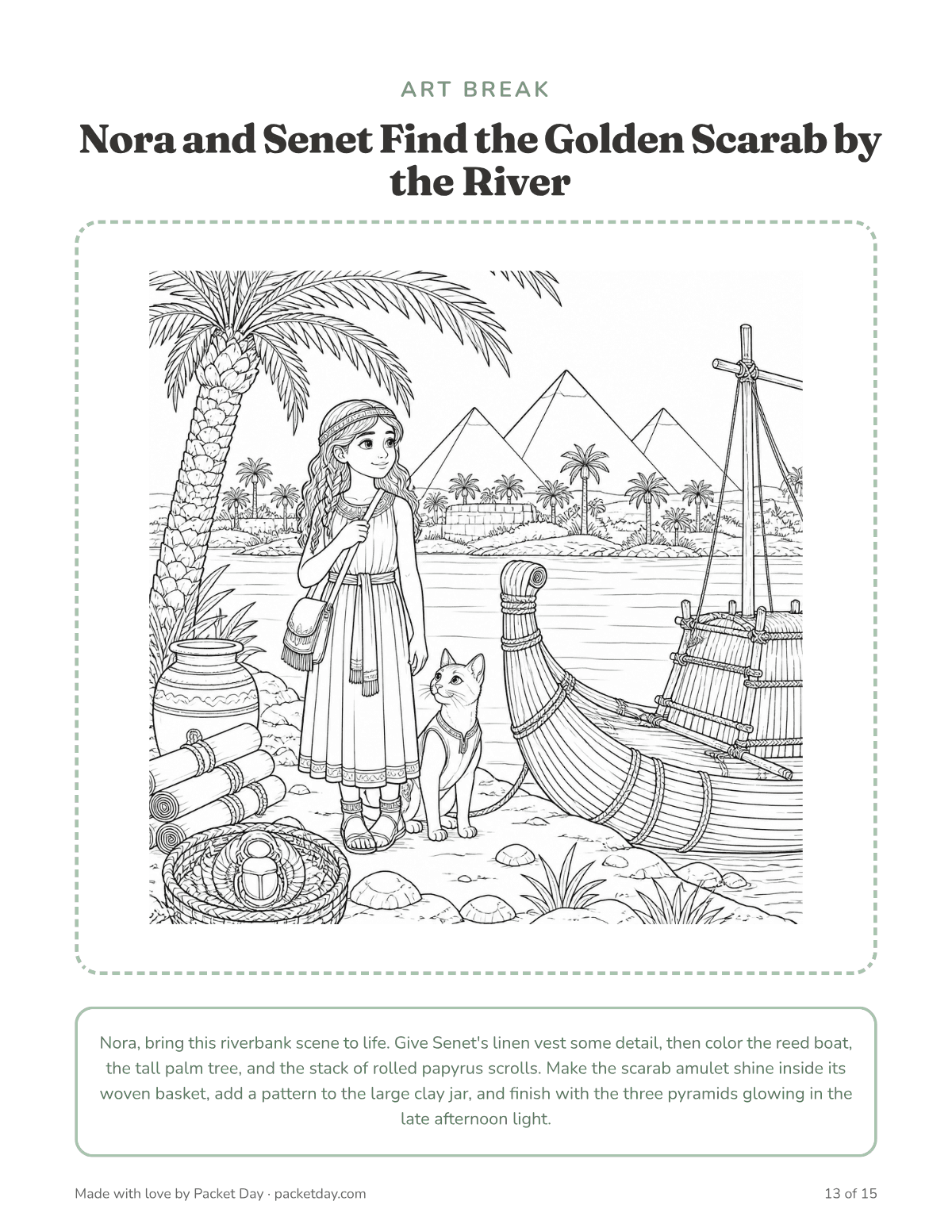
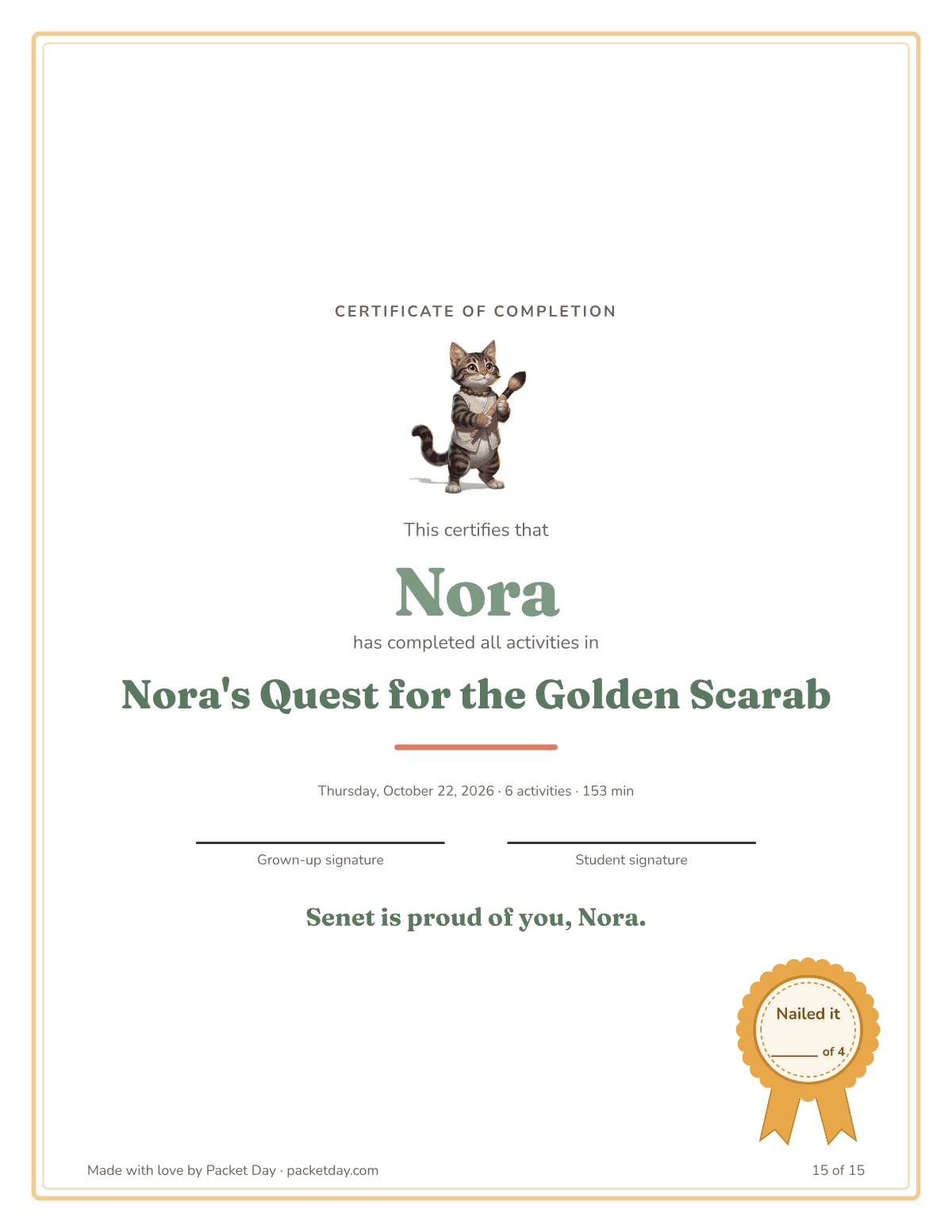
Free printable: Nora's Quest for the Golden Scarab
15 pages, grade 6, answer key included
Want one made for your kid instead? Make one free
What does my child actually do?
Math
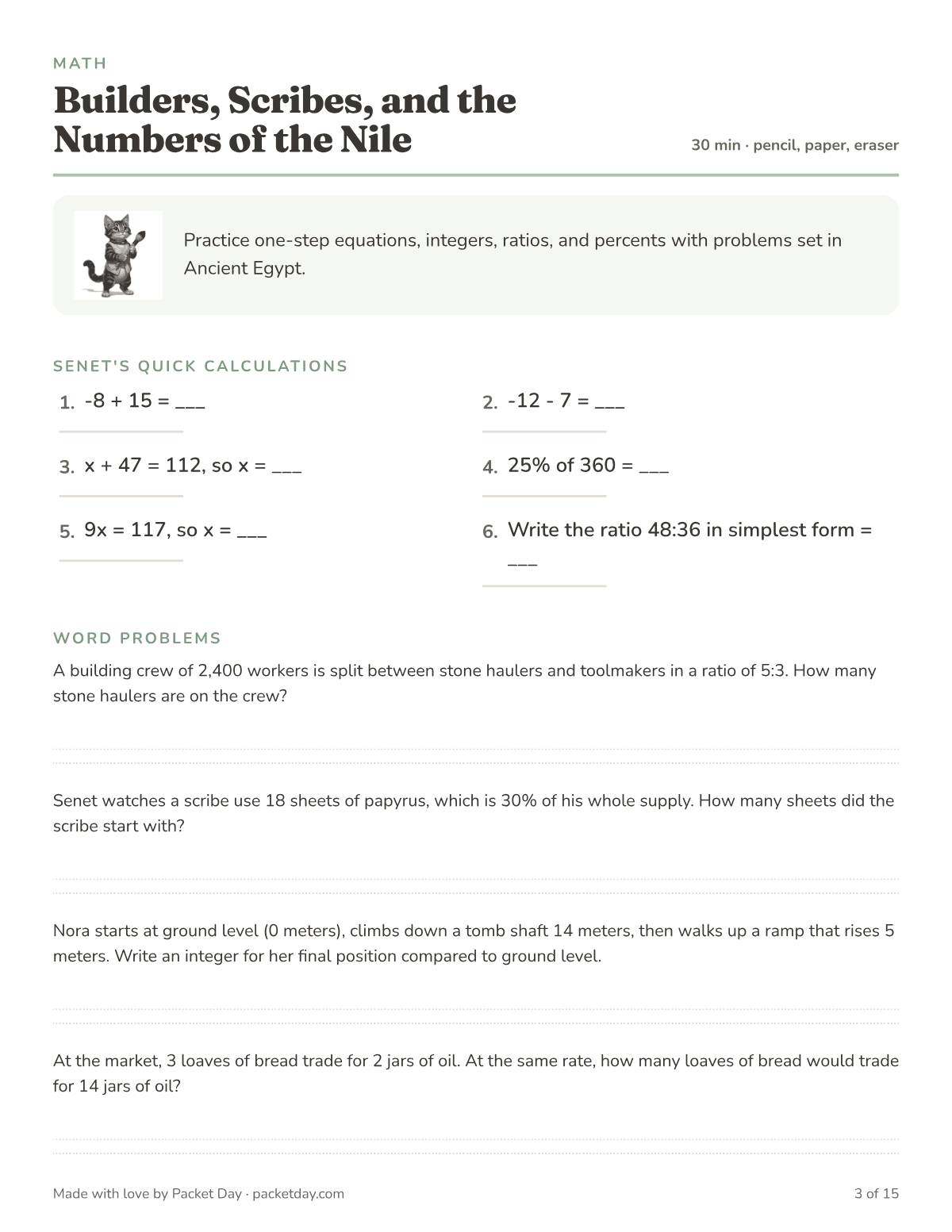
Builders, Scribes, and the Numbers of the Nile
One step equations, integers, percents and ratios, four word problems, then a tape diagram for a bead collar in a 2:5 ratio.
Reading
The Scarab in the Granary
A mystery of about 560 words set along the Nile, then seven questions that ask for recall, vocabulary, inference and a personal connection.
History
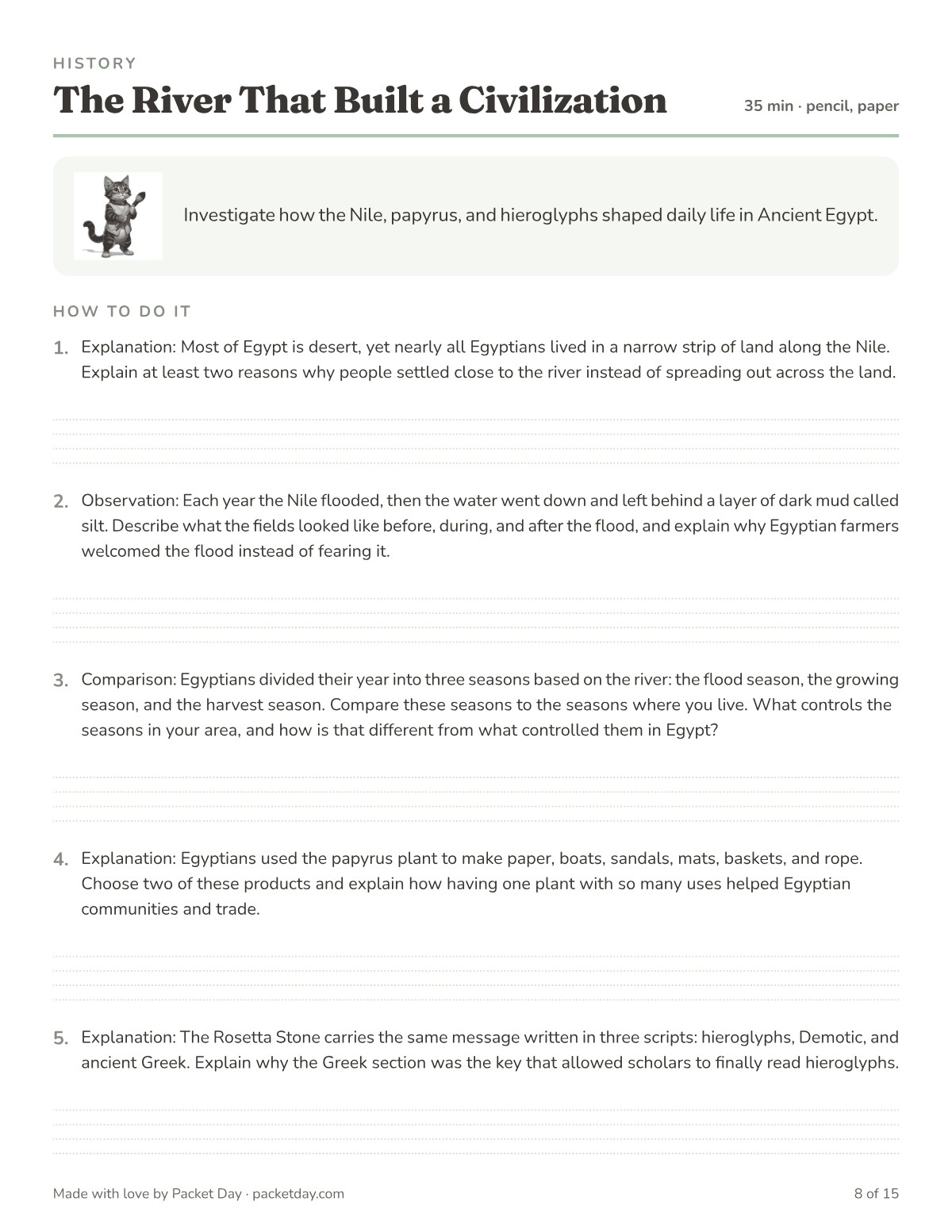
The River That Built a Civilization
Seven written questions on Nile farming, silt, papyrus, low flood years, the Rosetta Stone and how hieroglyphs compare to our alphabet.
Puzzle break
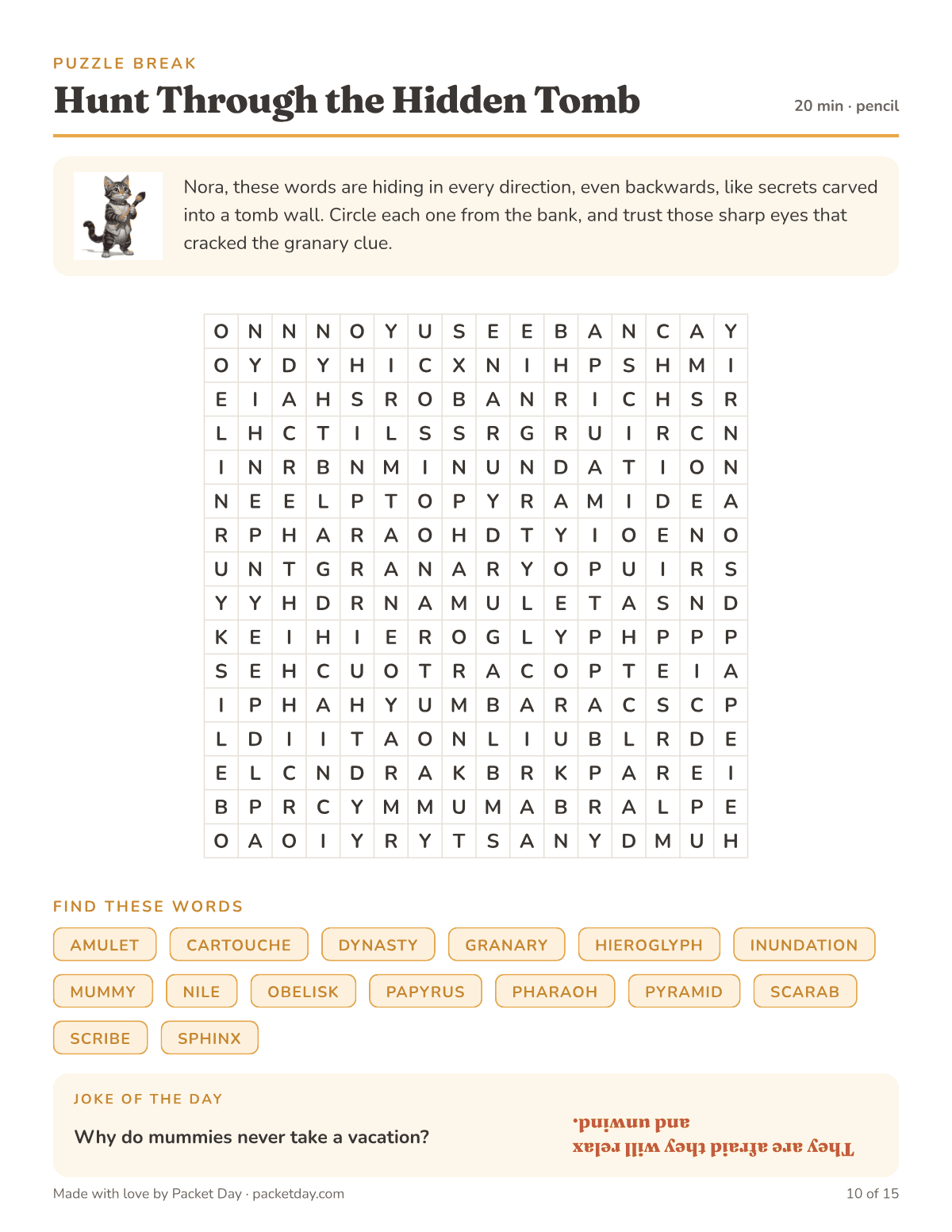
Hunt Through the Hidden Tomb
A 16 by 16 word search with 15 Egypt words hidden in every direction, and a joke about why mummies never take a vacation.
Movement break
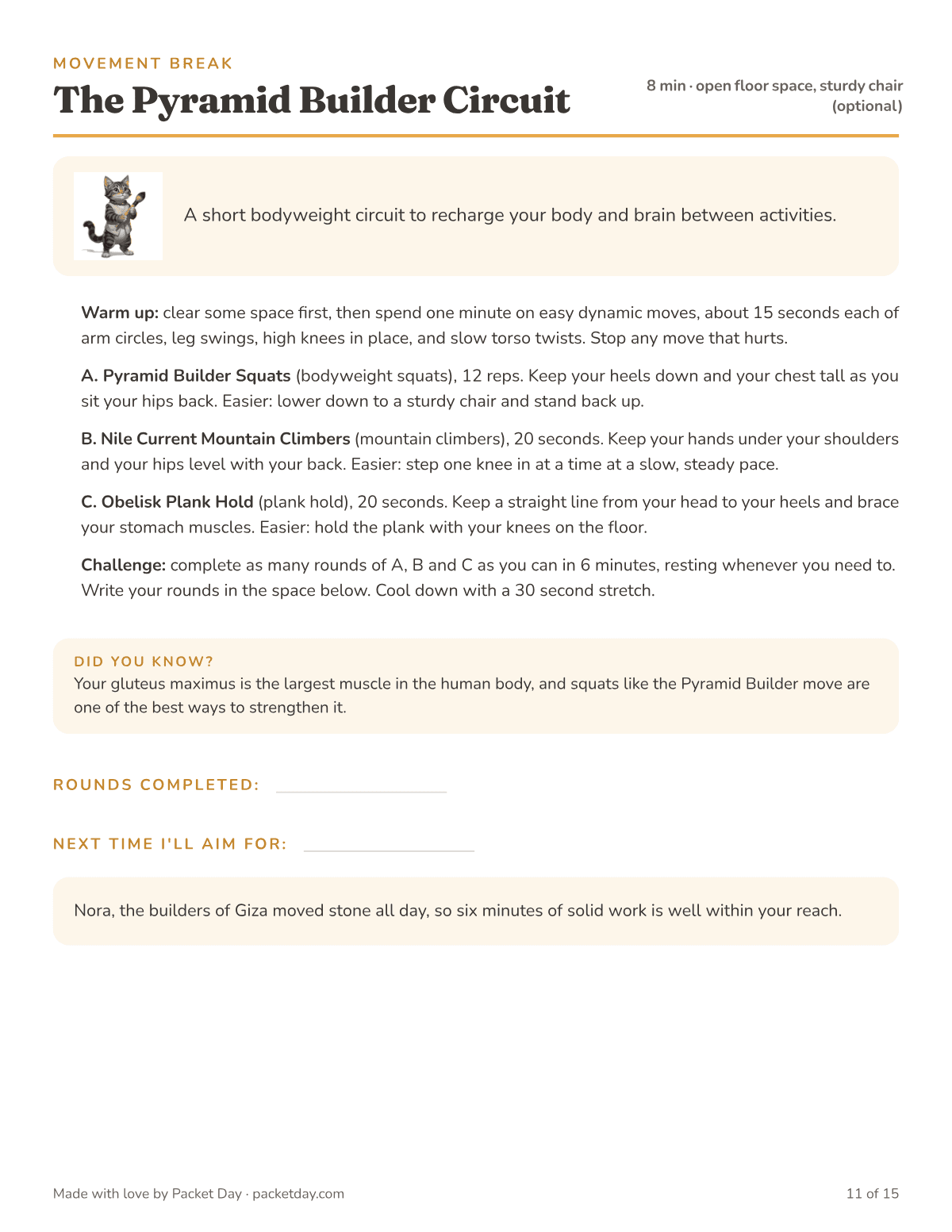
The Pyramid Builder Circuit
A warm up, then as many rounds as they can manage in 6 minutes of squats, mountain climbers and planks, each with an easier version.
Writing
The Apprentice's Diary
A diary entry of at least three paragraphs from the point of view of Meri's apprentice, with a prompt for each paragraph.
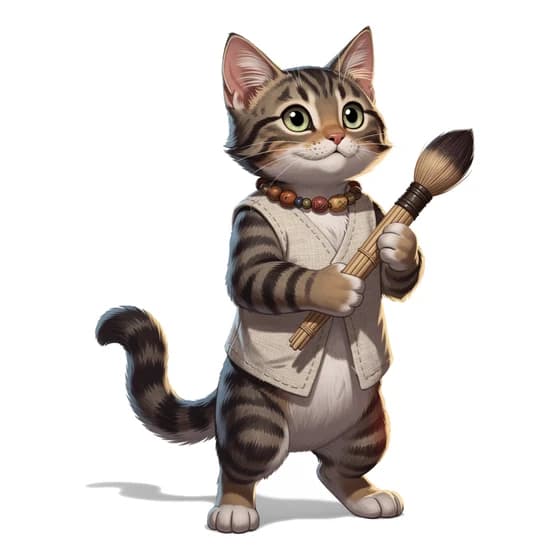
Meet Senet
Senet is a tabby cat in a linen vest and a bead collar, and he carries a paintbrush like it's a staff of office. His name comes from senet, a real board game in ancient Egypt. His first word in the story is "Focus."
He trots beside Nora along the Nile, teaches her which way to read a line of hieroglyphs, watches a scribe count papyrus in the math and sends her into the word search with a compliment about her sharp eyes.
A dry, slightly bossy cat is a good guide for a middle schooler. He treats Nora like a partner, not a little kid. His whole review of the day: "Not bad for one afternoon."
What will my child learn?
Your child gets a full grade 6 day: one step equations, integer math, ratios and percents, reading a longer story for evidence, answering history questions in their own words and writing from someone else's point of view.
The history is all cause and effect. The Nile flooded every year and left dark silt on the fields, so Egyptian farmers welcomed the water. A very low flood meant poor crops and not enough food. Even the calendar came from the river, with a flood season, a growing season and a harvest season.
Then comes writing itself. Papyrus became paper, boats, sandals and rope. Some hieroglyphs stand for sounds and others for whole words or ideas. Your kid works out why the Greek on the Rosetta Stone was the way in, then weighs what's hard about a writing system with hundreds of symbols.
Which grades is this for?
Grades K-2
Little Egypt fans get the same theme with short reading, simple words, early math and just a few sentences to write. Each packet is written new for the grade you pick.
Grades 3-5
Elementary kids get pyramids and the Nile too, with longer reading, richer vocabulary, math at their grade and more writing. Every packet is made from scratch for your kid's exact grade.
Grades 6-8
This sample is grade 6, so we can be specific. The story runs about 560 words. The math covers integers, one step equations, ratios and percents. The history section has seven written questions, and the diary asks for at least three paragraphs.
A note from Natalie
We just wrapped up ancient Egypt in our history curriculum, and the kids got completely hooked on mummies and pyramids. King Tut was the big favorite. They could not stop talking about what was found in his tomb and how the tombs were laid out.
If you have a kid like that, this packet gives all that excitement somewhere to go. Nora and Senet chase a missing scarab, and the history section digs into the river that made the whole civilization possible.
Middle schoolers can run most of this day on their own. (You get a quieter afternoon.)
Questions parents ask about ancient Egypt packets
Why was the Nile so important to ancient Egypt?
Most of Egypt is desert, so the Nile meant water, food and a way to travel. Each year it flooded and left dark silt that made the fields rich, and nearly everyone lived along that narrow strip. The history section asks your kid to explain why, then predict what happens in a year with a very low flood.
How do you read Egyptian hieroglyphs?
Start with the faces. People and animals in a line of hieroglyphs look toward the start of the line, so you read toward them. That means a line can run left to right or right to left, and signs can also run in columns. The story teaches this trick, and a history question compares the system to our alphabet.
What is the Rosetta Stone, and why does it matter?
It is a stone carved with one decree in three scripts: hieroglyphs, Demotic and ancient Greek. It was found in 1799. Scholars could already read Greek, so they could compare it with the hieroglyphs, and Jean Francois Champollion announced he had cracked the code in 1822. The history section asks your kid to explain why the Greek mattered.
Why did ancient Egyptians care so much about scarab beetles?
A scarab rolls a ball of dung across the ground, and Egyptians compared that to the sun moving across the sky. So the beetle came to stand for sunrise and new beginnings. A carved heart scarab was often placed over a mummy's heart for the afterlife. Yes, your middle schooler will enjoy the dung part. The story ends on it.
Who built the pyramids?
Most archaeologists and historians today think paid Egyptian laborers built the pyramids at Giza, not enslaved people. Workers' tombs found near the pyramids are part of that evidence. The math section puts your kid on the job site, splitting a crew of 2,400 workers by ratio. The Did You Know there adds that each side of the Great Pyramid's base is about 230 meters.
Are these made by AI, and are they any good?
Yes. AI writes every packet new, built around your kid's grade and the theme you give it. We are a homeschool family, our own kids test packets, and we fact check each sample shown here. Think of it as a strong first draft of a school day. Skim it first, and use the answer key to check the rest.
Packets for the days you need one
Fun Fridays
Friday packet day, the tradition that started Packet Day.
See how it works →Multiple kids
Two kids, two levels, one of you. One packet per kid fixes that.
See how it works →Browse every unit study packetSee a full sample packet
Tired of hunting down free worksheets? See the difference.
Keep the learning going
More unit study packets
 Dinosaurs unit studyA printable dinosaur unit study on T. rex, Triceratops and how a bone turns into a fossil, shown as a grade 5 sample with dig site math. Free to start.
 A Christmas Carol unit studyA printable A Christmas Carol unit study for December: Scrooge, the three spirits and London's coal smoke fogs, shown as a grade 7 sample. Free to start.
 Thanksgiving unit studyA printable Thanksgiving unit study on the Mayflower, the 1621 harvest and the Wampanoag Three Sisters garden, with real grade 4 math. Free to start.
Packets and guides that fit
- 6th Grade Homeschool GuideWhat sixth graders typically learn, how to teach arguing with evidence, easy activities for home and a real grade 6 sample packet.
- Fun Friday: The Weekly Tradition That Saved My HomeschoolEvery Friday is packet day in our homeschool. Here's how to start your own Fun Friday tradition, without the Thursday night assembly line I used to run.
Ready for your own ancient Egypt day?
Packet Day makes print ready, themed learning packets for kids in K to 8, built around whatever your kid is obsessed with.
Make your own ancient Egypt packet freeFree is 1 packet a month, no card needed. Unlimited is $9 a month billed annually ($108 a year) or $12 month to month.