
Thanksgiving Unit Study Packet for Kids
A Thanksgiving unit study packet is a printable school day about the Mayflower, the 1621 harvest and Wampanoag farming for kids in K to 8. This grade 4 sample has 14 pages plus a parent answer key: math, reading, writing, a word search, movement, science, coloring and a certificate, about 127 minutes of activities, plus breaks. Free to start.
By Natalie, homeschool mom and Packet Day co-founder
Updated October 2026Reviewed by Natalie
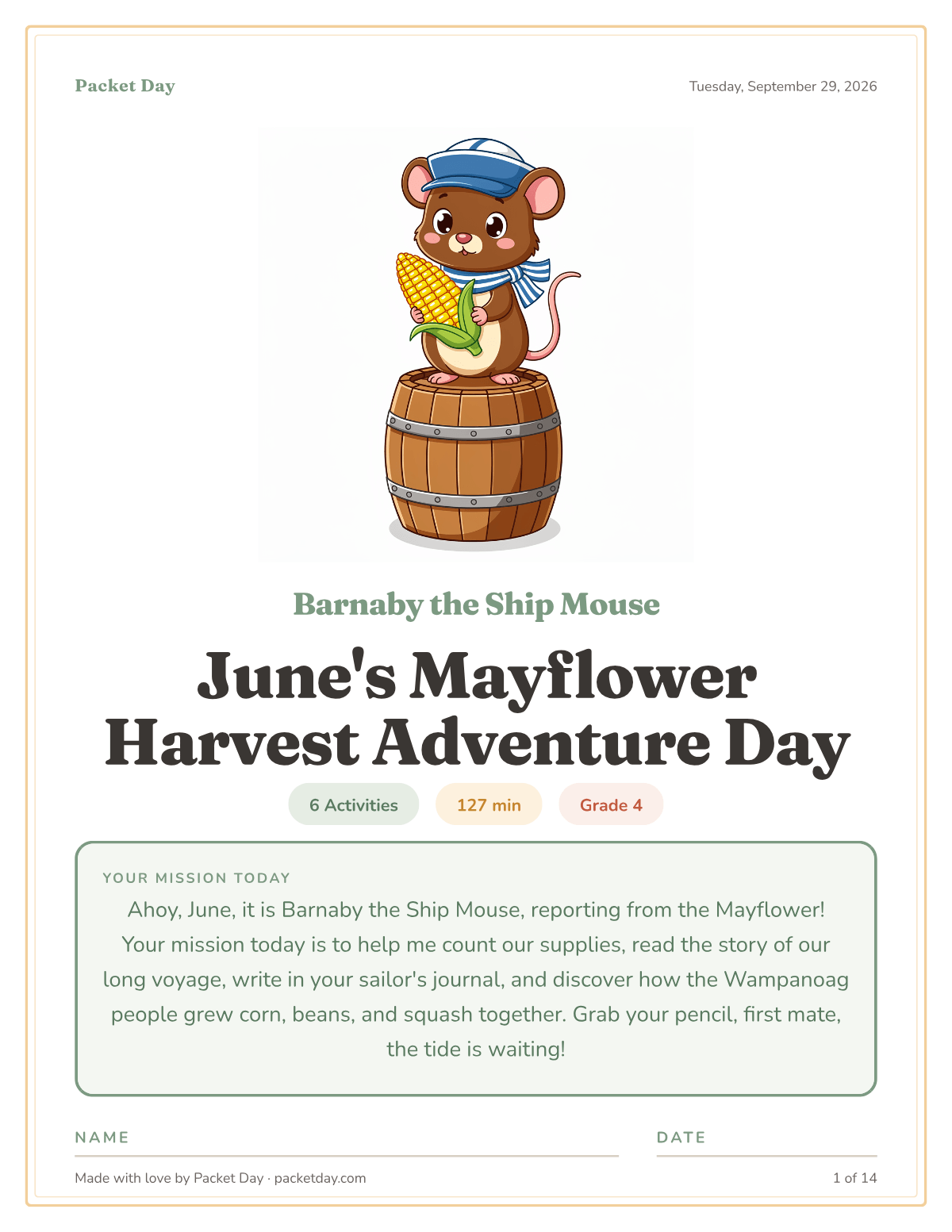
A sample packet made for a grade 4 learner named June
What is inside a Thanksgiving packet?
A Thanksgiving packet is a full school day on paper: 11 to 17 pages built around Thanksgiving, roughly 2 to 5 hours with breaks. This sample has 14 pages plus a parent answer key, and Barnaby the Ship Mouse guides the whole day.
What does my child actually do?
Math
Counting Supplies on the Mayflower
Six quick problems, word problems about 102 passengers, a 66 day voyage and 288 corn mounds, and an area model for a 23 by 14 foot garden.
Reading
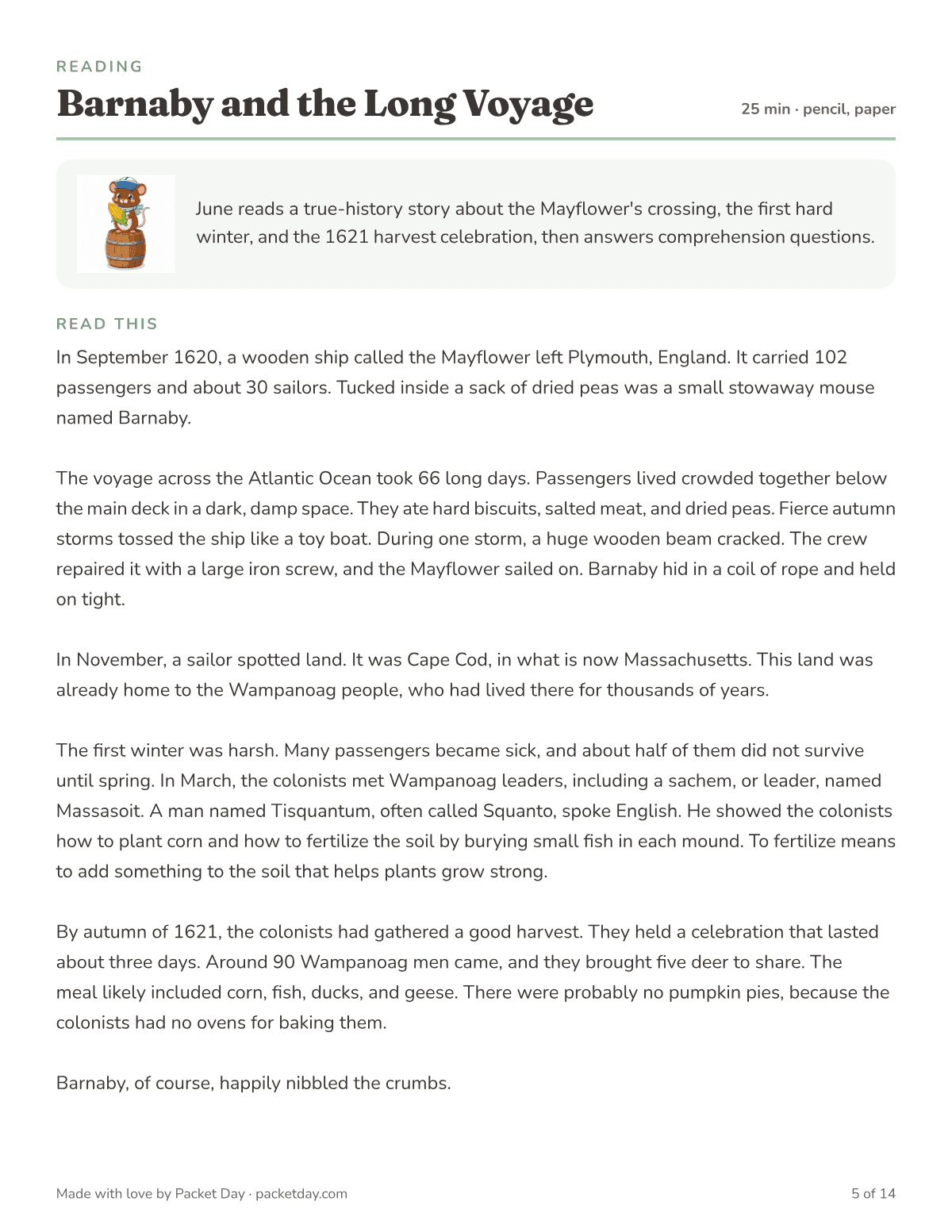
Barnaby and the Long Voyage
A true history passage from the 1620 crossing to the 1621 harvest, then six questions, including why Wampanoag help mattered so much.
Writing
My Mayflower Voyage Journal
A dated journal entry of at least two paragraphs, written as a young passenger or as Barnaby, using three of the five senses.
Puzzle break
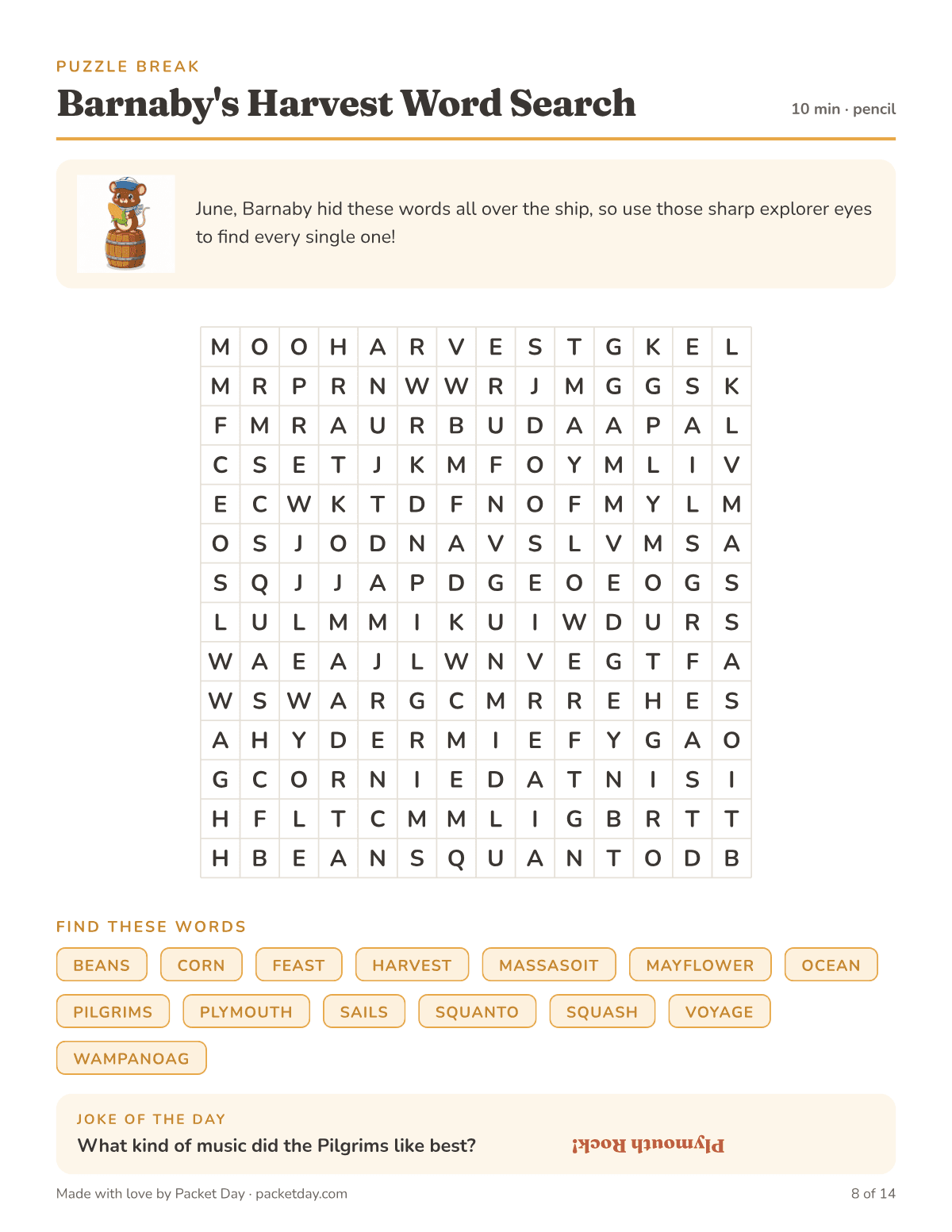
Barnaby's Harvest Word Search
Fourteen words from the voyage and the harvest, Mayflower and Wampanoag included, plus a joke of the day.
Movement break
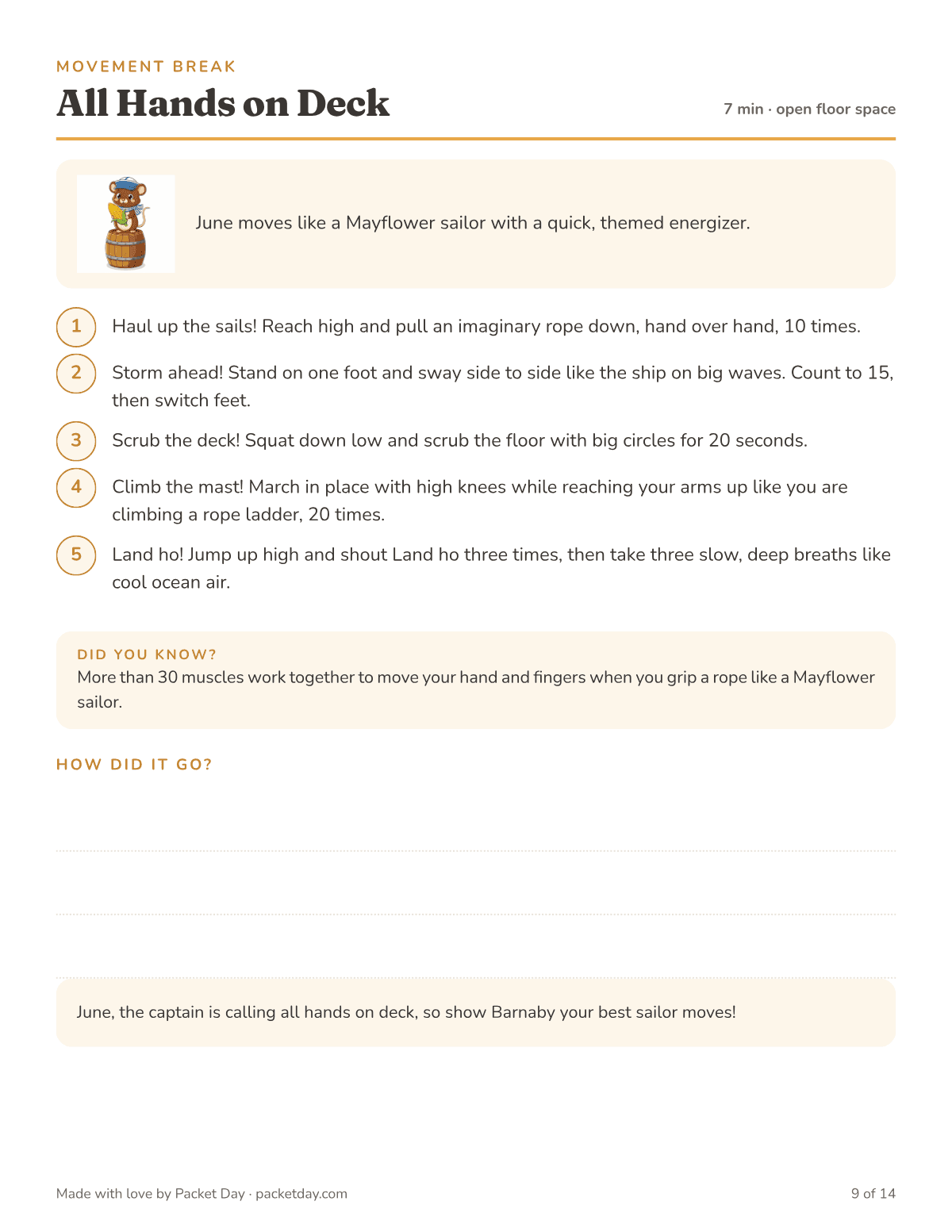
All Hands on Deck
Hauling sails, balancing like the ship on big waves, scrubbing the deck, climbing the mast and a big land ho.
Science
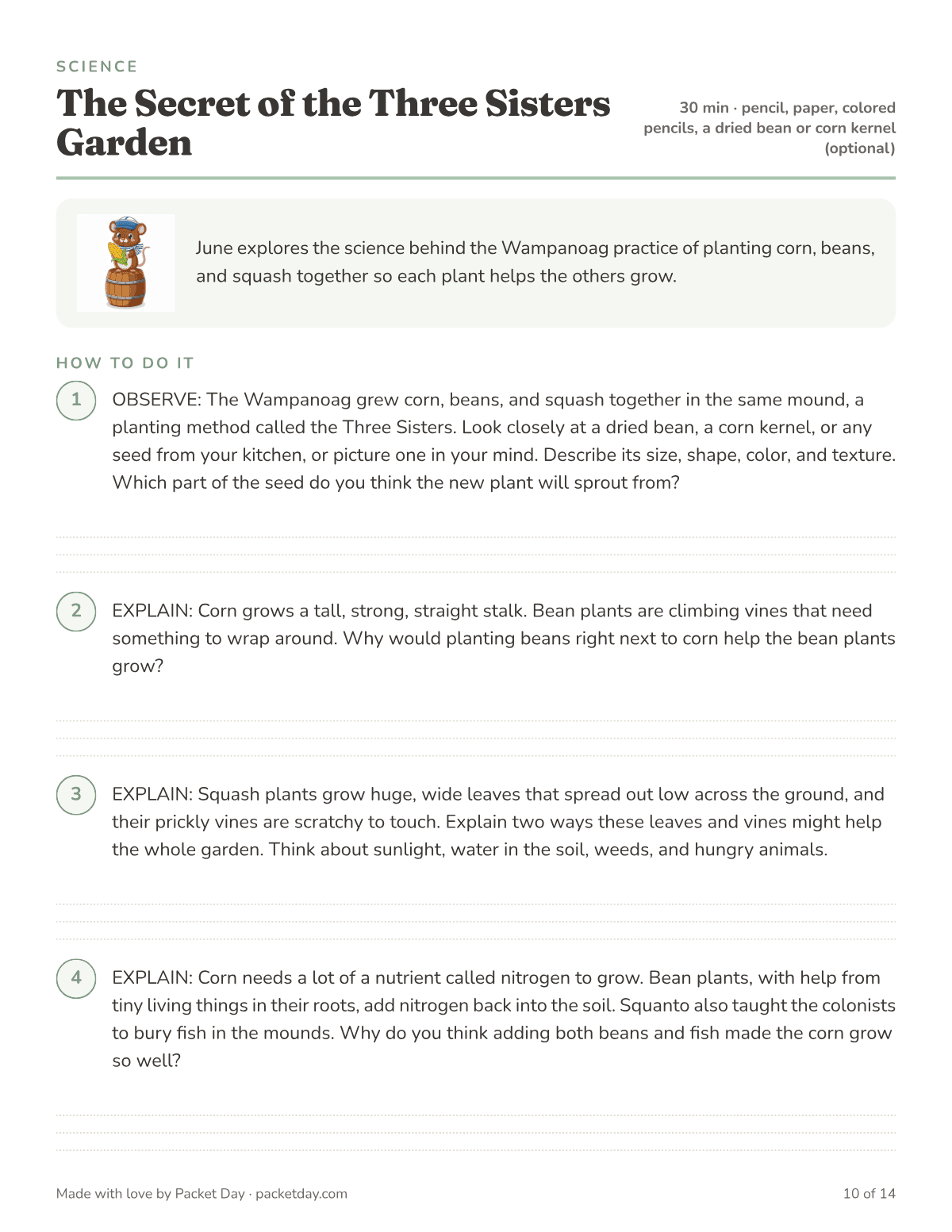
The Secret of the Three Sisters Garden
Why the Wampanoag planted corn, beans and squash in one mound, how each plant helps the others, and what happens to soil planted with corn alone.
Meet Barnaby
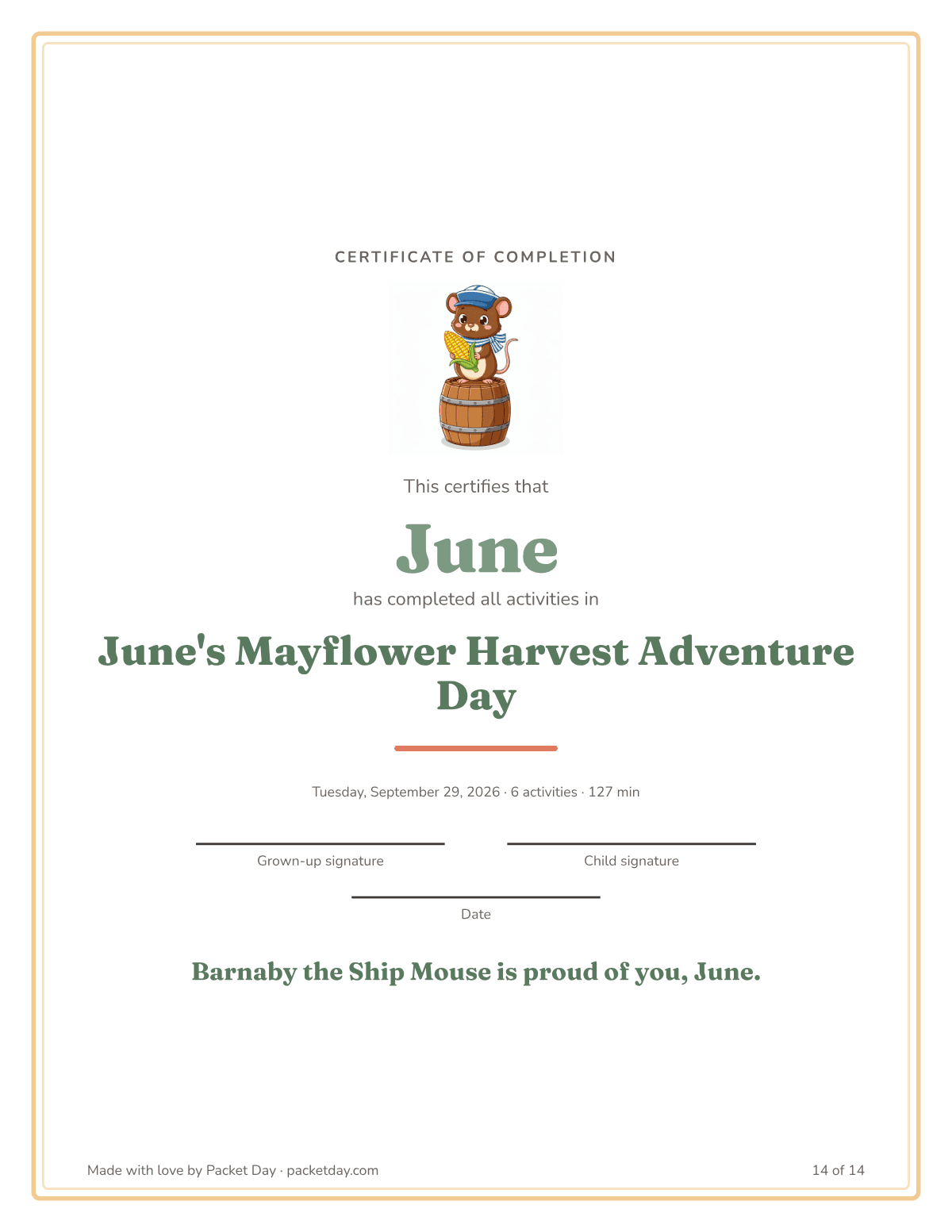
Barnaby the Ship Mouse is a stowaway. The reading passage finds him tucked inside a sack of dried peas when the Mayflower leaves England, hiding in a coil of rope during the storms, and nibbling crumbs at the harvest celebration.
He counts supplies in the math problems, hides the words in the word search and sails beside June on the coloring page. The writing prompt even lets June write the journal as Barnaby instead of as a passenger.
He is a useful guide for a heavy subject. The facts in the passage are real, and Barnaby is the one piece of it that is made up, which is a nice thing to point out to your kid.
What will my child learn?
Your child practices math, reading, writing and science in one day: grade 4 multiplication and division, reading a true history passage closely, writing a journal entry and learning how Wampanoag farmers made three crops work together.
In math, June adds and subtracts larger numbers, multiplies two digit numbers (36 x 47), divides with remainders (66 days is 9 weeks and 3 days) and finds a fraction of a set. The draw and solve uses an area model, splitting 23 by 14 into four smaller rectangles.
The reading questions ask for details, a vocabulary word (fertilize), an explanation using evidence and a personal connection. In science, June explains how corn holds up the beans, how squash leaves shade out weeds, and how beans put nitrogen back into the soil, then predicts what corn alone does to a field over the years.
Which grades is this for?
Grades K-2
Younger kids get the same Thanksgiving theme at their level: shorter reading, easier words, math at their grade and short writing. Every packet is written fresh for the grade you pick.
Grades 3-5
This sample is grade 4, so here we can be specific. The passage is about 290 words of real history, the math reaches two digit multiplication, long division with remainders and area models, and the journal entry asks for at least two paragraphs.
Grades 6-8
Middle schoolers get Thanksgiving with longer reading, harder vocabulary, math at their grade and more writing. Each packet is made from scratch for your kid's exact grade.
A note from Natalie
Our big Thanksgiving tradition with the kids is the Thankful Tree. We cut out paper leaves in different fall colors.
Through the week leading up to Thanksgiving, we write something we're thankful for on each leaf and glue it to the tree.
Some leaves are sweet, like "I am thankful for my family." Some are fun, like one of Oliver's: "I am thankful for pepperoni pizza."
Questions parents ask about Thanksgiving packets
Is this Thanksgiving packet historically accurate?
Mostly, yes, with two small liberties worth pointing out. The facts hold: 102 passengers, 66 days at sea, about 90 Wampanoag men at a three day harvest celebration. But one math problem calls those men guests, though Winslow's letter never says they were invited, and the coloring page puts a pumpkin on the Mayflower. Pumpkins are native to the Americas. Both make great talking points.
How do I teach Thanksgiving from the Wampanoag perspective?
Start with the fact that the Wampanoag lived there for thousands of years before 1620 and still live in Massachusetts today. Plymouth was built where Patuxet stood, a village emptied by an epidemic a few years earlier. Since 1970, many Native people have gathered in Plymouth on Thanksgiving for a National Day of Mourning. The science page centers Wampanoag farming.
Was there pumpkin pie at the 1621 harvest?
No, there almost certainly was no pumpkin pie, because the colonists had no ovens and little sugar. Winslow's letter mentions wild birds and the five deer, and corn was surely there. The event was not called Thanksgiving at the time either. It was a harvest celebration, which is how the packet describes it, and reading question five asks about the pie.
Who was Squanto?
Squanto, whose name was Tisquantum, was a Patuxet man who spoke English because an English captain kidnapped him in 1614 and took him to Spain. He made his way to England and back home in 1619, and found his village gone after the epidemic. The packet covers what he taught the colonists, so the rest is worth adding.
Is the Mayflower story too sad for a fourth grader?
No, the packet handles the hard part in one plain sentence: about half the passengers did not survive the first winter. It doesn't dwell on it, and the parent note tells you it is coming so you can be ready. Most fourth graders ask why, which opens the best conversation of the day about cold, hunger and sickness.
Are these made by AI, and are they any good?
Yes, AI writes each packet from scratch around your kid's grade and the theme you type in. We are a homeschool family and test packets on our own kids. They are good, and they are not perfect, which matters most on a history theme, so read the passage before you hand it over. The answer key makes checking the math quick.
More unit study packets
Pumpkins
Sample made for grade 2
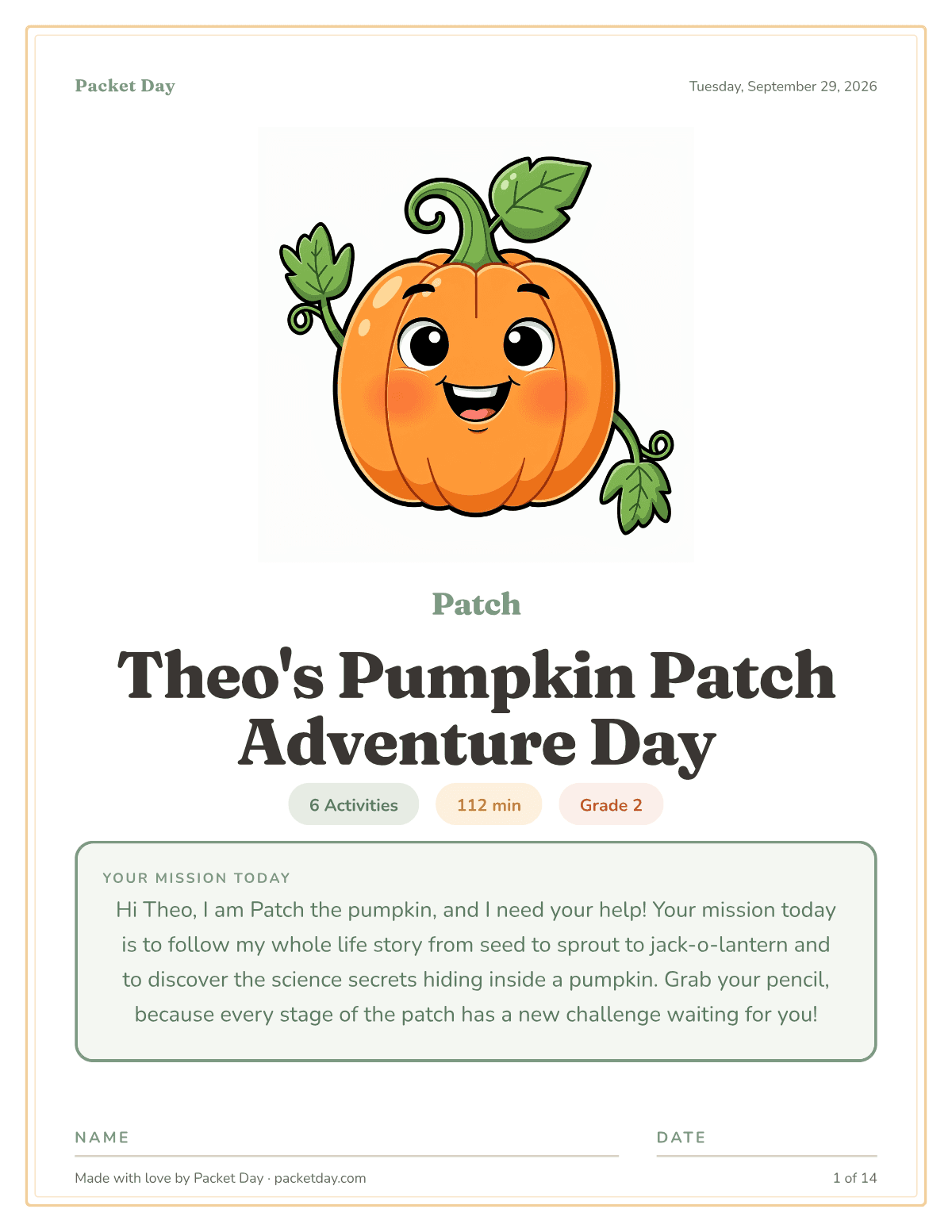
A printable pumpkin unit study that follows one pumpkin from seed to jack-o-lantern, with a float test, skip counting and a shape sudoku. Free to start.
See the pumpkins packet →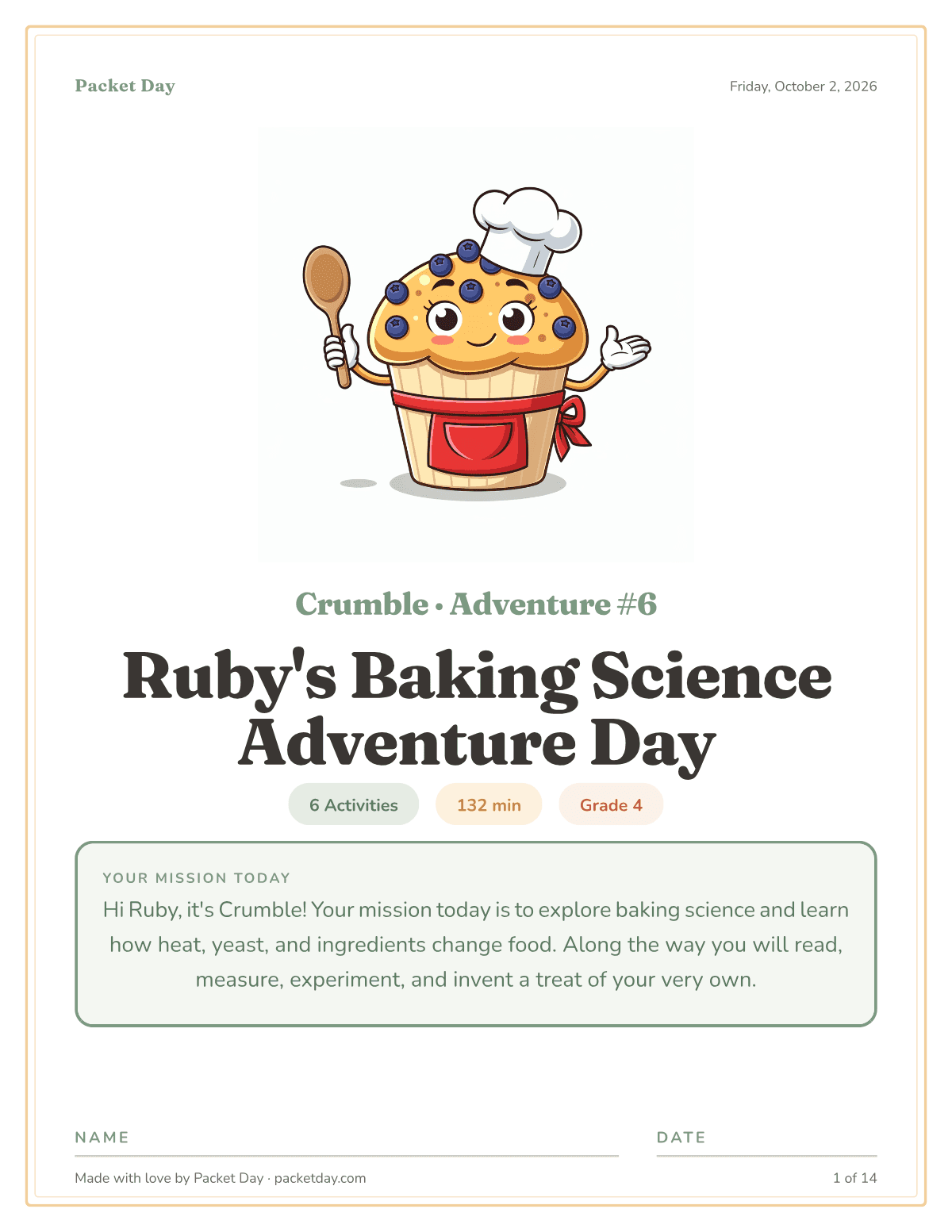
Baking Science
Sample made for grade 4
A printable baking science unit study on yeast, gluten and oven heat, with a two cup yeast experiment and bakery math in a grade 4 sample. Free to start.
See the baking science packet →Every unit study packet
See all the themes we have made so far, each with real pages from a sample packet.
Browse the unit studies →Packets for the days you need one
Ready for your own Thanksgiving day?
Packet Day makes print ready, themed learning packets for kids in K to 8, built around whatever your kid is obsessed with.
Make your own Thanksgiving packet freeFree is 1 packet a month, no card needed. Unlimited is $9 a month billed annually ($108 a year) or $12 month to month.