
4th Grade Homeschool Guide
Fourth grade is where math gets bigger and writing gets longer. Kids multiply bigger numbers, work with equivalent fractions, and write whole pieces with reasons and details. Here's what that usually looks like, and how to teach it at your kitchen table.
Ages: usually 9 to 10. Age cutoffs vary by state.
Homeschool mom of two and co-founder of Packet Day
✓ Last verified against official learning standards
The short answer ⚡
Most fourth graders work on multiplying and dividing bigger numbers, equivalent fractions, longer writing with reasons and details, reading for theme and main idea, and science like energy and how land changes. That list comes from the learning standards many states use for public schools. Your state's homeschool law may not ask you to follow it, so treat it as a helpful map, not a rulebook.
The year at a glance 👀
What 4th graders typically learn 📚
Here's what the standards ask for by the end of 4th grade, in plain English. Kids get there at different speeds, and that's normal.
Math
Bigger numbers, and fractions that start to make sense.
- Multiplying a number with up to four digits by a one digit number, and multiplying two two digit numbers.
- Dividing numbers with up to four digits by a one digit number, and finding the remainder.
- Adding and subtracting bigger whole numbers with the standard algorithm.
- Rounding whole numbers to any place.
- Equivalent fractions: seeing why 1/2 and 2/4 are the same amount, with pictures and models.
- Adding and subtracting fractions that have the same denominator.
- Decimals for tenths and hundredths, like 0.62 as 62/100.
- Angles: what they are and how they're measured.
At the kitchen table: Use measuring cups. Is 2/4 cup of milk the same as 1/2 cup? Pour it both ways and check.
Reading
Reading with a pencil in hand.
- Pointing to details and examples from the text to explain what it says and to make inferences.
- Finding the theme of a story, poem or play from its details, and summarizing it.
- Finding the main idea of nonfiction and explaining how the details support it.
- Describing a character, setting or event in depth, using specific details.
At the kitchen table: After a chapter, ask, "What's the big idea, and which details back it up?" Then have them summarize it in a few sentences.
Writing
Longer pieces with a plan.
- Opinion pieces that give reasons and information.
- Informative writing that introduces a topic and groups related facts into paragraphs and sections.
- Stories with descriptive details and a clear order of events.
- Short research projects that gather information from print and digital sources, take notes and list sources.
At the kitchen table: Have them pick a topic they love, take notes on index cards, and turn the notes into one page with a heading.
Science
Real investigations, with real mess.
- Energy: it moves from place to place by sound, light, heat and electric currents.
- Engineering: designing, testing and improving a device that changes energy from one form to another, like a circuit that lights a bulb.
- Structures: how the parts of plants and animals, like roots, thorns, hearts and lungs, help them survive.
- Landforms: how water, ice, wind and plants wear down and move the land.
At the kitchen table: Fill a tray with dirt, make a gentle slope, then a steep one. Pour water down each and compare what washes away.
How 4th grade fits in 🧩
Every year builds on the one before it. Here's what kids usually bring in, and what the next year picks up.
What they bring from 3rd grade
- Times tables from memory, and multiplying and dividing within 100.
- Fractions as numbers on a number line, with halves, thirds, fourths, sixths and eighths.
- Area and perimeter.
- Reading for meaning and writing paragraphs with a point.
What's coming in 5th grade
- Multiplying multi digit numbers with the standard algorithm.
- Adding and subtracting fractions with unlike denominators. Equivalent fractions from 4th grade are the key to this.
Where this list comes from 🧭
Many states teach public school math and English from the Common Core State Standards. That's where the math, reading and writing lists above come from. The science list comes from the Next Generation Science Standards. Every list links to the official standards in our sources at the bottom of this page.
Some states set their own standards instead, like Texas, Florida and Virginia. Not every state uses the science standards either. If you live in one of those states, its own standards are the better map, and the details and order may differ from what's here.
Homeschool rules are a separate thing. In Texas, for example, TEA points parents who are interested to its standards, the TEKS, as a resource. Check your state's guide for what applies where you live.
Easy 4th grade activities for home 🏡
No prep, no printer needed. Each one fits in a spare half hour.
Area model multiplication. Draw a rectangle for 14 x 23. Split it into tens and ones, find each part's area, then add the parts. Check with the usual method.
Fraction strips. Cut paper strips into halves, fourths and eighths. Line them up and find which pieces are equal, like 2/4 and 1/2.
Teach me the chapter. After a chapter or a nonfiction page, have them tell you the theme or the main idea and point to the details that prove it.
Energy detective. Walk around the house and find energy changing form: a toaster, a lamp, a speaker. Write down what goes in and what comes out.
One page research. Pick a topic, find two sources, take notes and write a one page report with a heading and a list of sources.
A real 4th grade sample packet 🧁
Here are five pages from a real sample packet, made for a fourth grader we call Ruby. Crumble the muffin runs a kitchen full of science with Ruby, and every page is matched to grade level.
This sample has 14 pages, 6 activities and about 132 minutes of work, plus an answer key for you. Every packet is made new for your child, so yours will look different.
Crumble the muffin, ready to run the kitchen. 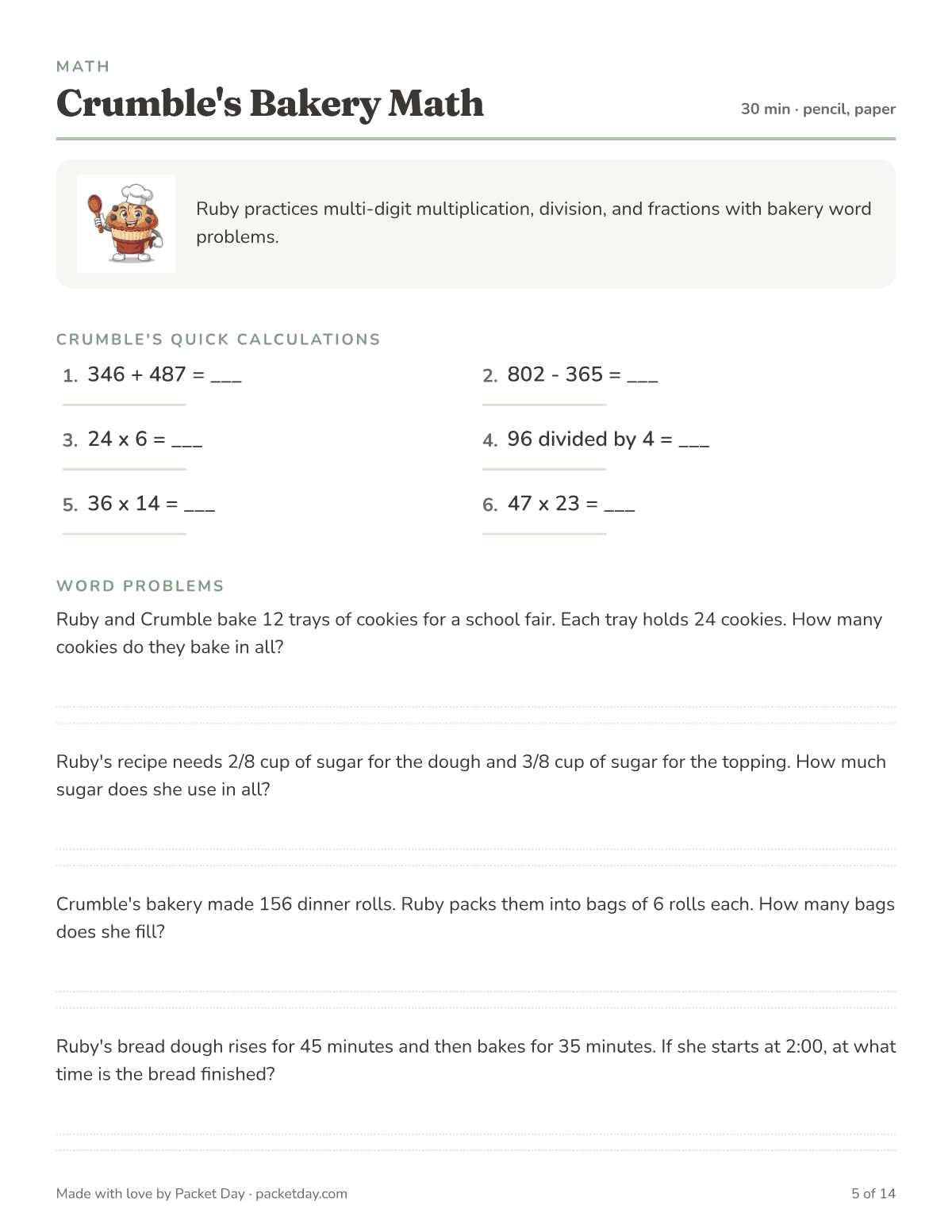
Two digit multiplication with a cookie tray attached. 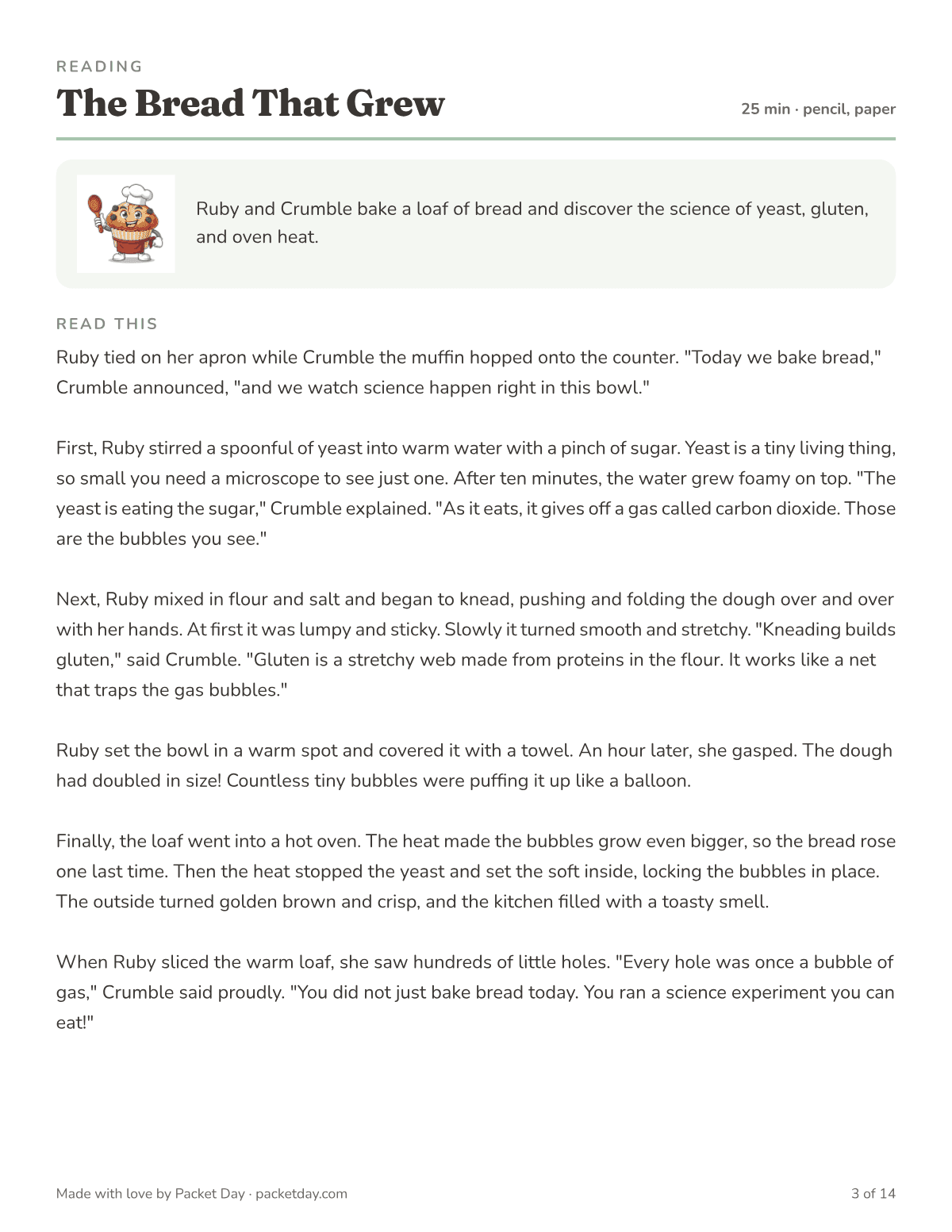
One loaf of bread, start to finish, with the science in every step. 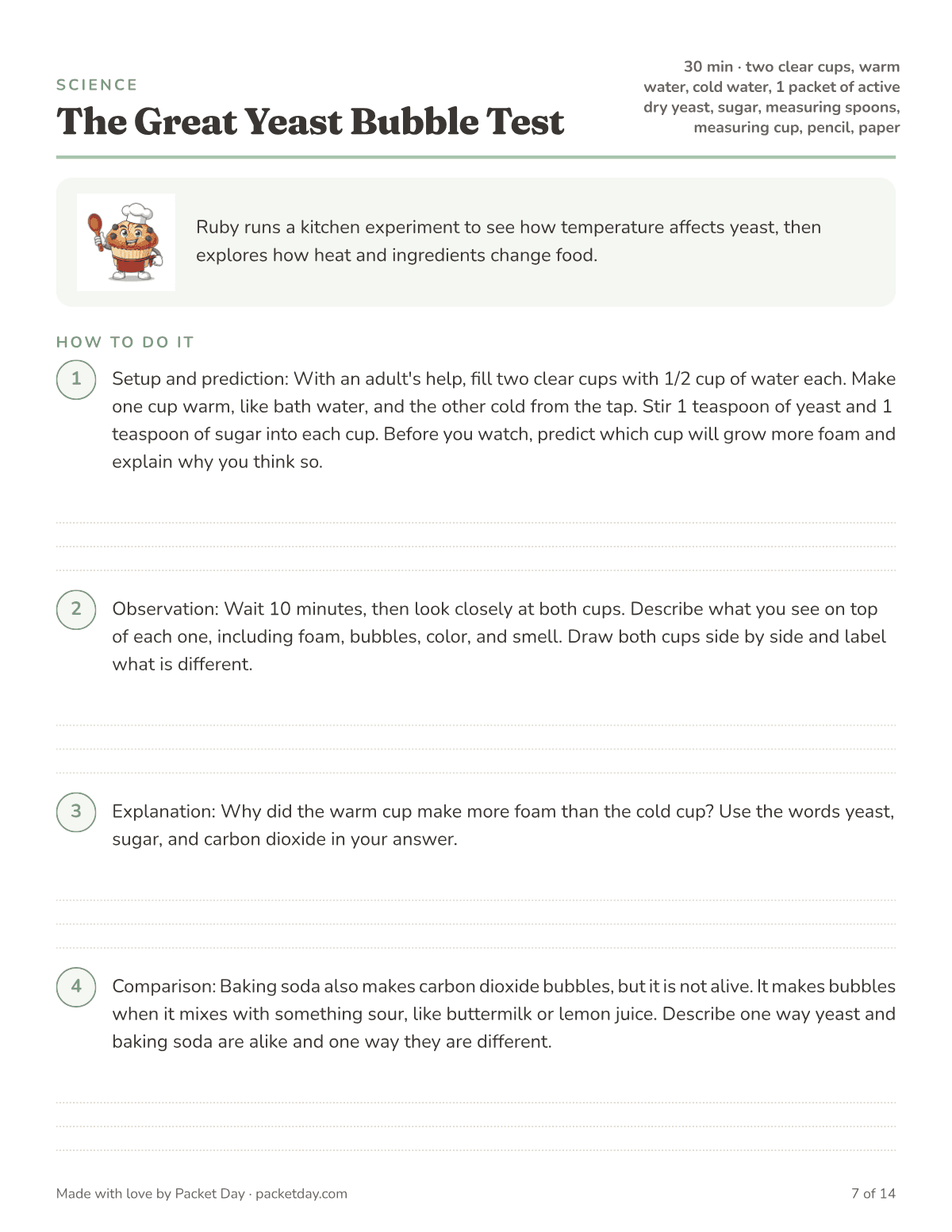
Two cups, one packet of yeast, ten minutes of waiting. 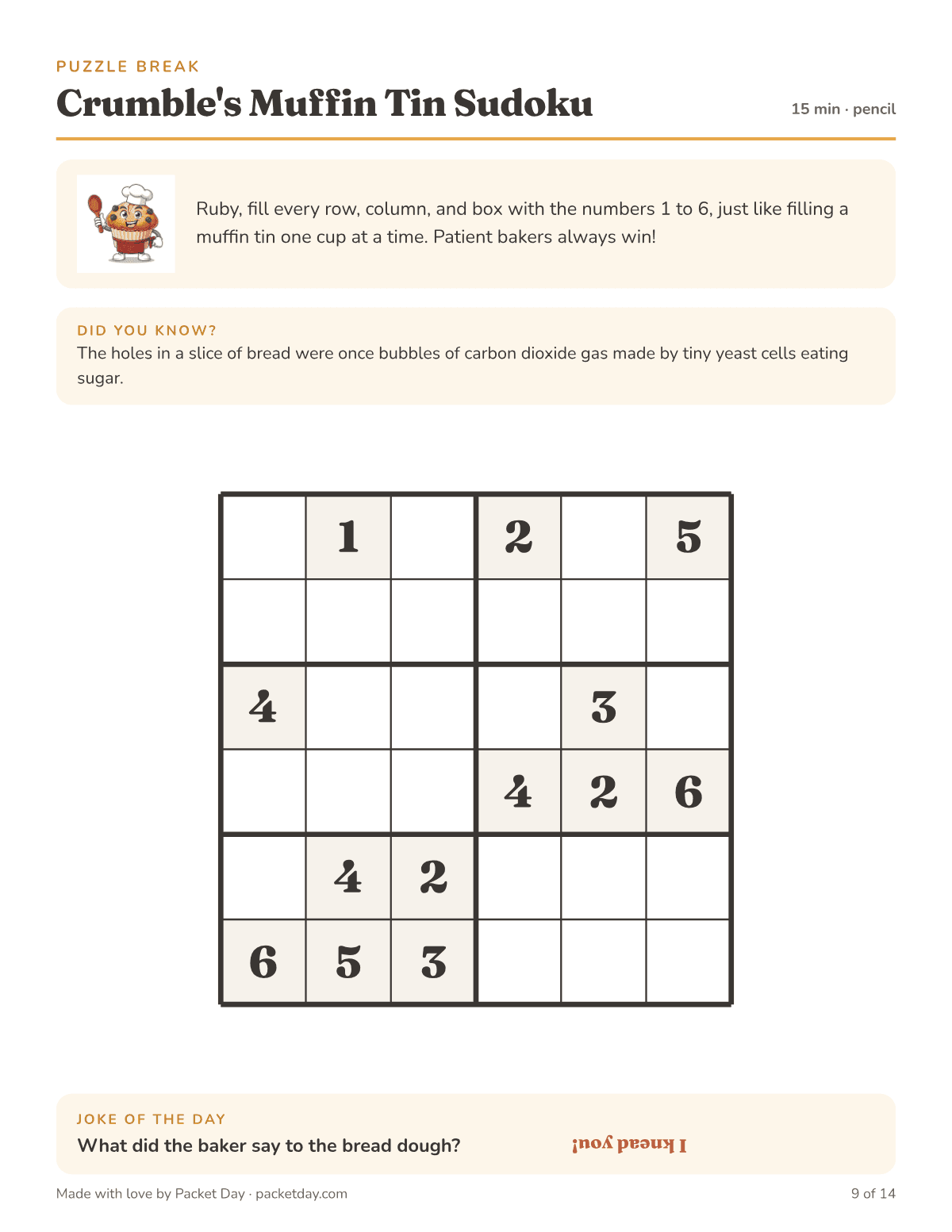
A six by six sudoku and a very bad bread joke.
Does my state test in 4th grade? 🏛️
Learning standards are written for public schools. Your state's homeschool law is a separate thing, and it varies a lot. Some states ask for a test or check on progress every year, so 4th grade is included. North Carolina asks for a nationally standardized test every year. New York asks for an annual assessment, and in grades 4 to 8 a written narrative can stand in for a test every other year. Virginia wants evidence of progress each year, either a test score or an evaluation, and Washington asks for a yearly test or assessment that you keep in your records.
Other states pick certain grades, and 4th isn't one of them. Pennsylvania asks for tests in grades 3, 5 and 8, and Tennessee tests in grades 5, 7 and 9. Georgia asks for a test every three years, starting at the end of grade 3. Arizona, California, Illinois and Ohio don't require one.
Your state's guide spells out what applies to you.
4th grade homeschool FAQ 💬
Does my 4th grader need to know long division?
Not the full written method yet. In 4th grade, kids divide numbers with up to four digits by a one digit number, with remainders, using any strategy that makes sense, like breaking the number apart or using multiplication. The standard written method, called the standard algorithm, shows up in 6th grade in the Common Core standards.
Is my child behind in 4th grade?
Probably not. Kids move through these skills at different speeds, and a gap in one subject is common. If times tables feel shaky, bigger multiplication will too, so a quick review of our 3rd grade guide is a good first step.
How many hours a day should I homeschool 4th grade?
Less than a school day. Home doesn't have lining up, waiting or a crowded classroom. Our guide to how many hours a homeschool day takes breaks it down by grade.
What does a 4th grade homeschool day look like?
One simple rhythm: math and reading in the morning while brains are fresh, then writing, science or a project after a break. The sample packet above is one full day: reading, math, a science experiment, a puzzle break and more.
What fractions does a 4th grader need to know?
Equivalent fractions are the big one, along with adding and subtracting fractions that share a denominator. The standards limit 4th grade fractions to denominators of 2, 3, 4, 5, 6, 8, 10, 12 and 100.
Do I have to follow Common Core to homeschool?
Only if your state's homeschool law asks for it. Learning standards are written for public schools, and homeschool laws are separate. Many states use Common Core in their public schools, and some, like Texas, Florida and Virginia, set their own standards. Check your state's guide to see what your state asks you to teach.
Want a 4th grade day you don't have to plan? 🌿
Packet Day makes a printable day of learning around your child's grade and interests, for the days you need a backup plan. 11 to 17 pages, generated around your kiddo in a minute or two.
Sources 📖
- Common Core State Standards: Grade 4 Math introduction (checked )
- Common Core: Grade 4 Operations and Algebraic Thinking (checked )
- Common Core: Grade 4 Number and Operations in Base Ten (checked )
- Common Core: Grade 4 Number and Operations, Fractions (checked )
- Common Core: Grade 4 Measurement and Data (checked )
- Common Core: Grade 4 Reading, Literature (checked )
- Common Core: Grade 4 Reading, Informational Text (checked )
- Common Core: Grade 4 Writing (checked )
- Common Core: Grade 3 Operations and Algebraic Thinking (checked )
- Common Core: Grade 3 Number and Operations, Fractions (checked )
- Common Core: Grade 6 The Number System (checked )
- Common Core: Grade 5 Number and Operations in Base Ten (checked )
- Common Core: Grade 5 Number and Operations, Fractions (checked )
- NGSS: Grade 4 Energy (checked )
- NGSS: Grade 4 Structure, Function and Information Processing (checked )
- NGSS: Grade 4 Earth's Systems, Processes that Shape the Earth (checked )
- Texas Education Agency: Texas Essential Knowledge and Skills (TEKS) (checked )
- Florida Administrative Code: Rule 6A-1.09401, Student Performance Standards (B.E.S.T.) (checked )
- Code of Virginia: § 22.1-253.13:1, Standards of Learning (checked )
- Texas Education Agency: Home Schooling (checked )
Last verified October 2026. Standards are summarized from the sources above. Social studies isn't sourced because it varies so much by state.
This page summarizes public learning standards for general reference. Your state's homeschool law is what applies to your family, so check your state's guide or department of education before making decisions.
Keep exploring 🧭
Nearby grades and a unit study to try
- 3rd Grade Homeschool GuideWhat third graders typically learn in math, reading, writing and science, with easy activities for home, a real grade 3 sample packet and official sources.
- 5th Grade Homeschool GuideWhat fifth graders typically learn, how to get ready for middle school, easy activities for home and a real grade 5 sample packet.
 Dinosaurs unit studyA printable dinosaur unit study on T. rex, Triceratops and how a bone turns into a fossil, shown as a grade 5 sample with dig site math. Free to start.
From the Packet Day blog
- How Many Hours of Homeschool a Day? Real Answers by GradeHow many hours of homeschool per day? Real answers by grade (K to 2, 3 to 5, and 6 to 8), plus why home learning needs fewer hours than school.
- What Should a 3rd Grader Know? (Without the Panic)Worried about what your 3rd grader should know? The real list (math, reading, and writing milestones), minus the panic and the jargon.
Homeschooling in a new state, or just starting out? Our homeschool requirements by state cover what to file and what to keep.
🗺️ Social studies
This one varies a lot from state to state.