
Snow Day Activities for Kids That Sneak in Learning ⛄
By Natalie
The text comes at 6am. No school today. Your kids cheer. You look at your calendar, which did not get canceled.
A snow day isn't winter break. There's no planning, no shopping run and no two weeks to find a rhythm. (If you do have two weeks to fill, our winter break list is built for that.) A snow day is one surprise day, and you get about as long as it takes to make coffee to figure it out.
So here's a plan that only uses what's already in your house, sorted by the kind of day you're actually having.
Homeschooling? You're invited too. Nobody's going to text you, so call it yourself. Fresh snow is all the permission you need to drop the plan for a day.
The short answer
A good snow day has four parts, and none of them need prep or a trip to the store:
- Outside first. Go while the snow is fresh and everyone's fired up.
- A warm up. Dry socks, something hot to drink and a snack.
- One quiet learning block. An hour or less at the table, while they're tired and happy.
- A free afternoon. Play, movies, naps, whatever. Nobody has to earn it.
If your school calls it a remote learning day instead, that work is your quiet block. Keep the rest.
"I'm working from home today" 💻
Here's the one move that helps. Before your first meeting, write the times you're free on a piece of paper and stick it on the fridge. "I can talk at 10, at noon and at 2." A time they can see is easier to wait for than "later." Then set out what they need for the first activity, and go.
K-2 📝
Little kids won't do much alone for long, so think short stretches.
- Snow bin. Bring a big bowl of snow inside and set it on a towel with cups, spoons and small toys. The mess stays on the towel, mostly.
- Arctic rescue. Pile white towels on the floor and bury stuffed animals in the "snowbank." Your kid digs each one out and tucks it in with a warm washcloth.
- My snow day book. Staple a few sheets of paper together. They draw one page after each thing they do today, then read it to you at dinner.
3-5 📚
- Be the weather reporter. They measure the snow, watch the sky and write a one minute forecast to deliver at lunch.
- Design the fort first. They draw a snow fort from above, label the walls and count how many snow blocks it needs. They build it on your lunch break.
- Invent a snow machine. They draw and label a machine that clears the driveway while everyone sleeps, then write out how it works.
6-8 🧠
- Shovel for hire. With your OK, they do your walk first, then write a price list for the neighbors and keep track of what they earn.
- Lunch is theirs. They plan and make lunch for everyone from what's in the kitchen. It's a real job, and it's one less thing on your plate.
- The big meeting shift. If you're comfortable with it, they run a game for a younger sibling during your biggest call. Pay them in something they actually want.
Need more quiet ideas for the stretch after lunch? Here's our list of screen free activities.
"We're all home and want a fun day" ☃️
Lucky you. Pick one or two and don't overthink it.
- Snow sculpture contest. Anything but a snowman. Build a dragon, a couch or the family dog, then everyone votes.
- Track detectives. Walk the yard and follow whatever left prints. Birds? A squirrel? The neighbor's cat? Make your best guess and follow the trail.
- Snow painting. Fill a squeeze bottle with water and a little food coloring, and paint right on the snow. No food coloring? A stick draws just fine.
- The neighbor mission. Shovel someone's steps together, then sneak away before they spot you.
- Sock snowball fight. Too icy to go out? Roll up every clean sock you own and use couch cushions as forts.
- The same spot photo. Take a picture of the kids in the same spot on every snow day. Years from now, you'll love having them.
Sneak in some learning 🔬
Nobody has to know this is school. Hand over a ruler and a good question, and walk away.
Snow science
- Melt test. Pack a clear cup to the top with snow and mark the line. Have them guess how high the water will be once it melts, then wait and see. Snow holds a lot of air, so the water ends up much lower.
- Measure the snowfall. Push a ruler straight down to the ground in three flat, open spots, away from any drifts. Older kids can find the average.
- Snowflake shapes. Chill a piece of dark paper or cloth outside first, then catch flakes on it. Use a magnifying glass if you have one. Most snow crystals have six sides or six arms, though plenty break or clump together on the way down. Draw the best ones.
- Why salt melts ice. Set two ice cubes on two plates and sprinkle salt on one. Watch which melts first. Salt lowers the temperature water freezes at, so ice can melt even when it's a little below freezing outside. That's why salt goes on icy roads.
Snow math
- K-2: Make a row of snowballs and count them by 2s, 5s or 10s.
- 3-5: Measure the sides of your snow fort and find the perimeter, then work out the area of the floor.
- 6-8: Measure new snow every hour, graph it and find the inches per hour. Then turn your melt test into a ratio of inches of snow to inches of water.
Writing prompts
- Write the school's announcement for a silly reason to cancel. "School is closed today due to..."
- Write a letter from a snowman who just noticed the sun coming out.
- You wake up and the snow is up to the roof. What happens next?
- For older kids: should schools have snow days at all? Give your best three reasons.
Still curious? Our polar animals unit study looks at how penguins and polar bears stay warm. If the afternoon turns into baking, try our baking science unit study or the gingerbread unit study.
And if you're worried about the missed day, don't be. One snow day won't put anyone behind. If you're wondering about the bigger picture, here's how to tell if your child is on grade level.
A quick word on the cold 🧤
Dress in layers, and keep dry socks and mittens ready. Little ones need an adult outside with them. Plan breaks to come in and warm up, and bring everyone inside when they're cold or wet. Check your local forecast and use your good sense. You know your kids.
The 60-second version: a quiet block in a minute or two 📝
Here's the part that saves your 10am meeting.
Ask your kid what they want to learn about today. Snowplows, penguins, sharks, it's their call. Open Packet Day, enter their grade and that topic, and a minute or two later you have 11 to 17 pages of math, reading, science and more, with a character made just for them. This isn't a download. Nothing here existed before you asked for it.
Print it and hand it over with a pencil. Answer keys are included, so you can check it after your meeting. Your littlest ones may need you to read the directions, and everyone else is off and running.
A packet is a full school day, roughly 2 to 5 hours with breaks, so nobody has to finish it. A few pages cover the quiet block. The one catch: you need a printer and paper.
One packet a month is free, no card required. Unlimited is $12/month, or $9/month billed yearly.
It's just one day
You don't have to make this magical. Wet mittens by the door and one good hour outside already count.
The schedule comes back tomorrow, and so do the emails. Today, you got a little extra time with your kids that nobody planned for. That's a pretty good surprise. 💛
Make my free packet → A minute or two, their topic, printed, done. One per month free, no card.
Frequently asked questions
How do I keep kids busy on a snow day while working from home?
Send them outside first if you can, then rotate through activities they can do mostly alone. Write the times you're free on a paper they can see, and set out supplies before your first meeting. Little kids need short activities, like a bowl of snow on a towel. Older kids can take on real jobs, like making lunch or shoveling.
Should kids do schoolwork on a snow day?
Only if your school assigned it. If your school calls a remote learning day, do that work first. On a true snow day, nothing is required. One quiet block of reading, snow science or a printed packet keeps things calm, but play counts too.
What are easy snow science experiments?
Try a melt test with a cup of snow, measure the snowfall with a ruler in three spots, catch snowflakes on chilled dark paper, or sprinkle salt on one of two ice cubes and watch which melts first. All of them use things you already have at home.
How long can kids play outside in the snow?
There's no single right number. It depends on the weather, how they're dressed and the kid. Dress in layers, plan breaks to warm up, and come inside when anyone is cold or wet. Check your local forecast and use common sense.
What can kids do on a snow day with no prep?
Follow a simple shape: outside first, then a warm up, one quiet learning block and a free afternoon. Snow sculptures, track detectives, a bowl of snow on a towel and silly writing prompts all work with what you already have.
What can kids do if it's too icy or cold to go outside?
Bring the snow to them with a big bowl on a towel, or skip it and have a sock snowball fight with couch cushions as forts. A quiet learning block, a design a snow fort challenge or a salt and ice test all work indoors.
Keep reading
More from the blog
- 25 Winter Break Activities for When Everyone's Over It by Day 1025 winter break activities for kids, sorted by the day of break you're on: the fun first days, the holiday stretch, the Day 10 slump and the reset.
- 25 Screen-Free Activities That Actually Work25 screen-free activities for kids that actually hold their attention: quiet, creative, and active ideas for sick days, road trips, rainy days.
- Is My Child on Grade Level? How to Tell (and What to Do If They're Behind)Is your child really on grade level? Report cards can't always tell you. Try these quick K-8 reading and math checks, plus calm next steps if they're behind.
Packets that fit
 Polar animals unit studyA printable polar animals unit study on how penguins and polar bears stay warm, with a blubber glove experiment and grade 3 math. Free to start.
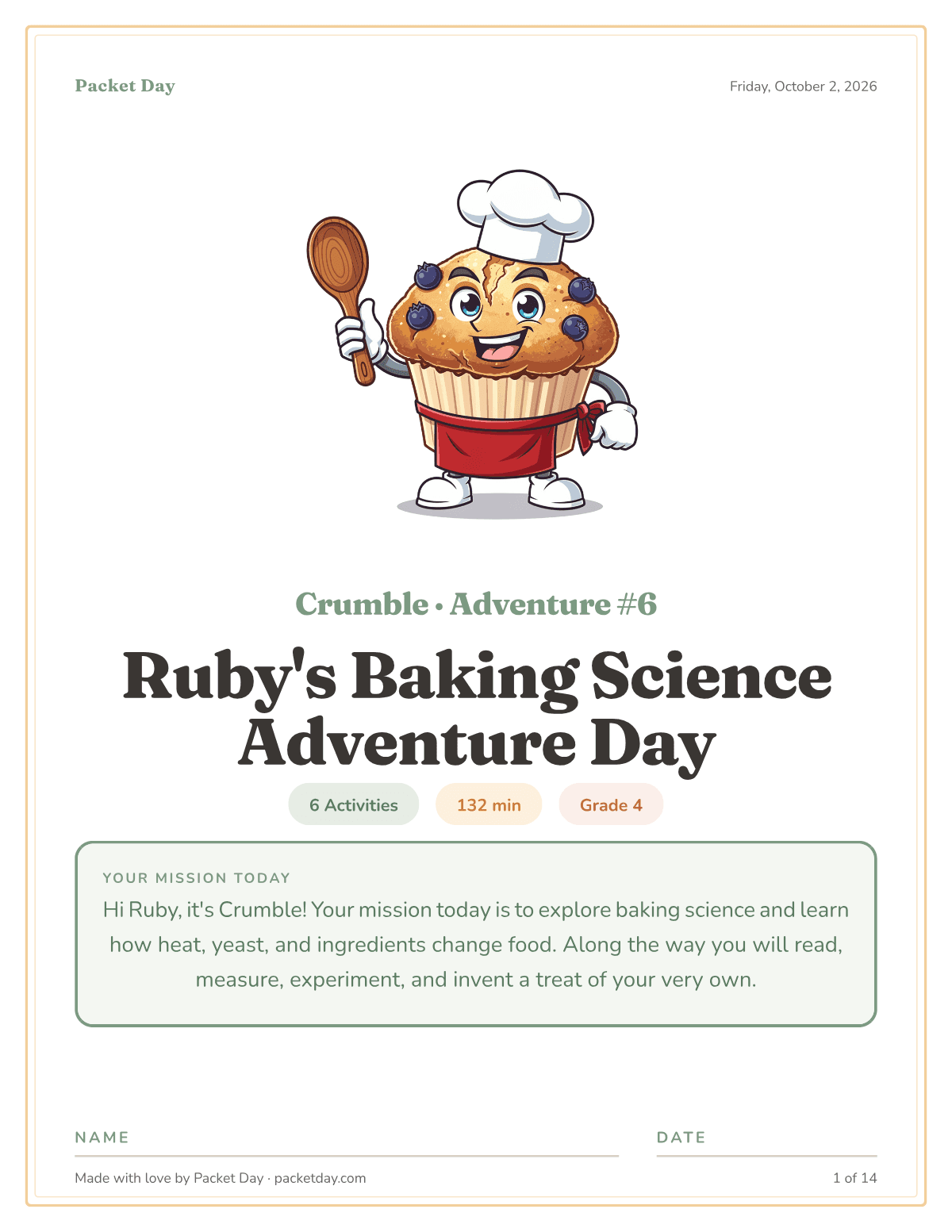 Baking science unit studyA printable baking science unit study on yeast, gluten and oven heat, with a two cup yeast experiment and bakery math in a grade 4 sample. Free to start.
Like what you just read? 📝
Packet Day turns an idea like this into a real, printable day. Pick a grade, pick an obsession, and it's ready in a minute or two.
Try Packet Day Free