
Bats Unit Study Packet for Kids
A bats unit study packet is a printable school day about bats and echolocation for kids in kindergarten through 8th grade. This grade 2 sample has 14 pages plus a parent answer key: math, reading, writing, a maze, a movement break, science, a coloring page and a certificate, about 105 minutes of activities, plus breaks. Free to start.
By Natalie, homeschool mom and Packet Day co-founder
Updated October 2026Reviewed by Natalie
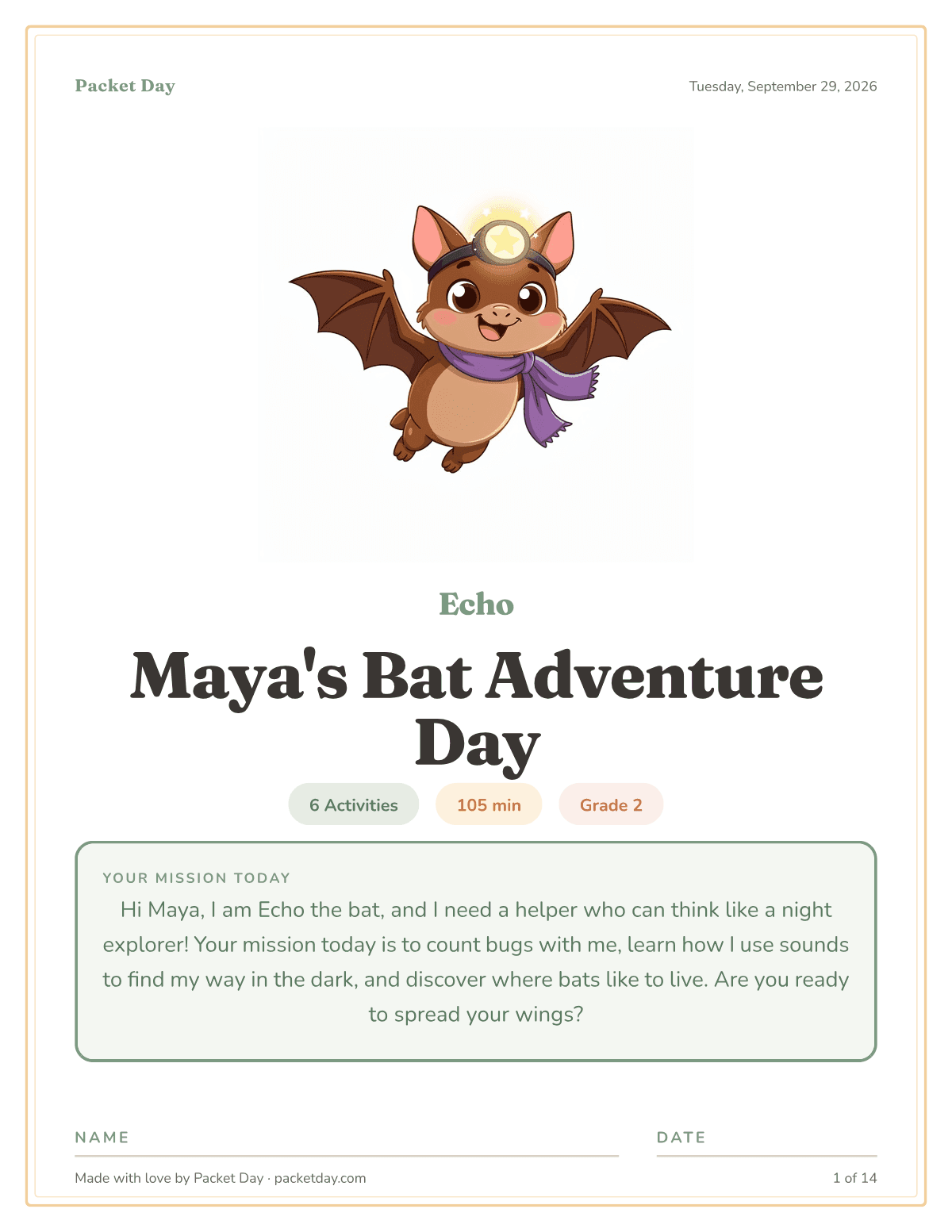
A sample packet made for a grade 2 learner named Maya
What is inside a bats packet?
A bats packet is a full school day on paper: 11 to 17 pages built around bats, roughly 2 to 5 hours with breaks. This sample has 14 pages plus a parent answer key, and Echo the bat guides the whole day.
What does my child actually do?
Math
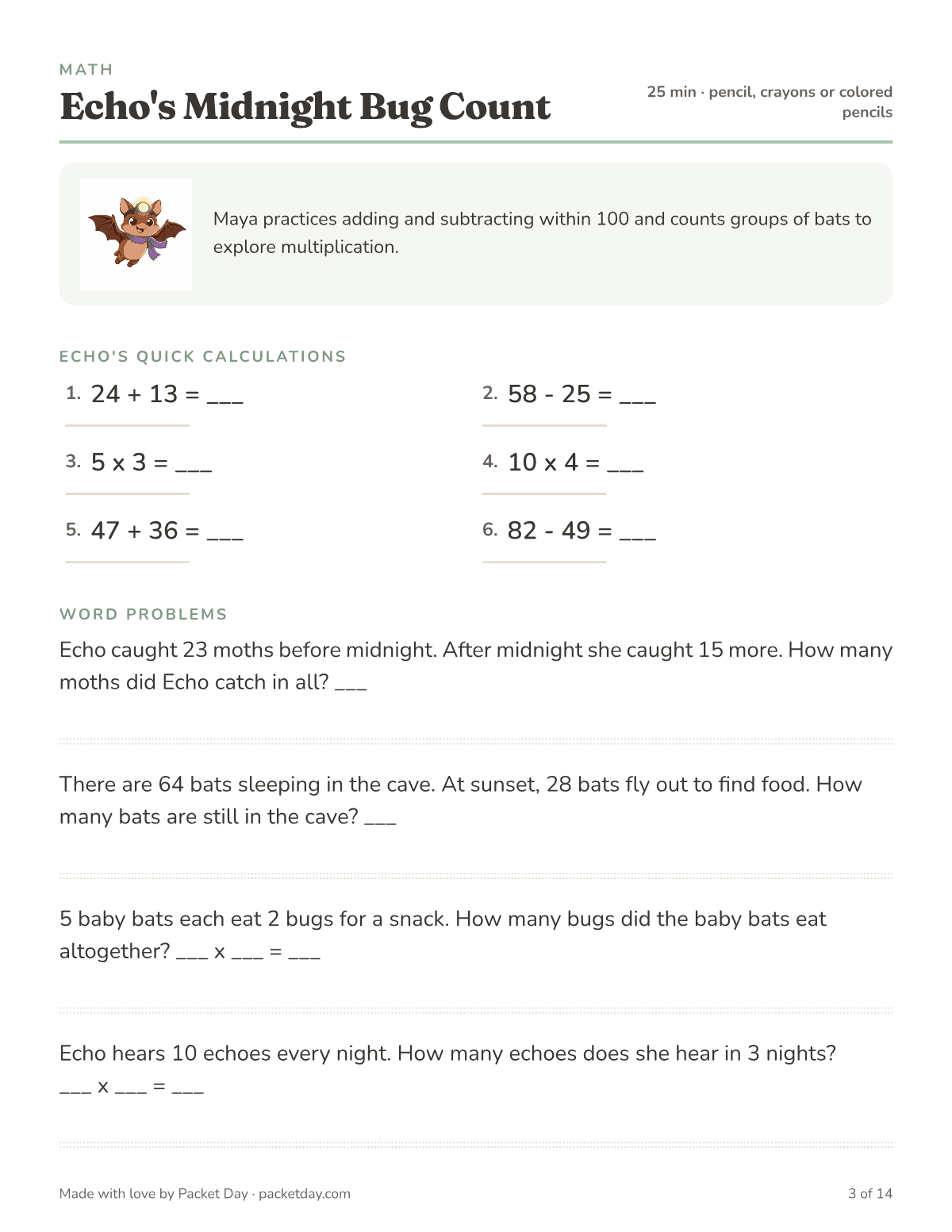
Echo's Midnight Bug Count
Six quick problems, four word problems about moths and a cave full of bats, and a draw and solve with 4 branches of 5 bats.
Reading
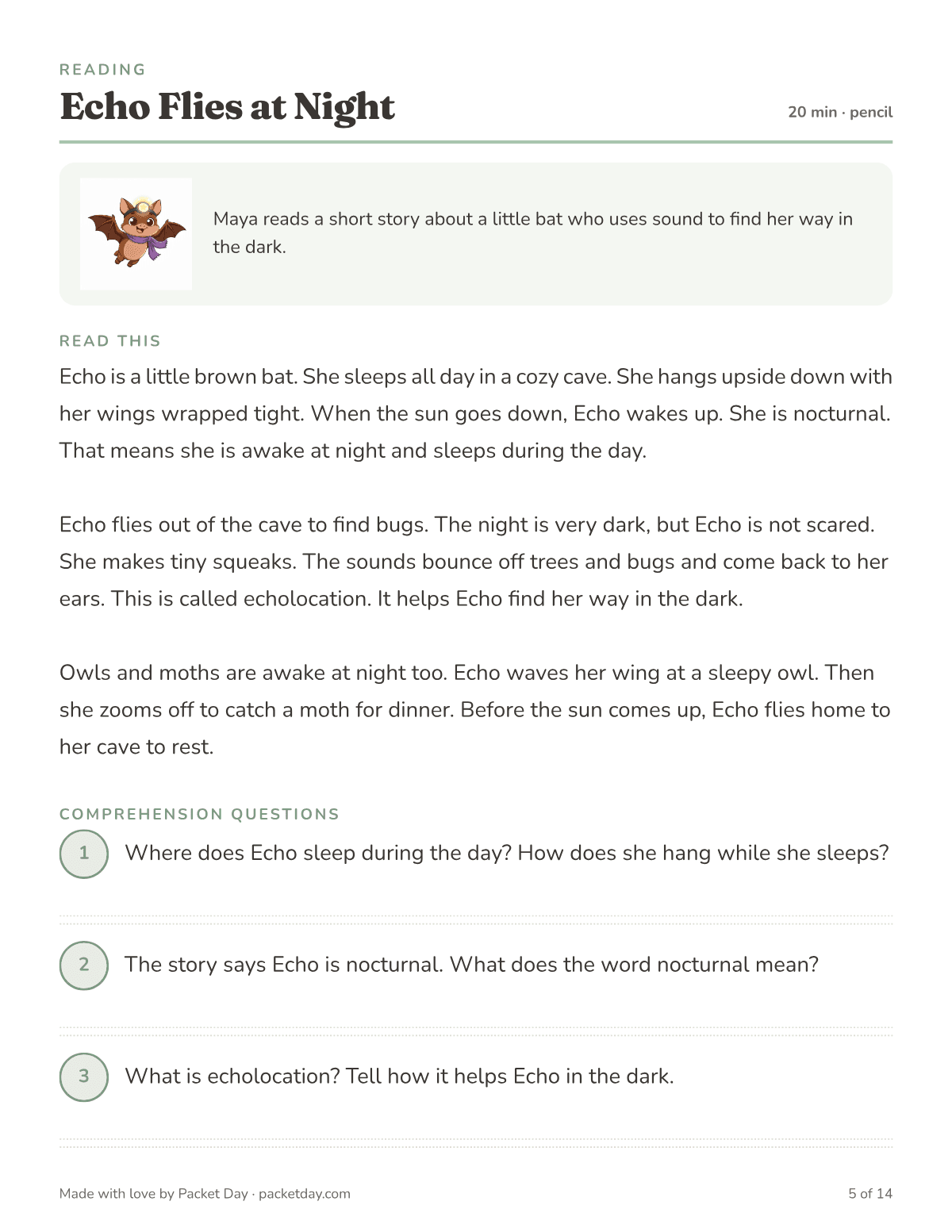
Echo Flies at Night
A short story about a little brown bat's night out, then six questions about it.
Writing
My Night Flight with Echo
Your kid imagines bat wings for one night and writes 4 to 6 sentences about the flight.
Puzzle break
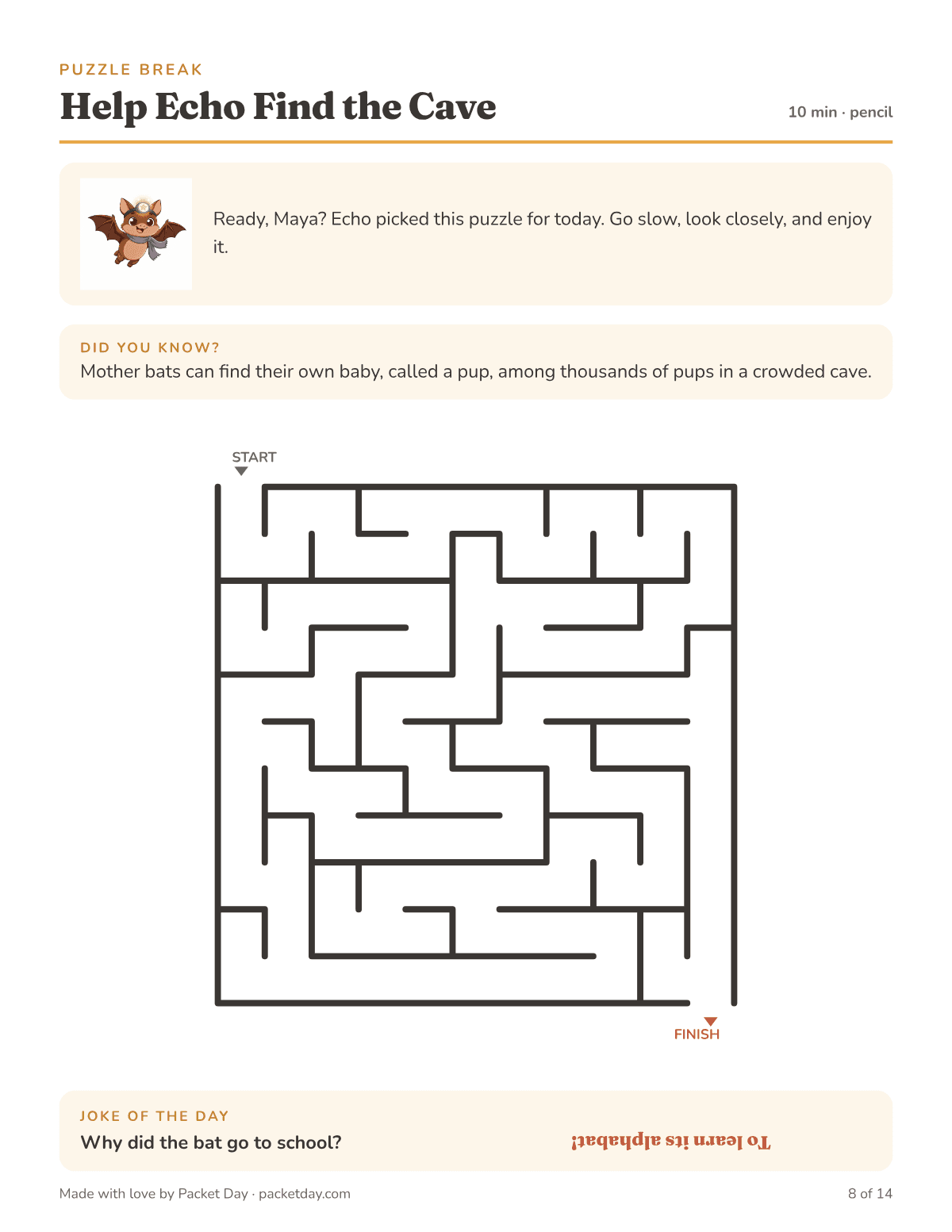
Help Echo Find the Cave
A maze from START to FINISH, a fact about mother bats and a joke of the day.
Movement break
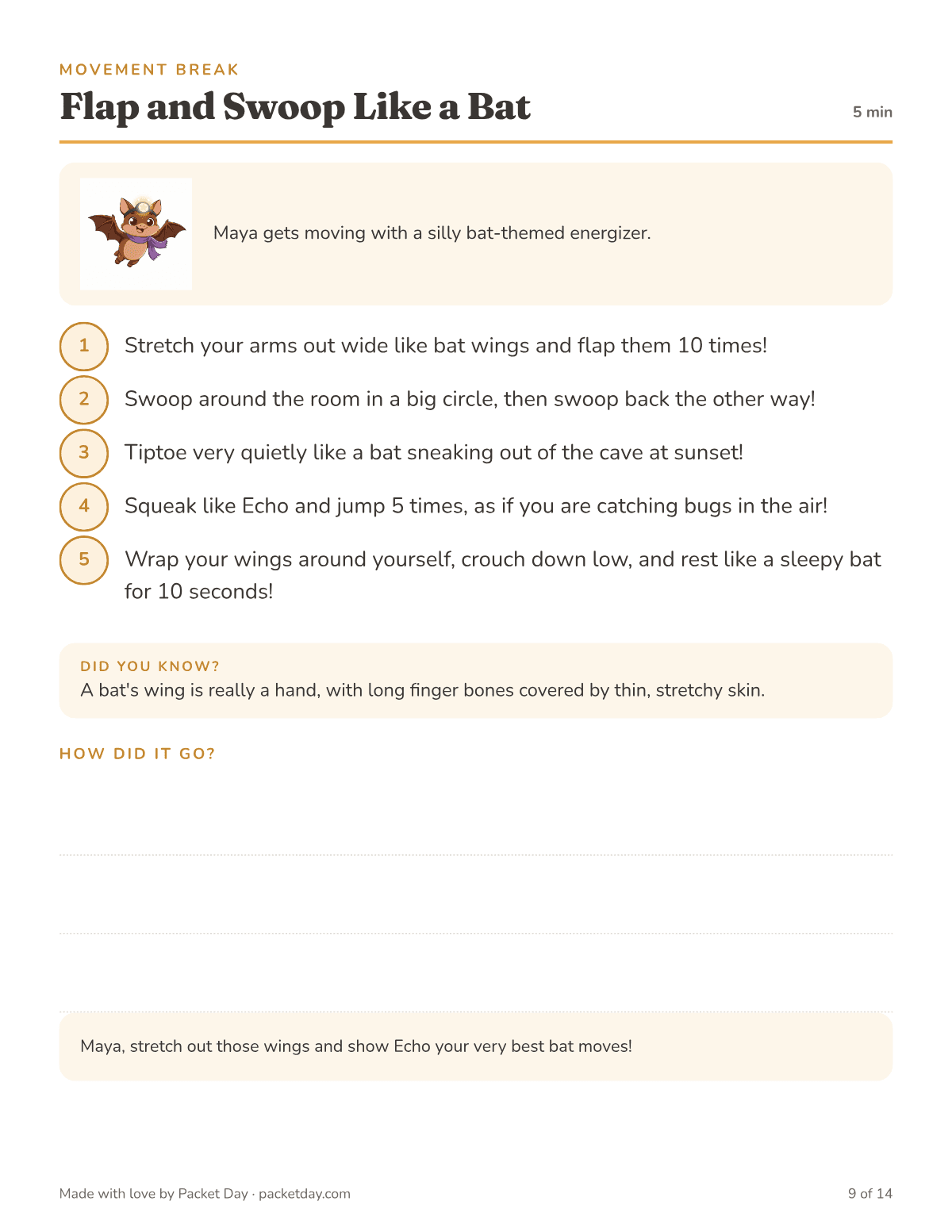
Flap and Swoop Like a Bat
Flapping, swooping, tiptoeing out of the cave, jumping for bugs, then a rest wrapped in pretend wings.
Science
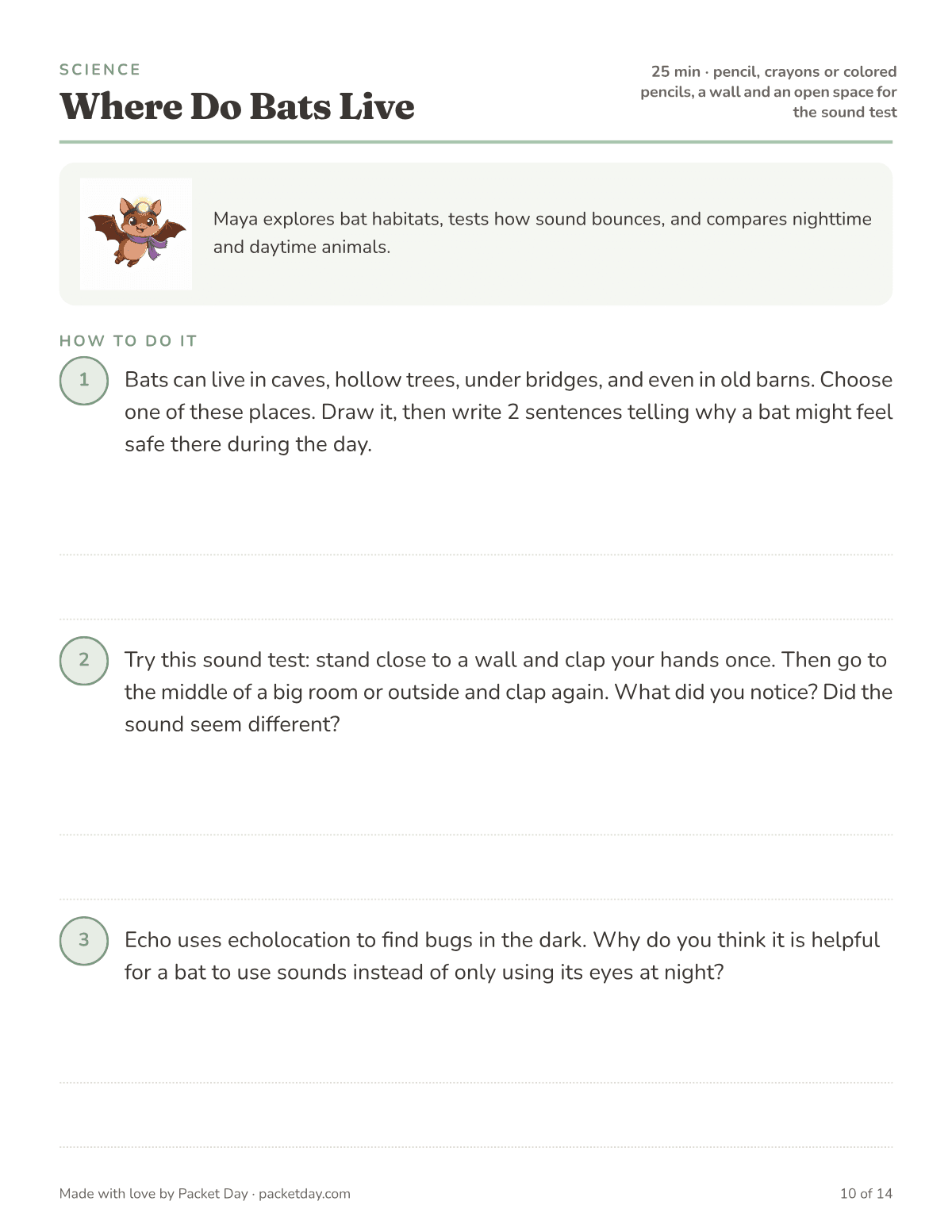
Where Do Bats Live
Bat homes like caves, hollow trees and old barns, a clap test to hear sound bounce, and night animals compared with day animals.
Meet Echo
Echo is the little brown bat who runs Maya's day. She wears a purple scarf and a tiny headlamp (a funny choice for an animal that finds its way by sound), and she shows up on nearly every page.
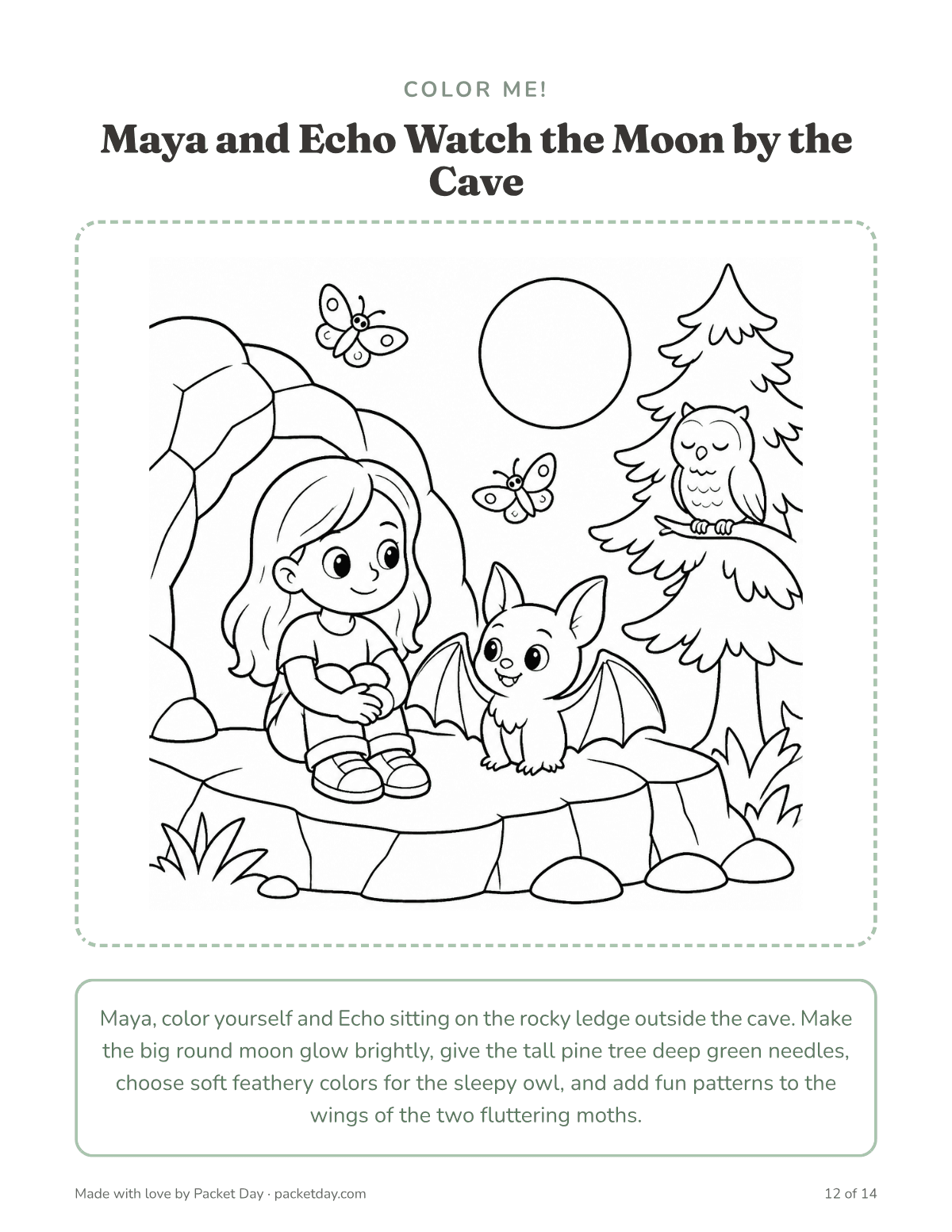
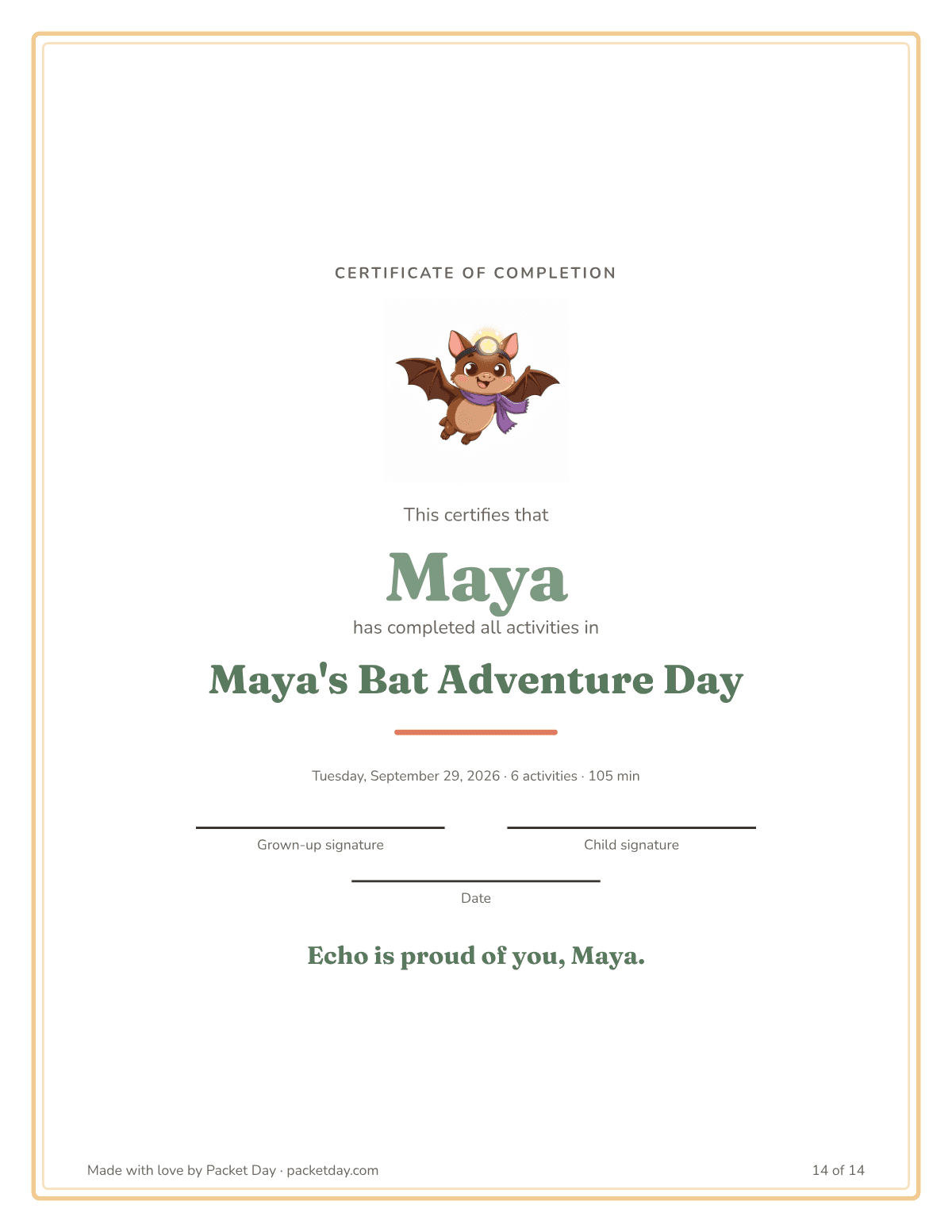
She introduces herself on the cover, catches moths in the math problems, waves at a sleepy owl in the reading story and flies beside Maya in the writing prompt. At the end she sits next to Maya on the coloring page, and the certificate reads: Echo is proud of you, Maya.
Kids will do a lot of subtraction for a character they like. The reflection page even sends them back to find every page Echo appears on.
What will my child learn?
Your child practices math, reading, writing and science: regrouping and a first taste of multiplication, a short story with two new words, a few sentences of their own and a hands on sound test.
In math, Maya adds and subtracts two digit numbers with regrouping (82 minus 49 is on there), then meets multiplication as equal groups: 5 baby bats eating 2 bugs each, and 4 branches with 5 bats on each one.
The reading questions ask her to recall details, explain two new words and guess why Echo isn't scared of the dark. The writing page asks for 4 to 6 sentences about her own night flight.
Science is where the vocabulary pays off. Nocturnal and echolocation come back from the story, the clap test lets her hear an echo for herself, and the last questions ask her to compare night and day animals and predict what happens to a bat that loses its home.
Which grades is this for?
Grades K-2
This sample is grade 2, so here we can be specific. The story uses short sentences and two big words, the math stays within 100 with multiplication as groups you can draw, and writing tops out at 4 to 6 sentences. Kindergarten and first grade packets are written for their own grade.
Grades 3-5
For grades 3 to 5, the same bat theme comes with longer reading, harder vocabulary, math at their grade level and longer writing. We are not showing a grades 3 to 5 bats packet here, so this is how packets grow, not a preview.
Grades 6-8
For grades 6 to 8, expect longer reading, harder vocabulary, math at their grade level and more writing. We are not showing a grades 6 to 8 bats packet here either. The theme and the character stay. The difficulty is what changes.
A note from Natalie
Halloween season is a big deal in our house. The kids love it, so in the lead up we lean in. We do school, and they get to wear their costumes while we do it.
Then comes the part nobody warns you about: trying to get everyone settled back into learning days later, while they're still on a sugar high. (Pray for us.)
The one Halloween tradition that runs itself is the candy. Oliver and Vivian sort it by type, count how many of each, and rank every kind. If your October looks like ours, a bats packet keeps the theme going and still gets some real learning done.
Questions parents ask about bats packets
What do bats eat?
Most bats eat insects, like moths, beetles and mosquitoes, which is why Echo spends the math page counting bugs. Some bats eat fruit or drink flower nectar instead, and a few catch fish or frogs. Ask your kid which kind of bat they would rather be.
Is echolocation too hard for a second grader?
No, not the way this packet teaches it. The story explains it plainly: Echo squeaks, the sound bounces off trees and bugs, and it comes back to her ears. Then the science page has your kid clap near a wall and again in an open room to hear the difference. A seven year old gets it.
How do I turn this into a Halloween unit?
Print it for the last week of October and let bats be your friendly Halloween animal. Bat Week runs October 24 to 31 every year, so the timing lines up. Add a bat picture book or look for bats at dusk. After trick or treating, let them sort, count and rank their candy, which is real math they won't notice.
Are bats really blind?
No, bats can see, and some see quite well, so "blind as a bat" is a myth. Many bats still hunt mostly by echolocation because it works in total darkness. That's exactly what the science page asks: why would a bat use sound instead of only its eyes at night?
How long does the bats packet take?
This sample adds up to 105 minutes of activities, from a 5 minute movement break to 25 minutes each for math and science. Add snack breaks and the usual detours and it fills a morning or a slow afternoon. Every packet is a full school day of 2 to 5 hours with breaks, depending on grade and pace.
Are these made by AI, and are they any good?
Yes, AI writes each packet from scratch, built around your kid's grade and whatever they are into right now. We are a homeschool family and our own kids test packets constantly. They are good, and they are not perfect, so skim it before you hand it over. The answer key makes checking the work quick.
More unit study packets
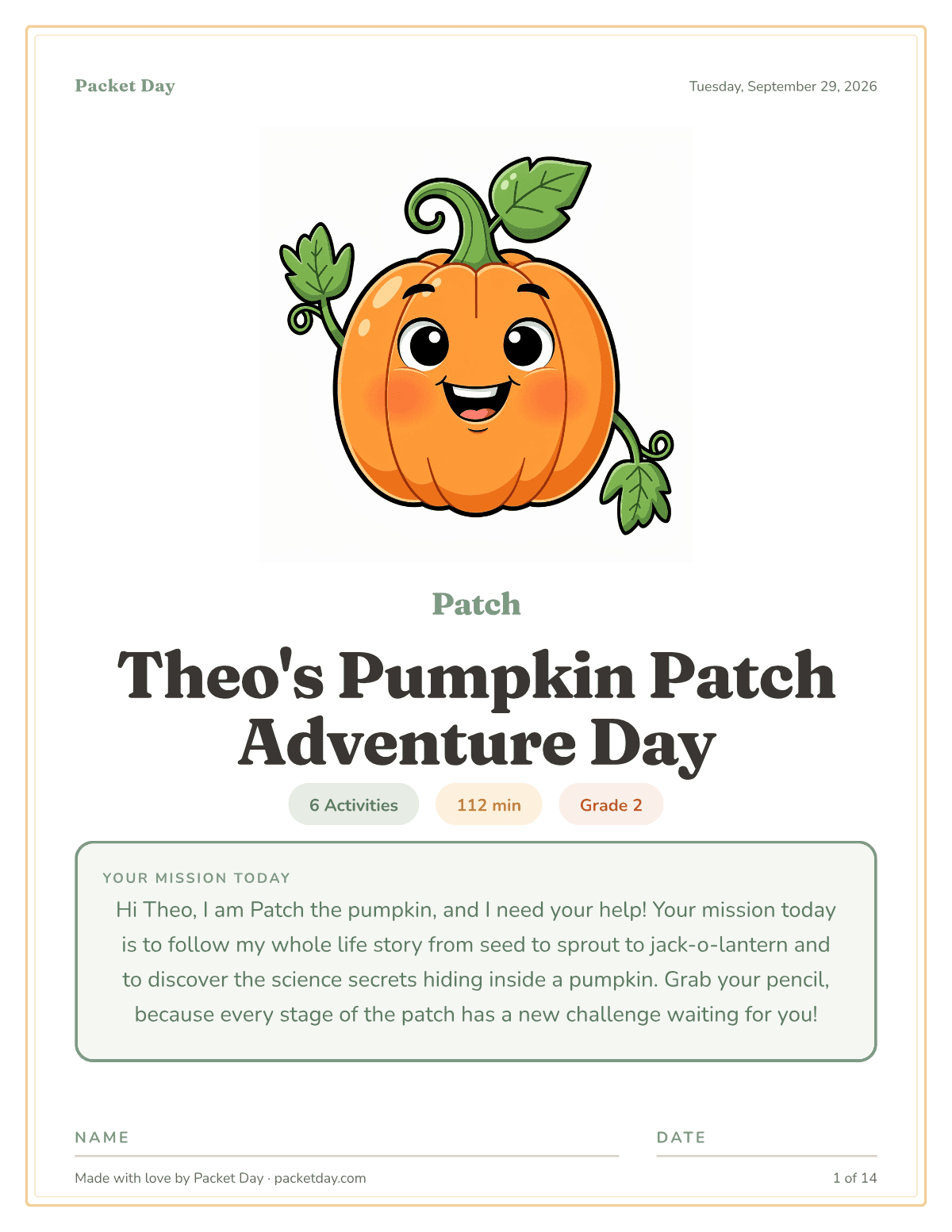
Pumpkins
Sample made for grade 2
A printable pumpkin unit study that follows one pumpkin from seed to jack-o-lantern, with a float test, skip counting and a shape sudoku. Free to start.
See the pumpkins packet →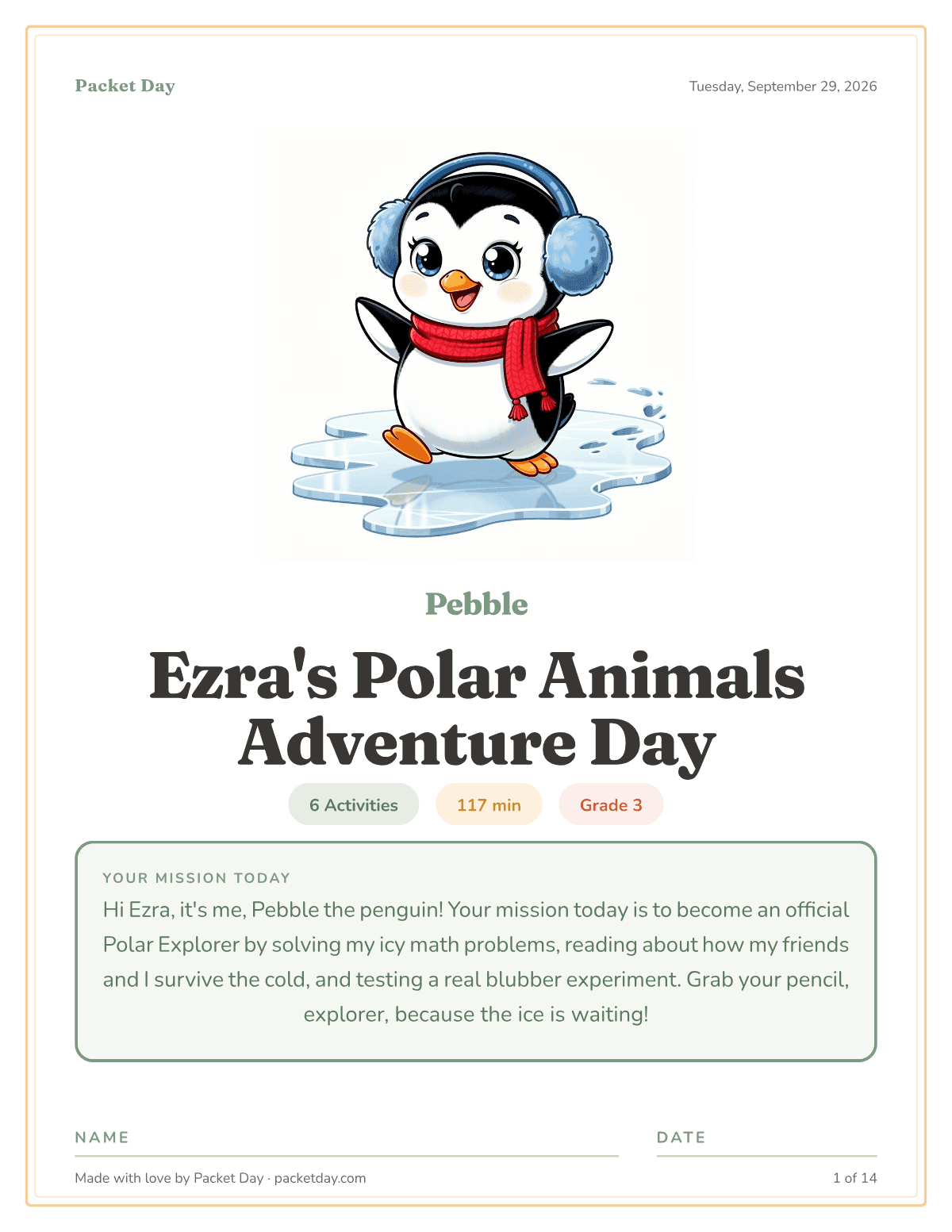
Polar animals
Sample made for grade 3
A printable polar animals unit study on how penguins and polar bears stay warm, with a blubber glove experiment and grade 3 math. Free to start.
See the polar animals packet →Every unit study packet
See all the themes we have made so far, each with real pages from a sample packet.
Browse the unit studies →Packets for the days you need one
Ready for your own bats day?
Packet Day makes print ready, themed learning packets for kids in K to 8, built around whatever your kid is obsessed with.
Make your own bats packet freeFree is 1 packet a month, no card needed. Unlimited is $9 a month billed annually ($108 a year) or $12 month to month.