
Pumpkins Unit Study Packet for Kids
A pumpkin unit study packet is a printable school day about the pumpkin life cycle for kids in K to 8. This grade 2 sample has 14 pages plus a parent answer key: math, reading, writing, a shape sudoku, a movement break, a science lab, coloring and a certificate, about 112 minutes of activities, plus breaks. Free to start.
By Natalie, homeschool mom and Packet Day co-founder
Updated October 2026Reviewed by Natalie
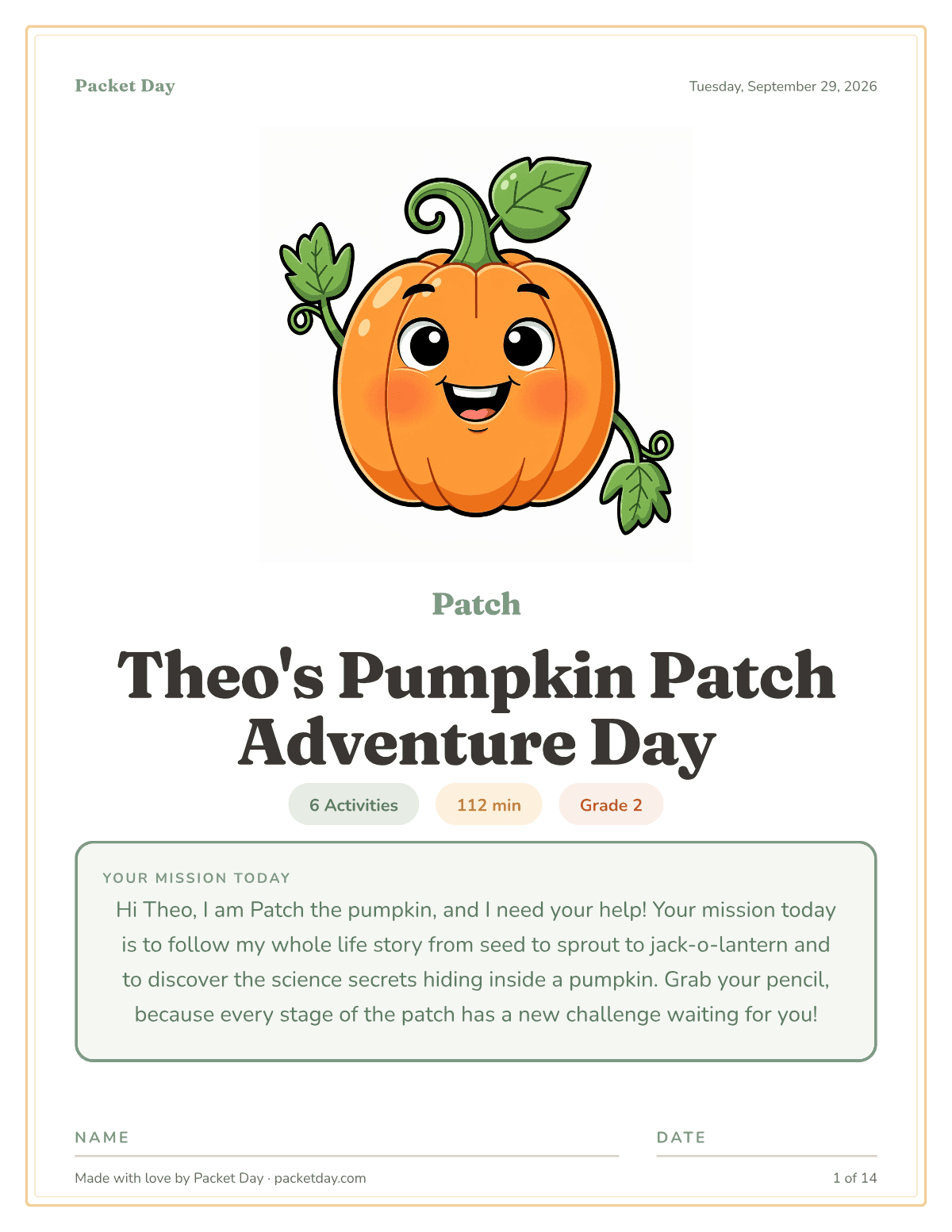
A sample packet made for a grade 2 learner named Theo
What is inside a pumpkins packet?
A pumpkins packet is a full school day on paper: 11 to 17 pages built around pumpkins, roughly 2 to 5 hours with breaks. This sample has 14 pages plus a parent answer key, and Patch the pumpkin guides the whole day.
What does my child actually do?
Math
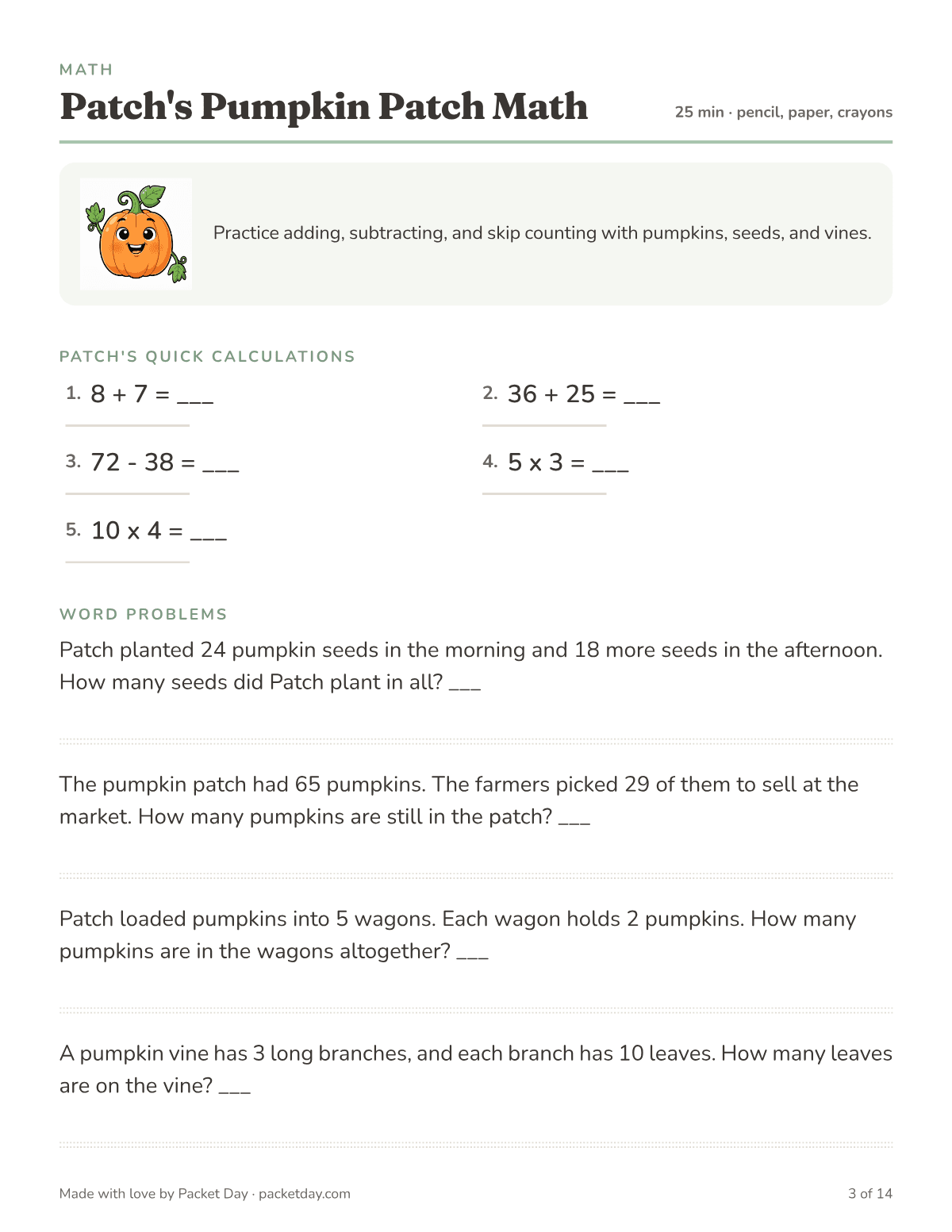
Patch's Pumpkin Patch Math
Five quick problems, four word problems about seeds, wagons and vines, and a draw and solve: 5 jack-o-lanterns with 2 triangle eyes each.
Reading
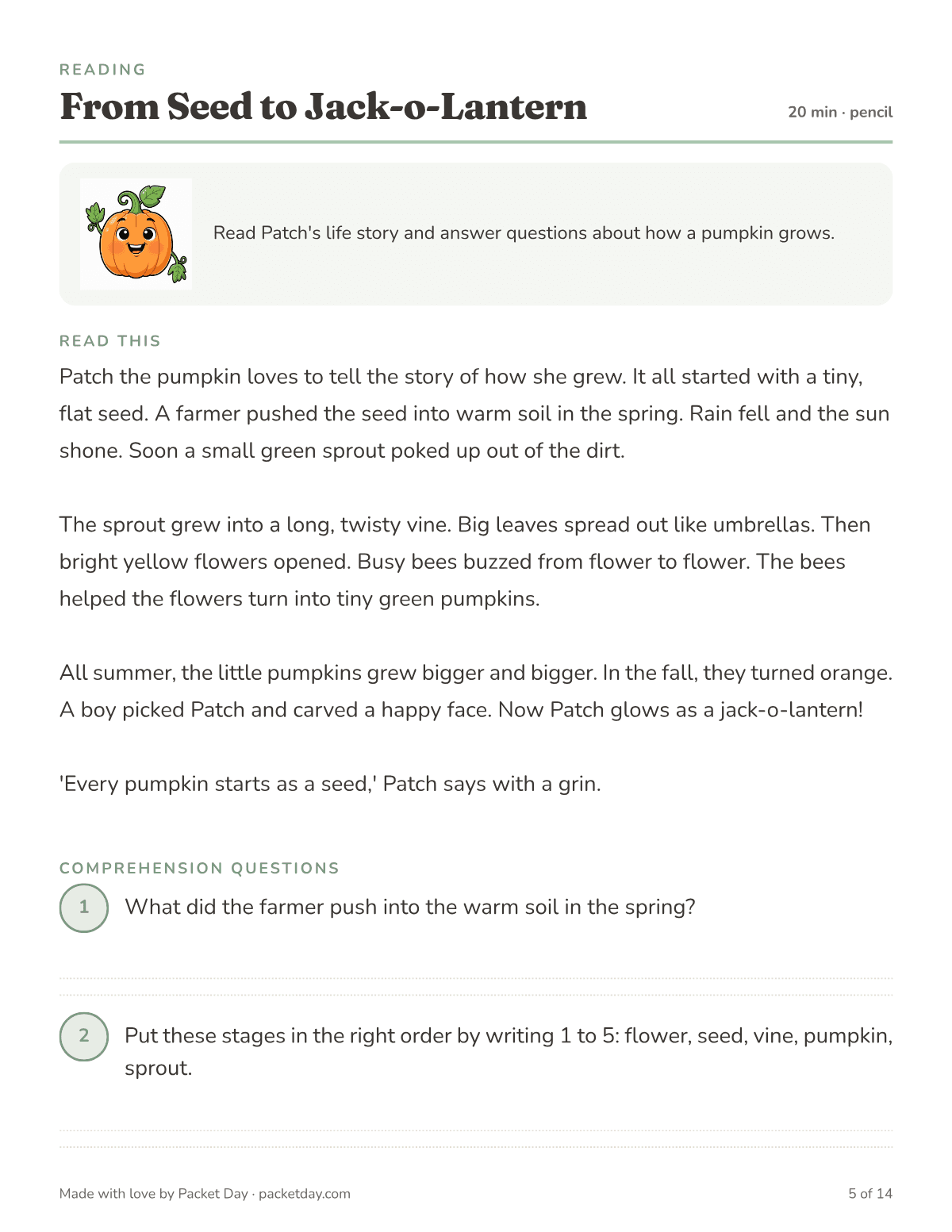
From Seed to Jack-o-Lantern
Patch tells her own life story, then five questions, including putting the stages in order.
Writing
My Life as a Pumpkin Seed
Your kid pretends to be a seed next to Patch and writes 4 to 5 sentences about growing up, with at least two color words.
Puzzle break
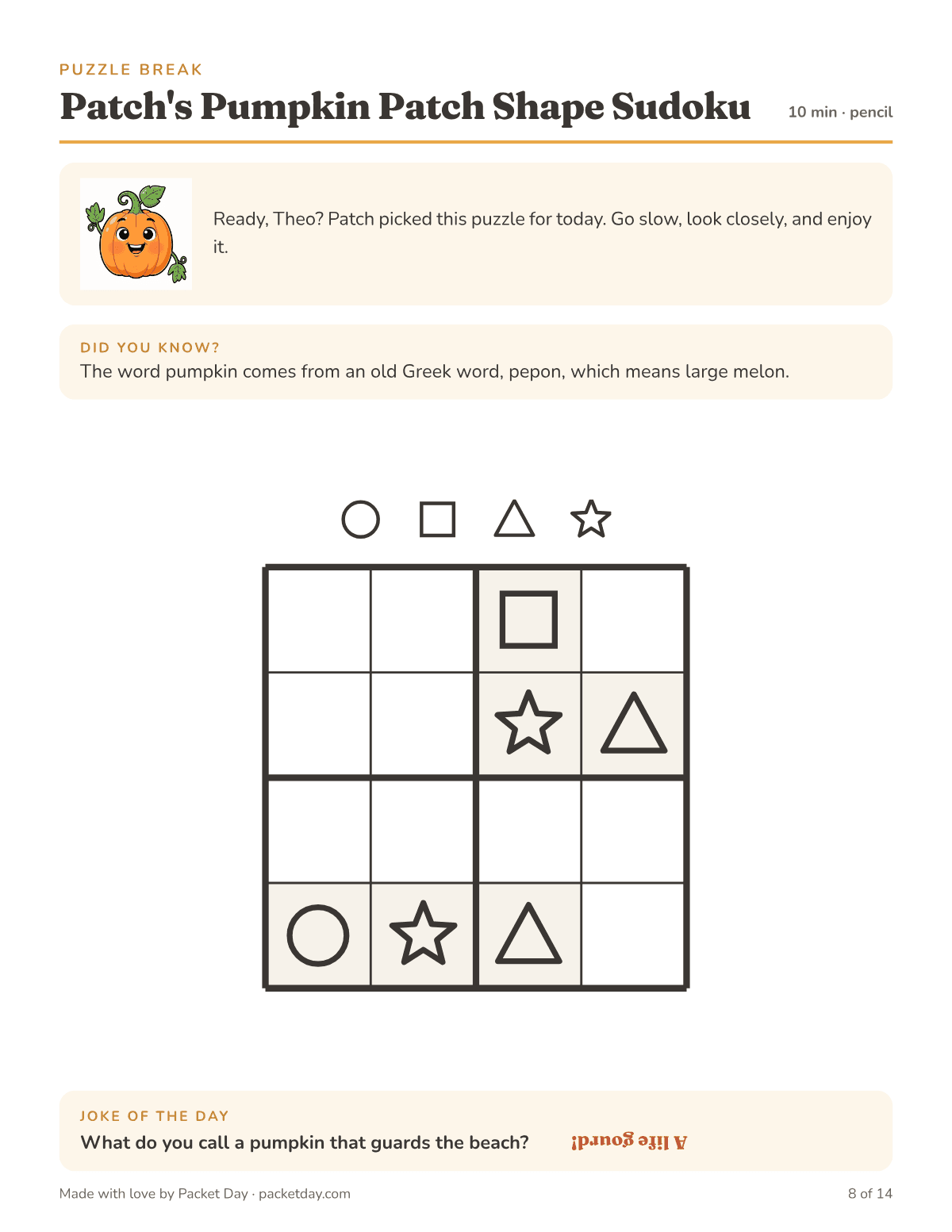
Patch's Pumpkin Patch Shape Sudoku
A 4 by 4 sudoku with circles, squares, triangles and stars, plus a joke of the day.
Movement break
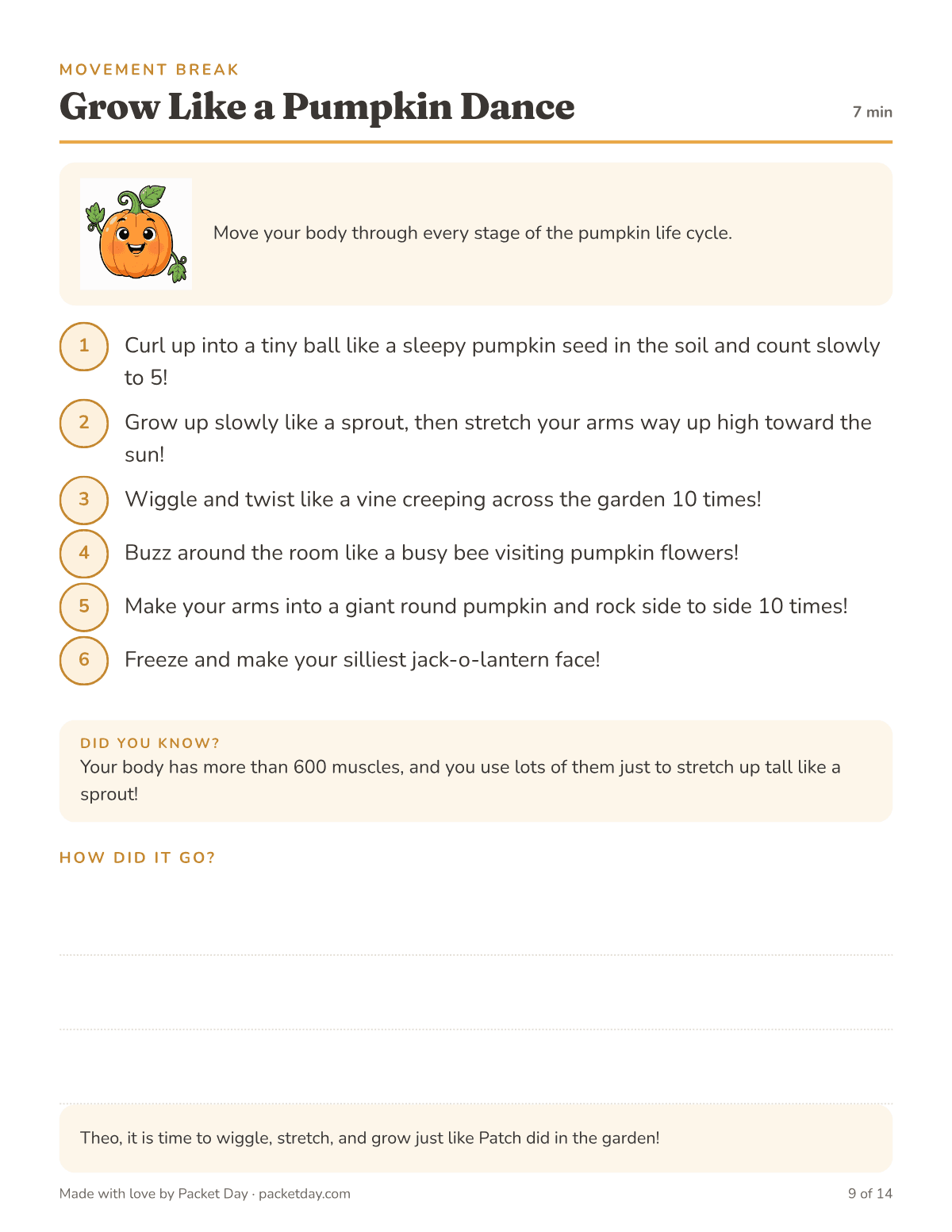
Grow Like a Pumpkin Dance
Your kid acts out every stage, from a curled up seed to a rocking pumpkin, and ends on their silliest jack-o-lantern face.
Science
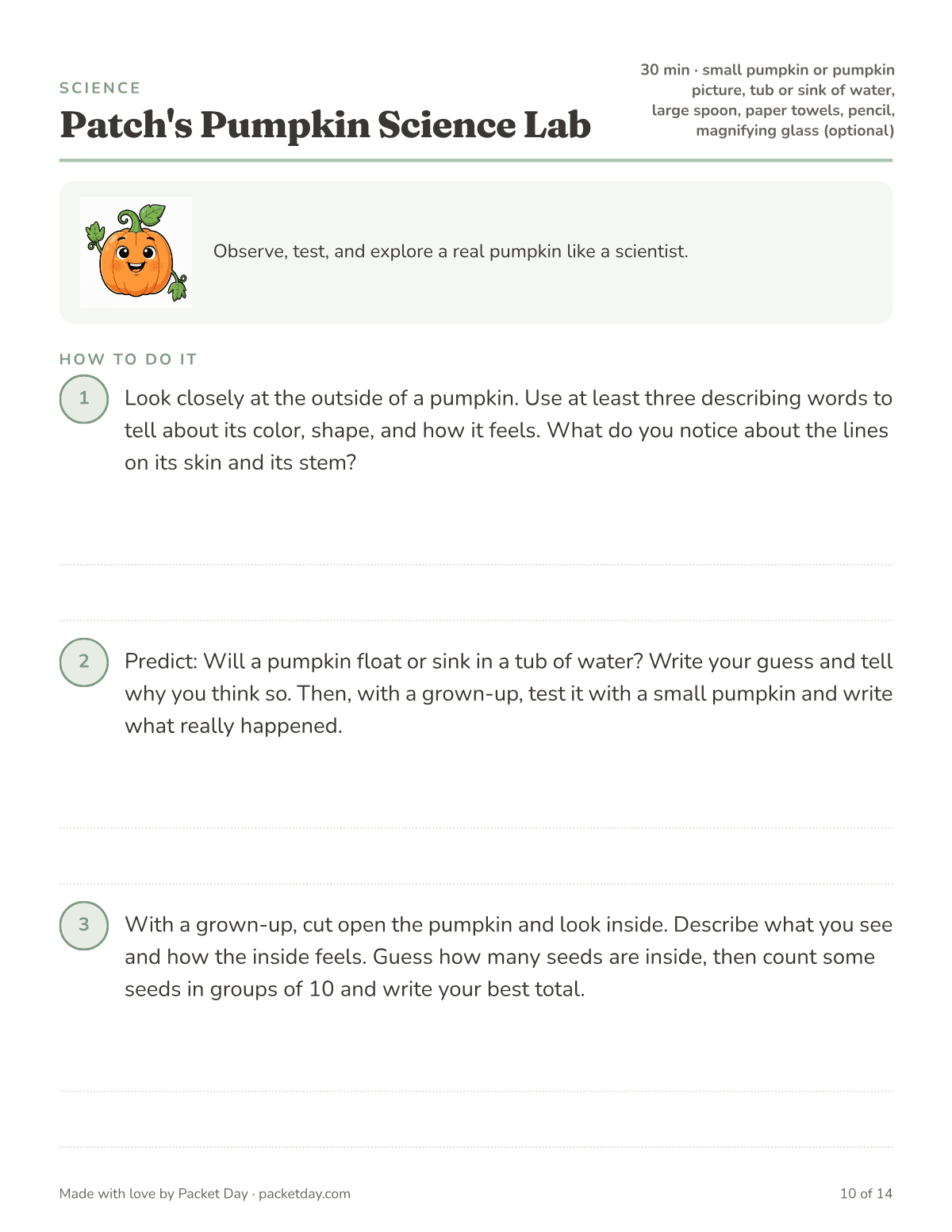
Patch's Pumpkin Science Lab
Describe a real pumpkin, predict whether it floats and test it in a tub of water, then open it up and count the seeds by tens.
Meet Patch
Patch is the pumpkin telling this whole story. The reading page is her life story in her own voice, from a tiny flat seed in warm spring soil to the jack-o-lantern glowing at the end.
She plants the seeds in the math problems, loads the wagons and helps carve the jack-o-lantern eyes in the draw and solve. The writing prompt plants Theo right next to her in the garden, and the science lab makes him her lab partner.
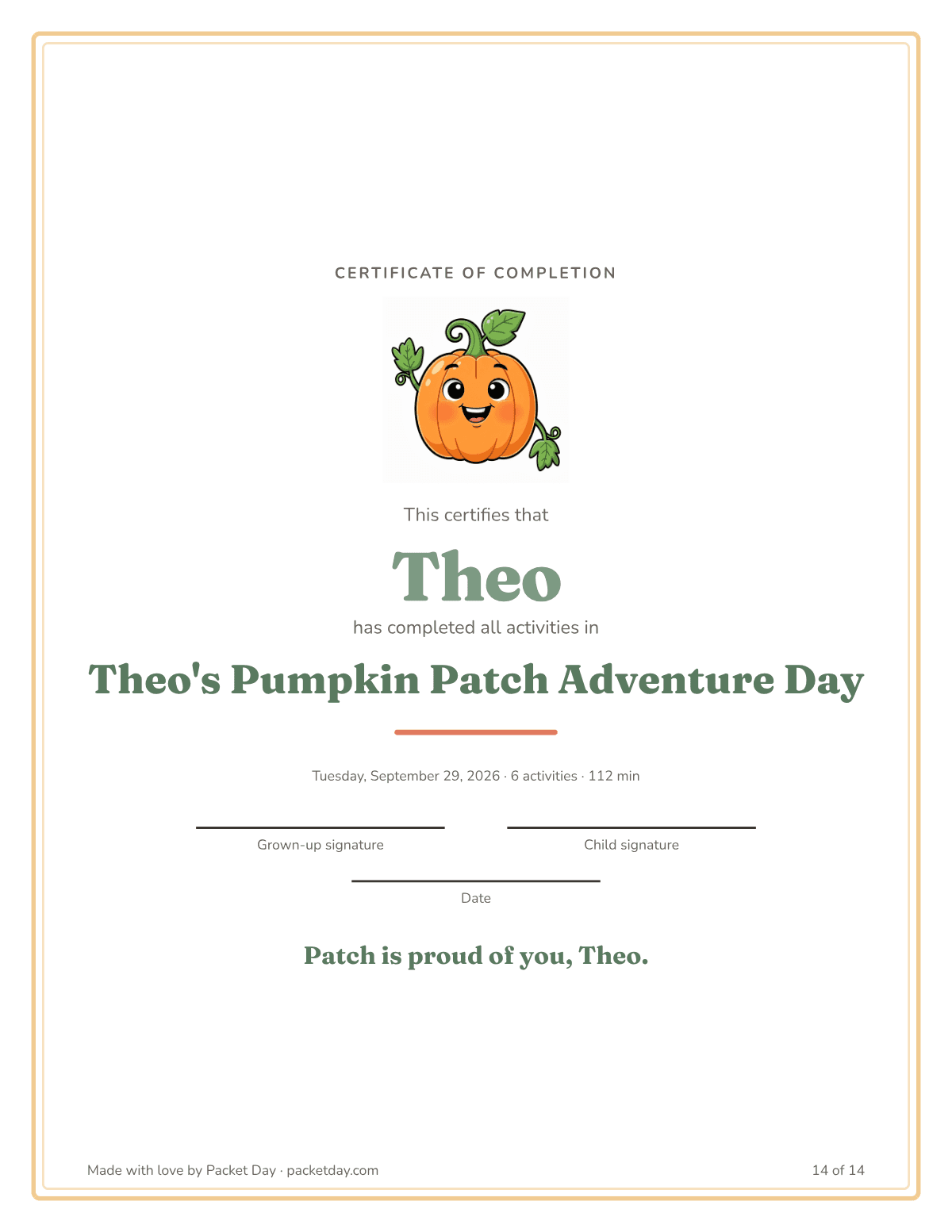
On the reflection page Patch says Theo is officially a Pumpkin Patch Expert, and the certificate reads: Patch is proud of you, Theo.
What will my child learn?
Your child practices math, reading, writing and science through one pumpkin's life: two digit adding and subtracting, early multiplication, reading for order and detail, a short piece of writing and a real experiment.
In math, Theo adds and subtracts with regrouping (72 minus 38 is there) and meets multiplication by skip counting: 5 wagons of 2 pumpkins, 3 branches of 10 leaves, 5 jack-o-lanterns with 2 eyes each.
The reading asks him to recall a detail, put five stages in order, explain what "like umbrellas" says about the leaves and use a clue to explain why the bees mattered.
Science is the part that feels like play. He describes a pumpkin with three describing words, makes a prediction and tests it, estimates the seeds and then counts some in groups of 10.
Which grades is this for?
Grades K-2
This sample is grade 2, so here we can be specific. The story is three short paragraphs with one comparison to figure out, the math stays within 100 with skip counting by 2s, 5s and 10s, and the writing asks for 4 to 5 sentences. Kindergarten and first grade packets are written for their own grade.
Grades 3-5
For grades 3 to 5, the pumpkin theme comes with longer reading, harder vocabulary, math at their grade level and longer writing. We are not showing a grades 3 to 5 pumpkin packet here, so this is how packets grow, not a preview.
Grades 6-8
For grades 6 to 8, expect longer reading again, harder vocabulary, math at their grade level and more writing. We have not seen a grades 6 to 8 pumpkin packet either, so we are not describing one. The theme and the character stay. The difficulty changes.
A note from Natalie
Oliver once asked for only Megalodons three days in a row. He got three completely different packets.
So if your kid finishes this one and wants more pumpkins tomorrow, make another. Same pumpkin obsession, new story, new problems.
Questions parents ask about pumpkins packets
Do pumpkins really float?
Yes, pumpkins float, even though they are about 90 percent water. The inside is mostly hollow and full of air, which makes the whole pumpkin lighter than the water it pushes aside. That's the surprise in the science lab: Theo writes his prediction first, then tests it in a tub or sink. Most kids guess sink.
Do I need a real pumpkin for the science lab?
No, a small real pumpkin is best, but the packet works without one. A photo covers the describing and observing questions, and you can talk through the float prediction together instead of testing it. If you do use a real pumpkin, a grown up handles all the cutting, and a towel nearby helps with the seeds.
What are the stages of a pumpkin life cycle?
A pumpkin grows from seed to sprout to vine to flower, and then the flower becomes a small green pumpkin that turns orange by fall. Bees carry pollen between the flowers, which is how the flowers turn into pumpkins. The reading asks your kid to put five of those stages in order, and the movement break acts them all out.
Is a pumpkin a fruit or a vegetable?
A pumpkin is a fruit to a botanist, because it grows from a flower and holds the seeds. In the kitchen most people treat it like a vegetable. That makes a good question to ask at the end of the science lab, when your kid is holding a spoonful of seeds and can see the answer for themselves.
How do I make this a fall or Halloween school day?
Print it in October and let the pumpkin carry the day, from the morning math to the afternoon float test. The parent note suggests rinsing and roasting the seeds you counted as a snack afterward. For a second themed day in late October, the bats packet is a natural partner.
Are these made by AI, and are they any good?
Yes, each packet is written by AI from scratch around your kid's grade and interests. We are a homeschool family, and our own kids test packets all the time. They are good, and they are not flawless, so skim it before you print. The parent answer key is there so checking the math takes a couple of minutes, not a whole afternoon.
More unit study packets
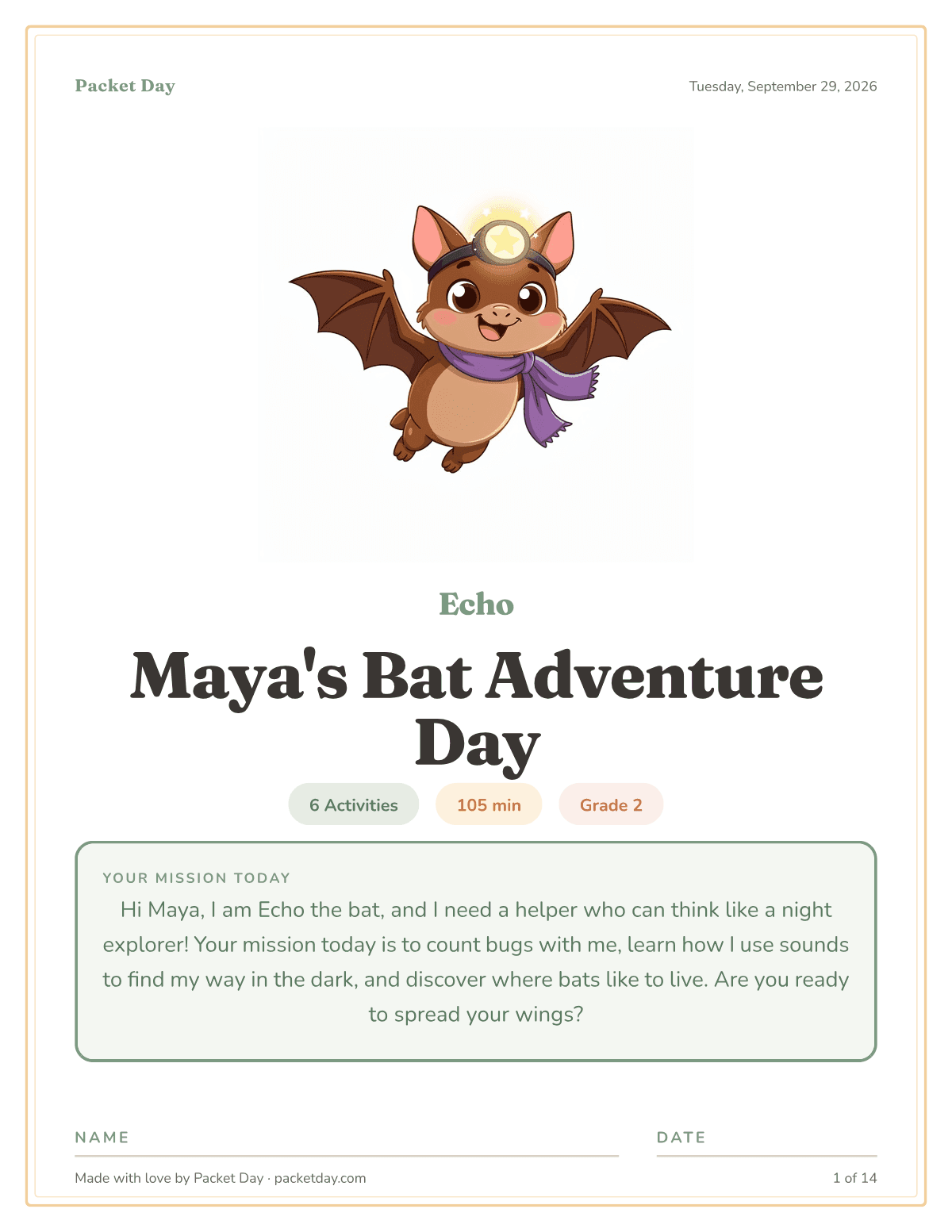
Bats
Sample made for grade 2
A printable bats unit study with a bug counting math page, a short echolocation story, a maze and a clap test you can try at home. Free to start.
See the bats packet →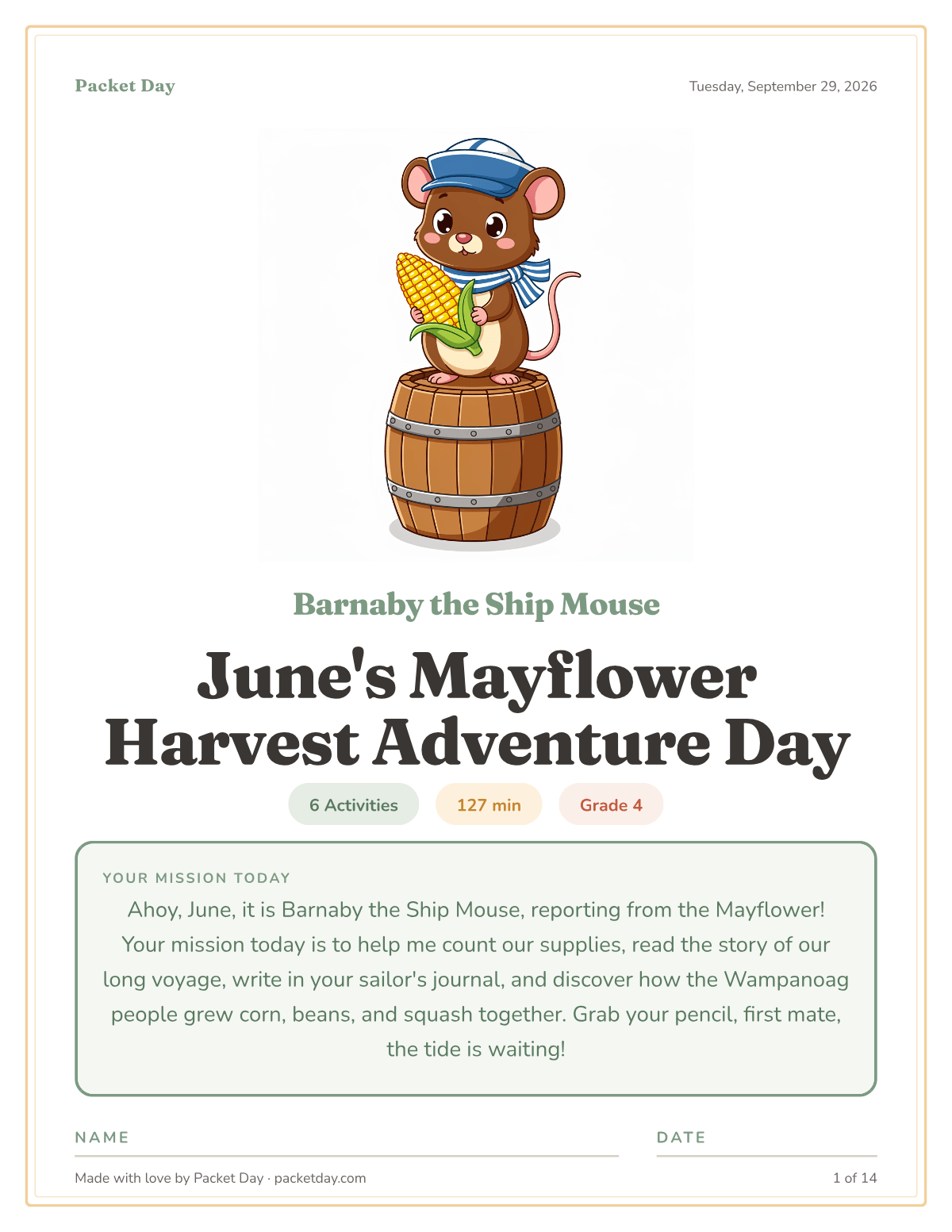
Thanksgiving
Sample made for grade 4
A printable Thanksgiving unit study on the Mayflower, the 1621 harvest and the Wampanoag Three Sisters garden, with real grade 4 math. Free to start.
See the Thanksgiving packet →Every unit study packet
See all the themes we have made so far, each with real pages from a sample packet.
Browse the unit studies →Packets for the days you need one
Ready for your own pumpkins day?
Packet Day makes print ready, themed learning packets for kids in K to 8, built around whatever your kid is obsessed with.
Make your own pumpkins packet freeFree is 1 packet a month, no card needed. Unlimited is $9 a month billed annually ($108 a year) or $12 month to month.